The Palestinian camp of Yarmouk, a deep Syrian wound (to translate)

The Palestinian camp of Yarmouk, a deep Syrian wound (to translate)

About the author: Cédric Domenjoud is an independent researcher and activist based in Europe. His research areas focus on exile, political violence, colonialism, and community self-defense, particularly in Western Europe, the former USSR, and the Levant. He is investigating the survival and self-defense of Syrian communities and developing a documentary film about Suwayda, as part of the Fajawat Initiative.
 

The history of the Yarmouk camp is a microcosm of the region’s history since the beginning of the Assad clan’s dictatorship, which can be described as national socialist. It provides a snapshot of the power relations and political loyalties that have led to the violent fracturing of Syrian and Palestinian societies since the mid-1950s. Yarmouk has also been a microcosm of the uprising and civil war that have ravaged Syria since 2011. Here is a comprehensive review of the chronology of the last fourteen years…

Non-exhaustive presentation of the camp

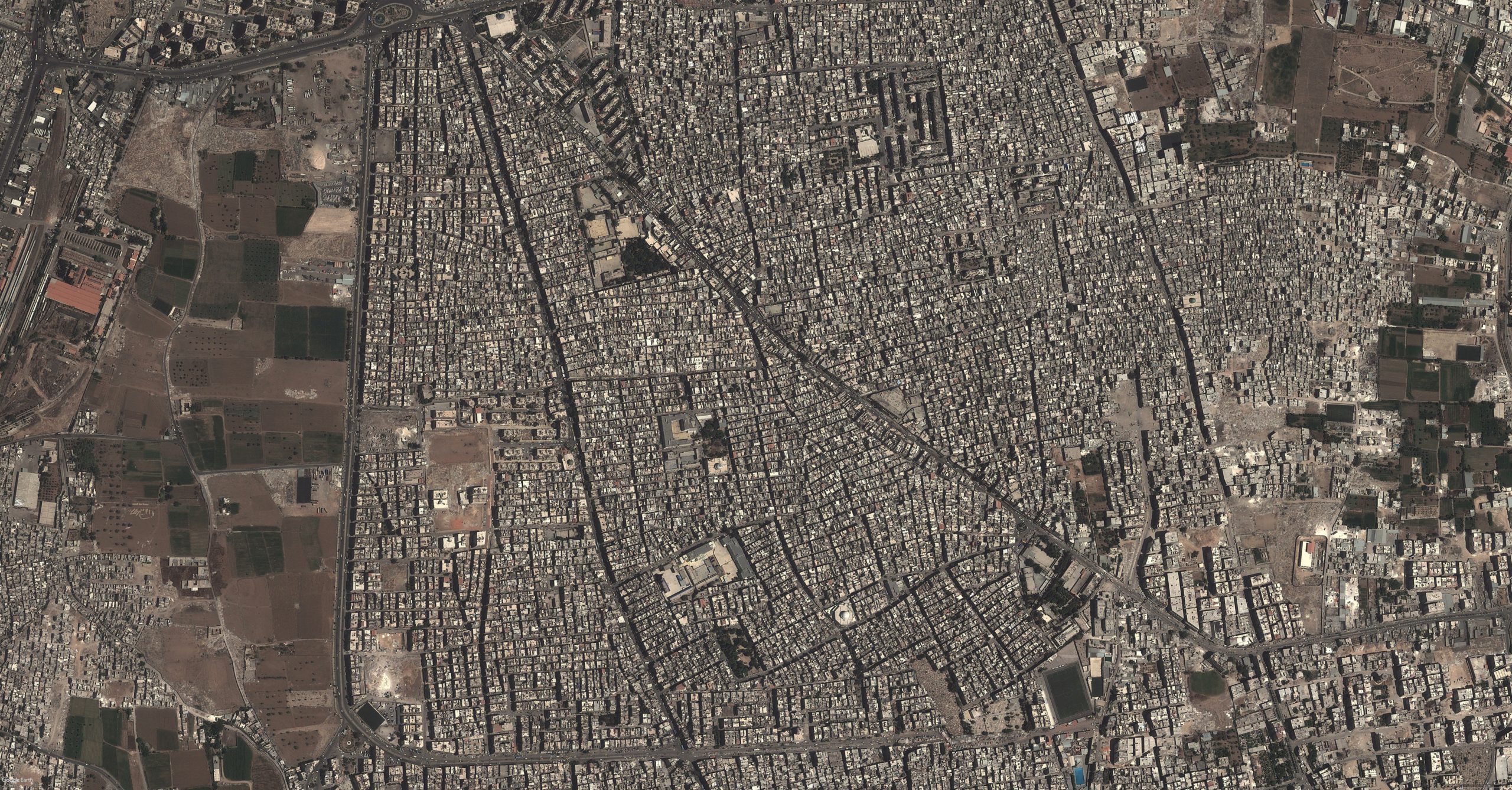
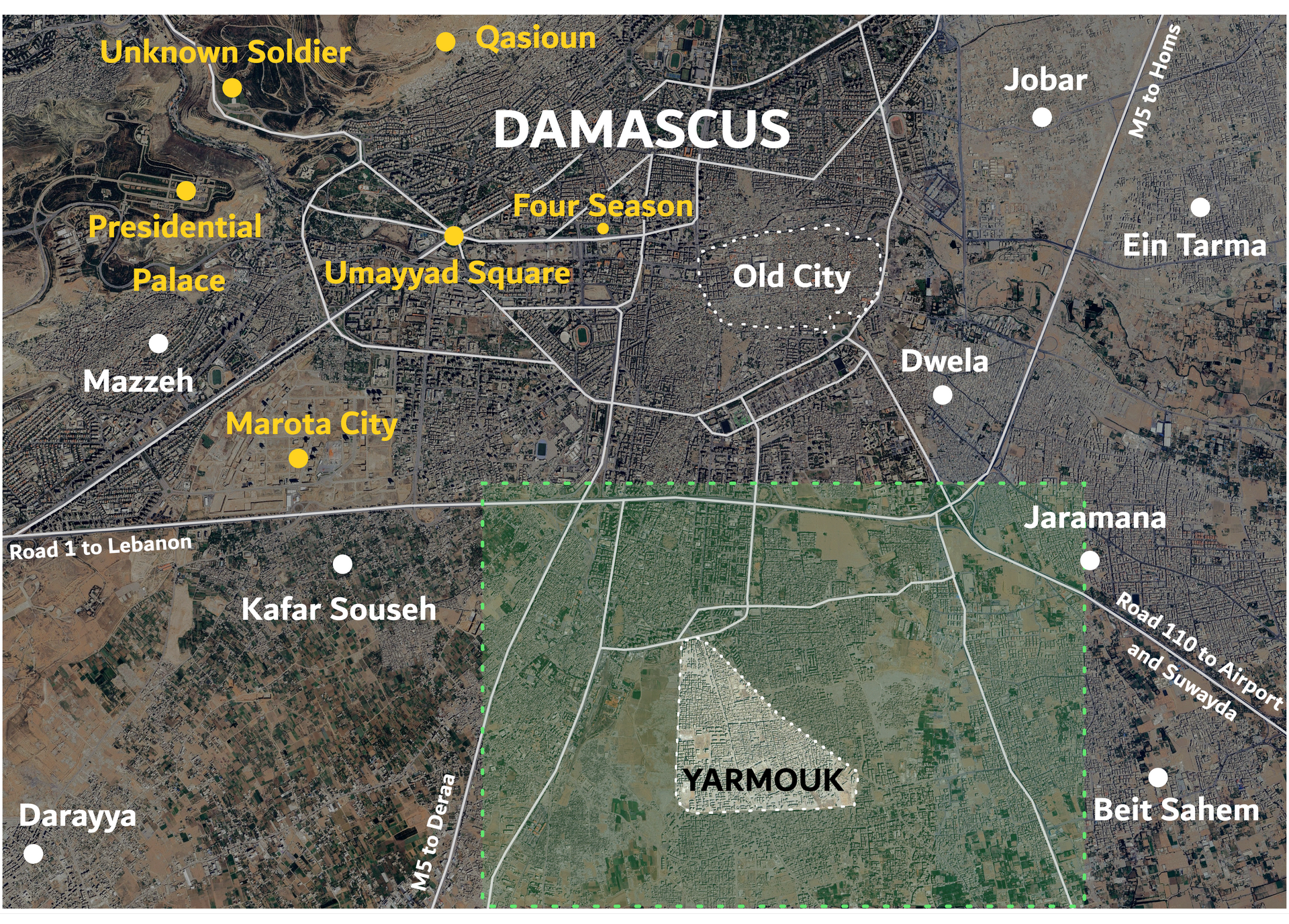
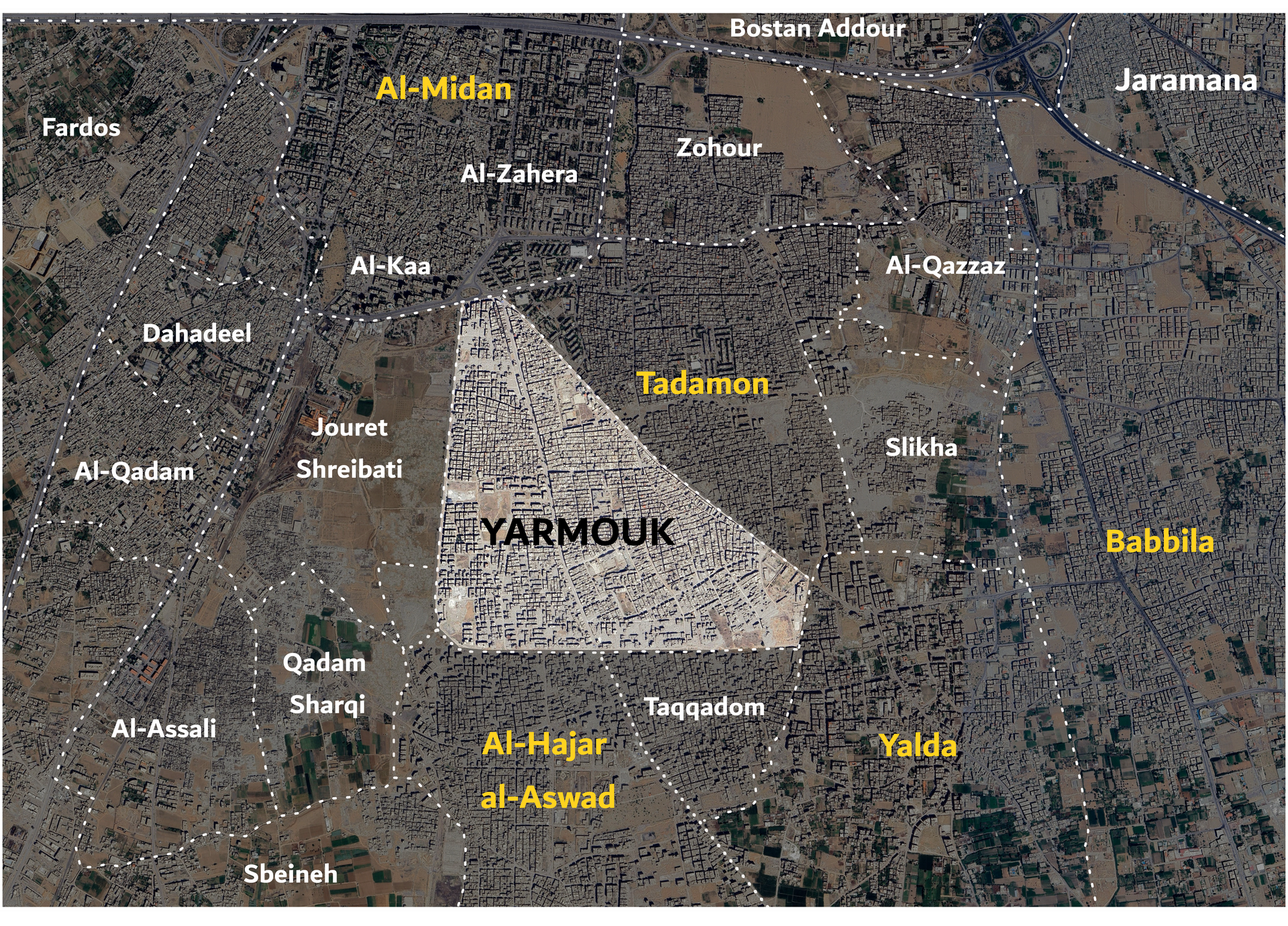
The Yarmouk refugee camp was established in 1957 on the outskirts of Damascus, covering an area of 2.11 square kilometers bordered to the north by Al-Midan district (Al-Qa’a and Al-Zahera neighborhoods), to the west by Al-Qadam district (Qadam Sharqi and Jouret Shreibati neighborhoods), to the east by Tadamon, and to the south by Yalda, Taqaddom, and Al-Hajar al-Aswad. Its residents fled Palestine in 1948, and some of them passed through Lebanon or Jordan before reaching Syria. The camp gradually expanded eastward after 1967, welcoming refugees from the Golan Heights (including Druze—25%, Turkmen, and Alawites—3%), most of whom settled in the neighboring district of Tadamon. Strictly speaking, the Yarmouk camp initially referred to the area bounded by the 30th Street to the west and Yarmouk Street to the east, then the entire area extending to Palestine Street (see map). In some articles and reports, the camp is incorrectly divided into two separate camps, “Yarmouk camp” and “Palestine camp,” but this division does not correspond to any administrative reality. Similarly, the districts of Al-Hajar al-Aswad and Taqaddom are sometimes included in the name “Yarmouk camp” because some of their residents were also refugees from Palestine.

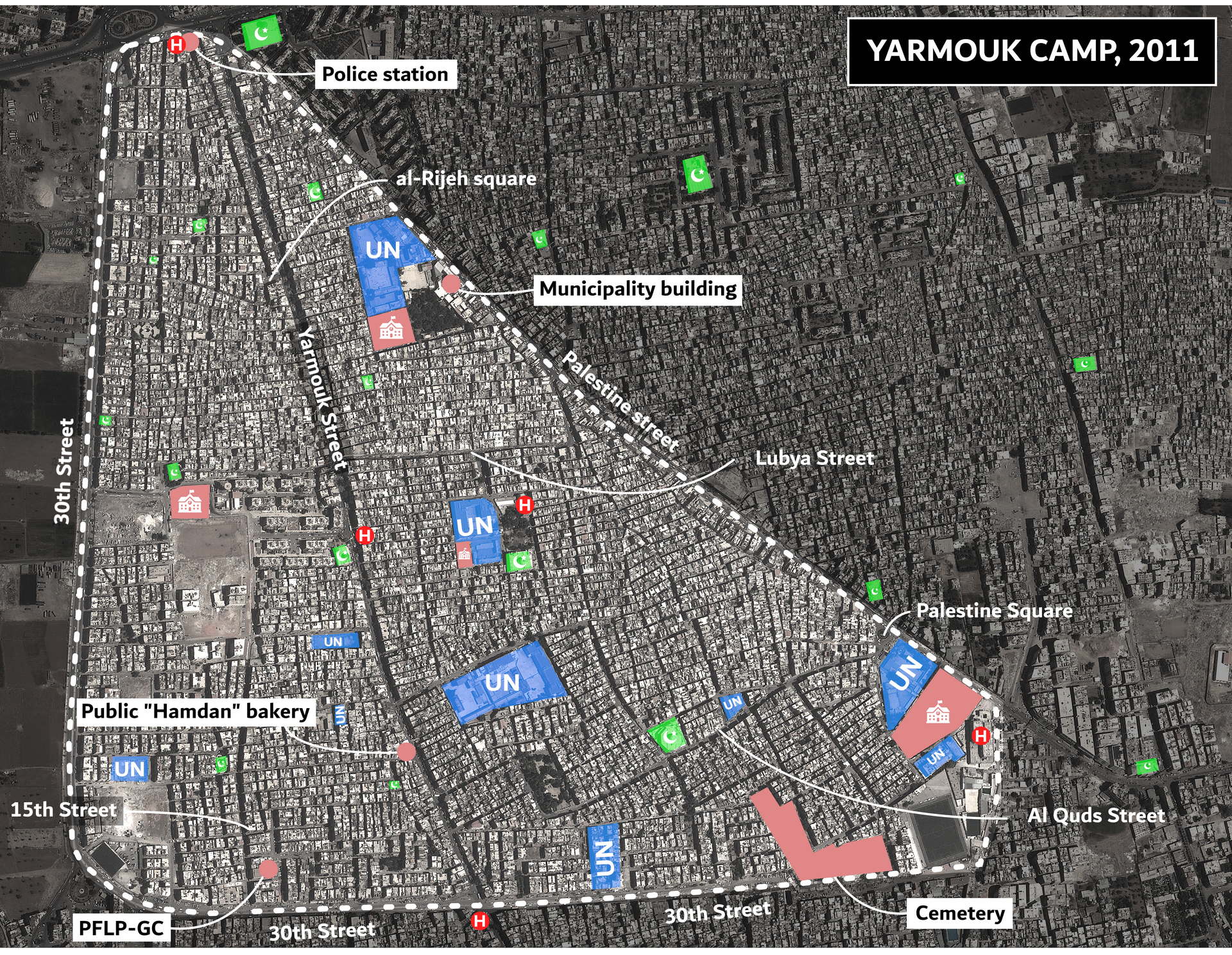
In 2011, Yarmouk was the largest Palestinian refugee camp among the 12 camps in Syria. At the beginning of the uprising, Yarmouk had 351,500 Syrian residents and 171,880 Palestinian refugees (44,279 families). UNRWA administered 23 facilities there, including 16 schools, three medical centers, a Youth Cultural Center, an Educational Development Center, and two Community Centers [1]. In addition to the schools run by UNRWA, there were seven public schools. There were also 11 mosques in Yarmouk, as the population was almost exclusively Sunni Muslim.

The administrative management of the camp was entrusted to a municipality affiliated with the Ba’ath Party and Palestinian factions loyal to it, led by the Popular Front for the Liberation of Palestine – General Command (PFLP-GC). The main Palestinian factions present and active in Yarmouk at the start of the uprising were loyal to Bashar al-Assad’s regime:

  • Popular Front for the Liberation of Palestine – General Command (PFLP-GC), a splinter group of the PFLP founded in 1968, which left the PLO in 1974. Led by Ahmad Jibril, Talal Naji, and Anwar Raja;
  • Palestine Liberation Army (PLA – Jaysh al-Tahrir al-Falastini), founded by the PLO in 1964, then subservient to the Syrian Ba’ath Party and expelled from the PLO in 1973. Led by Akram Muhammad al-Salti;
  • Fatah al-Intifada (translated as “The Fatah Uprising”), a splinter group of Fatah founded in 1983 and expelled from the PLO the same year. Led by Saïd al-Mouragha “Abu Mussa” until 2013, then Ziad al-Saghir “Abu Hazim”;
  • As-Sa’iqa (translated as “lightning strike”), the Palestinian branch of the Syrian Ba’ath Party founded in 1966. Led by Mohammed Qeis.
  • Harakat Falasteen Hurra (translated as “Free Palestine Movement”), founded in 2003 and led by Yasser Qashlak and Saed Abd Al-Aal.

However, they did not represent the majority of Palestinians in Yarmouk and owed their existence solely to their loyalty to the regime, as other Palestinian movements were banned. Hamas, meanwhile, had enjoyed a presence in Syria since 1999 that was both largely symbolic, due to its membership in the “Axis of Resistance,” and closely controlled, due to its historical affiliation with the Muslim Brotherhood, which had been violently persecuted by the regime since the 1980s.

Map 1: Location of Yarmouk regarding Damascus (green square = Map 2)

Map 2: Neighborhoods and districts located around Yarmouk.

Map 3: Infrastructure of the Yarmouk camp.

Before 2011: The Premises.

The Palestinian presence in Syria predates the Assad dictatorship. The influx of refugees in 1948 occurred under the presidency of Shukri Al-Quwatli, two years after Syria had gained its independence. At that time, there were 85,000 Palestinian refugees on Syrian territory, but several successive waves would occur in 1967 from the Golan Heights following the Six-Day War, in 1970 from Jordan following the events of Black September, and in 1982 from Lebanon due to the Lebanese civil war. In 2011, there were 585,610 Palestinian refugees in Syria.

Initially involved with the Palestinians in the Six-Day War and at the beginning of the 1970 crisis (Black September), Syria quickly betrayed their cause under Hafez al-Assad. Its participation in the Yom Kippur offensive in 1973 was aimed more at recovering the Golan Heights lost in 1967 than at defending the Palestinian cause. And as in 1967 and 1970, the Syrian armed forces were defeated, killing hundreds of Palestinian fighters from the Palestine Liberation Army, who were used to serve the interests of the dictatorship. The Golan Heights were left to Israel as part of the disengagement agreements signed between the two countries in 1974.

On January 20, 1976, Syria’s Palestinian proxies, the Palestine Liberation Army and As-Sa’iqa, massacred more than 500 Christian civilians in Damour, bringing shame on the Palestinian resistance, then embodied by the Palestine Liberation Organization (PLO), and prompting Christian militias to call on Syria for help. A little over four months later, Assad sent his army into Lebanon in an incomprehensible strategy aimed at supporting the Christian Phalangists against the “Palestinian progressives” of the PLO led by Yasser Arafat and the Lebanese National Movement led by Druze leader Kamal Jumblatt, thereby claiming to prevent Israeli intervention in Lebanon. Immediately after entering Lebanese territory, and after being stopped by the PLO in the Chouf, the Syrian army besieged the Palestinian camp of Tel al-Zaatar with the help of 3,000 Christian Phalangists. After a two-month siege, the Palestinian resistance surrendered and Assad allowed the Christian (fascist) militias to enter the camp on August 12, 1976. The militias proceeded to loot and burn homes, as well as rape and systematically massacre Palestinian civilians, executing more than 1,500 camp residents in one of the largest massacres of Palestinians since the Nakba.

From then until its withdrawal from Lebanon in April 2005, the Syrian army and the Assad regime would determine the fate of Lebanon, but also of the Palestinians in Lebanon and Syria. Following the Israeli intervention in Lebanon in 1982, the Syrian regime first allowed Iran to create, train, and arm Hezbollah and Islamic Jihad, using its territory as a bridge between Iraq and Lebanon, before using Iranian militias as proxies in its bloody war against all Syrians from 2011 onwards, whether they were progressives or Islamists. At the same time, the PLO was expelled from Lebanon, marking the end of political freedom for Palestinians in Lebanon, whose situation became aligned with that of Palestinians in Syria. Treated as eternal foreigners and deprived of their civil rights, they were condemned to neutrality and economic dependence, while being dispossessed of their struggle for the liberation of Palestine, which was taken over by the Syrian state, the Iranian state, and their proxies, with Syria itself soon becoming Iran’s proxy, after having been that of Soviet Russia.

Now that we have set the context, let us turn to the recent history of Yarmouk.

2011–2012: Turmoil. Pro-Assad militias and the regime’s first bombs.

When the uprising broke out in March 2011, the residents of Yarmouk and its political factions initially maintained the position of neutrality that had been imposed on them for nearly 30 years. After an initial strike—which was violently suppressed—to protest the bombing of the Palestinian refugee camp in Dera’a in April, tensions gradually increased between June 2011 and July 2012.

On the occasion of the commemoration of the Nakba and the Naksa, the regime organized two demonstrations on the Golan border on May 15 and June 5, 2011, through the PFLP-GC, during which 26 young Palestinians from Yarmouk were killed by the Israeli army while trying to cross the security barriers. During the funerals held in Yarmouk on June 6, Assad was accused by Yarmouk residents of trying to divert attention from his crimes against Syrians, as well as from the controversial statements made by his cousin and key regime businessman Rami Makhlouf, who had just claimed that “the security of the Syrian regime was one with that of Israel.” The PFLP-GC, for its part, was held responsible for the tragic events that occurred on the Golan border, and in particular for sending the demonstrators into a trap after galvanizing and manipulating them to serve the regime’s false pro-Palestinian propaganda. The regime claimed that attacking it was tantamount to attacking the “Axis of Resistance” and serving the interests of American imperialism and Zionism. Consequently, the Syrian rebellion was equated with a Zionist conspiracy, and Syrian protesters and rebels were portrayed as agents of Western imperialism. Unfortunately, a large part of the Palestinian solidarity movement and the Western Left fell for this specious argument and continue to this day to support the Assad regime and its allies [1]. In any case, the Palestinians of Yarmouk were not deceived, and the funeral, which brought together 30,000 people, turned into a demonstration and surrounded the PFLP-GC headquarters “Al-Khalsa” located on the southern edge of Yarmouk. The guards opened fire, killing two protesters: Rami Siyam (14) and Jamal Ghutan. Hundreds of protesters then stormed the building and set it on fire, killing two members of the PFLP-GC before being repelled by regime forces and PFLP-GC reinforcements.

In August 2011, the regime bombed the Al-Ramel Palestinian refugee camp on the outskirts of Latakia, accusing its residents of supporting “terrorism” due to the strong anti-Assad activity in the camp. More than half of its 10,000 residents were forced to flee the camp by regime forces and their shabiha, who proceeded to loot their homes. In the wake of this, Yarmouk organized its first demonstration in solidarity with Al-Ramel on August 17, 2011, bringing together around 300 people. During the summer, nearly 70,000 displaced persons from various cities targeted by the regime were welcomed en masse into the mosques, schools, and public spaces of Yarmouk.

During 2012, demonstrations and strikes multiplied, echoing the main slogans of the Syrian revolution, while the army opened fire on the crowd and broke the locks of striking businesses to force them to resume their activities. The regime’s security services began to express concern about these protest movements, urging community leaders to silence them.

It should be noted that before the summer of 2012, Yasser Qashlak, a Palestinian millionaire loyal to the regime and founder and leader of the Free Palestine Movement, formed the «Al-Aqsa Shield Forces » (Quwaat Der’a Al-Aqsa), a group of mercenaries tasked with deterring the opposition from gathering, in particular by meeting at the exits of mosques and staging pro-regime demonstrations. At the end of the summer, Qashlak also financed the arming of 1,100 members of the armed wing of the PFLP-GC, the Jibril Jihad Brigades (Kataeb Jihad Jibril), 500 of whom went on to form the Popular Committees (Al-Lijan al-Sha’biyah), militias set up in Yarmouk and in various districts of the Damascus region to prevent the infiltration of Sunni rebel groups and thus counter the predictable offensive of the Free Syrian Army[2].

On July 13, 2012, Yarmouk was the starting point for a demonstration of several thousand people heading to the neighboring district of Tadamon to protest against its bombing, but also against the massacre of more than 150 civilians in Tremseh (Hama) by Assad’s shabiha and the death of Palestinian recruits in the war waged by the regime against its people. Once again, the army opened fire on the demonstration and killed 10 protesters.

The next day, the funeral, attended by 50,000 people, led to the encirclement of Yarmouk by armored vehicles, and the foreign minister threatened the Palestinian refugees, declaring that as guests they were subject to a duty of neutrality. This desire for neutrality was widely shared by residents and all Palestinian factions, who knew what dramatic consequences opening a new front with the regime in Yarmouk could bring.

[1] Read our publication “Western leftist comrades, you failed your Levantine fellows,” available at https://interstices-fajawat.org/western-leftist-comrades-you-failed-your-arab-fellows/ 

[2] Tom Rollins, Palestinian-Syrian Militarization in Yarmouk, Atlantic Council, July 19, 2017, available at https://www.atlanticcouncil.org/blogs/syriasource/palestinian-syrian-militarization-in-yarmouk/ 

2012–2013: The Explosion. The armed rebellion takes control of Yarmouk.

In July 2012, the Free Syrian Army launched its “Damascus Volcano” offensive to liberate the capital. On July 15, the police station at the entrance of Yarmouk was attacked and set on fire, prompting an air strike by the regime and the first strikes on the camp on July 17, killing nine people. Three days later, the FSA withdrew and the regime’s army regained control of all the areas bordering the camp (Al-Hajar al-Aswad, Tadamon, Qadam), forcing many of its inhabitants to take refuge in Yarmouk in addition to the thousands of displaced persons already there.

During the summer, the Yarmouk camp took in thousands more displaced persons, while the regime continued its massive bombardment of Syrian cities in response to the Free Syrian Army rebellion. As a result of this massive influx of displaced persons, the population reached nearly 900,000, three times more than before the uprising. On August 2, 2012, a regime strike killed 21 people in what became known as the “Ja’ouneh Street massacre.” Yarmouk then entered the civil war for the first time, seeing the spread of a “call to protect the Palestinian camps” during the fall, followed by the establishment of Palestinian armed factions opposed to the regime: Aknaf Beit al-Maqdis (affiliated with Hamas and led by Abu Ahmed Mushir), Liwa al-Asifa, Ababil Falastin, Liwa Al-‘Ahda Al-‘Umariya…

Map No. 3: Yarmouk – Situation after the FSA offensive, late 2012.

Hamas, which had supported the protests against the regime, was now offering its expertise to the rebels of the Free Syrian Army and Aknaf Beit al-Maqdis without publicly admitting it. This dangerous choice was motivated by the rise to power of Mohamed Morsi and the Muslim Brotherhood—their patrons and sponsors—in Egypt, but it would very quickly lead to retaliation by the Syrian regime with the arrest and torture of Mamoun al-Jaloudi, commander-in-chief and bodyguard of Hamas Political Bureau Chief Khaled Meshaal, followed by the expulsion of Meshaal and other Hamas leaders from Damascus to Qatar, Cairo, and Gaza. [1] [2] It was also during this period that Jabhat al-Nusra began operating in the district alongside the FSA.

While the regime continued its daily bombardments since the summer, the escalation reached a breaking point in December when Palestinian militias loyal to the regime began to establish checkpoints around Yarmouk and to confront the Free Syrian Army militarily in al-Hajar al-Aswad and Yalda, where the latter had now established itself. It should be noted that the PFLP-GC had so far only used its weapons to intimidate and persecute camp residents, without ever confronting the armed opposition.

Starting on December 12, 2012, the regime initially banned trucks carrying materials from entering the camp. The next day, a strike targeted Al-Bassel Hospital, and then, on December 16, 2012, another air strike targeted the Abd Al-Qader Al-Hussaini mosque and the adjacent school, which were sheltering several hundred refugees from neighboring neighborhoods, killing 200 people in what was called the “MiG massacre” or “Abdul Qader Al-Hussaini massacre.” [3]

The very next day, hundreds of Free Syrian Army and Jabhat al-Nusra fighters took possession of Yarmouk, pushing the PFLP-GC and its allies to the northern end of the camp and declaring it a “liberated zone.” The regime then bombarded the camp heavily, forcing 80% of its residents, both Palestinians and internally displaced persons, to flee Yarmouk to Qudseya and Sehnaya. [4] The factions affiliated with the FSA at the time were Suqur Al-Joulan, Ababil Hawran, Jund Allah, Saraya al-Beyt, Ahfad Aisha, Abu Al-Harith Joulani, Imam Thahabi, Shuhada Al-Nour, and others.

The Suqur al-Joulan and Ababil Hauran factions began looting the homes of residents who refused to leave Yarmouk while squatting with their families in empty homes, creating tensions between residents and the factions present, while Jabhat al-Nusra gradually established Islamic law and persecuted Palestinian activists.

[1] Mohanad Hage Ali, Kill List, Carnegie Middle East Center, 14 mai 2018, accessible à https://carnegieendowment.org/middle-east/diwan/2018/05/kill-list?lang=en

[2] Mamoon Alabbasi, How did Hamas’s military expertise end up with Syria’s rebels?, Middle East Eye, 23 mai 2015, accessible à https://www.middleeasteye.net/news/how-did-hamass-military-expertise-end-syrias-rebels

[3] Action Group For Palestinians in Syria, 9 Years On, Palestinians of Syria Remember Tragic ‘Mig Massacre’ in Yarmouk Camp, 16 décembre 2022, accessible à https://www.actionpal.org.uk/en/post/13709/articles/9-years-on-palestinians-of-syria-remember-tragic-mig-massacre-in-yarmouk-camp

[4] Al-Arabiya, (ARABE) The Military Council of the Free Army storms the Yarmouk camp, 17 Décembre 2012, accessible àhttps://www.alarabiya.net/articles/2012/12/17/255640

2013–2015: The Siege. Pro-Assad militias take revenge on civilians.

Following its expulsion from Yarmouk, the PFLP-GC established a partial blockade at the checkpoint located at the northern entrance to the camp on the initiative of its leader Anwar Raja, preventing any food or medicine from entering for six months, but initially contenting itself with filtering the passage of people without prohibiting it, except on certain occasions. Food and medicine were then smuggled into the camp in small quantities from the south and sold inside at excessive prices.

Throughout the siege, demonstrations and symbolic actions were regularly organized inside the camp to call for the lifting of the siege and alert the international community. These were mainly initiated by the Yarmouk Coordination Committee, which at the same time set up an agricultural project called “Bassmat Kheir” to produce vegetables for the community. The alternative school “Al-Dimashkiya” also launched its educational activities during this period for children in the camp who had been deprived of education since the end of UNRWA activities, opening several alternative schools inside and near the camp.

During the first half of 2013, while Palestinian factions within the camp were fragmented into some twenty small groups with no power or influence, Aknaf Beit al-Maqdis obtained external support enabling it to arm itself and expel the criminal factions Suqur Al-Joulan and Ababil Hauran from the camp. The leader of Suqur Al-Joulan, Abu Ammar Bayan Muzail, had previously been arrested and identified as an agent of the regime. [1]

On July 18, 2013, the partial blockade of the camp turned into a total siege, with the regime and the PFLP-GC prohibiting all movement of goods and people. This led to a state of health crisis and advanced malnutrition among the camp’s residents, so much so that in October the imam of Yarmouk issued a fatwa authorizing the killing and consumption of dogs, cats, and donkeys. The level of famine was so high that even the fighters of the various factions were more concerned with survival than with fighting each other.

Following the overthrow of Mohamed Morsi in Egypt, Hamas was considerably weakened and definitively withdrew its support for the Syrian-Palestinian rebels, before renewing its ties with Hezbollah and Iran. However, the Syrian regime did not reopen dialogue with Hamas, refusing to release its members from prison.

Meanwhile, on November 6, 2013, several of the main rebel groups present in the Damascus region formalized the creation of a military alliance independent of the FSA and placed under the umbrella of the Greater Damascus Operations Room. This included several factions active in Yarmouk and the surrounding districts (Al-Hajar al-Aswad, Yalda, Babbila, Beit Sahem): Ahrar al-Sham, Aknaf Beit al-Maqdis, Liwa Sham al-Rasul, Kataeb Sahaba, Liwa Shabab al-Hoda, Liwa al-Ummah al-Wahida, etc. [2]

On February 2, 2014, the regime arrested 27 people as they arrived at a checkpoint to receive food aid. On the same day, the Director of National Palestinian Civil Society, Fuad Omar Abu Basil, was kidnapped by the regime, and the next day, it was the turn of humanitarian worker Mahmoud Mu’ad to be arrested and disappear without a trace. Residents were regularly arrested or beaten by regime soldiers during distributions or while attempting to pass through checkpoints, particularly towards Yalda.

Contacts were established between the residents and the Palestine Liberation Organization (PLO), as well as the Fatah leadership in Ramallah, in order to initiate talks with the Arab League and the regime to end the siege and the accompanying reprisals against civilians. As part of these negotiations, the PLO secured food distributions in Al-Rijeh Square in the northern part of the camp. The main organizations distributing humanitarian aid in the camp at the time were the Palestine Charity Committee, the Nour Association for Relief and Development, the Jafra Foundation for Relief & Youth Development, and the Palestinian Red Crescent Society.[3]

The humanitarian distribution site quickly became the scene of rivalries and regular armed confrontations between factions, and residents waiting for aid were regularly targeted and wounded by sniper fire. On March 23, an anti-tank rocket (RPG) was fired at the crowd gathered to receive humanitarian aid in Al-Rijeh Square, killing seven people. The shooter, Mouaffaq Dawa, a member of the “Free Palestine Movement,” was nicknamed “The Butcher of Yarmouk” by residents and was also accused of rape. He was in charge of a checkpoint and food aid distributions. A few years later, when brought before German courts, he justified his actions as revenge for the death of his nephew. [4] [5]

That same month, a truce was agreed between the regime and the opposition, including Jabhat al-Nusra.

In March 2014, Aknaf Beit al-Maqdis (100 to 300 fighters) and Liwa al-Asifa controlled 75% of the territory, where a number of small factions also remained, such as Free General Command (around 40 defectors from the PFLP-GC), Al-Zaatoot (around 50 Fatah members), Ahrar al-Yarmouk (around 50 members), Free Palestine Liberation Army (defectors from the PLA), Liwa Al-‘Ahda Al-‘Umariya, Zahrat al-Mada’en, the Ibn Taymiyyah battalion, Al-Kara’in (Fatah members), Sahran, Yarmouk Residents League, and Joint Palestinian Power.

At the same time, Palestinian members of Jabhat al-Nusra formalized their activities in the camp, joined by approximately 250 non-Palestinian Jabhat al-Nusra fighters from al-Hajar al-Aswad.

During 2014, five successive truces were signed between the various parties to the conflict, but none were respected and the regime continued to bomb the camp, destroying infrastructure and rendering it uninhabitable. [6] Each party blamed the other for the violence and the violation of the agreements, with Fatah accusing the PFLP-GC and the regime, while the latter accused Fatah and Jabhat al-Nusra. In July, eleven civilian groups and institutions in the camp called on all parties to take immediate action to resolve the humanitarian crisis, in particular by allowing food, medicine, and drinking water to enter and lifting the siege. The UN, the Palestinian Embassy in Syria, and the General Authority for Palestinian Arab Refugees were also called upon by the Yarmouk Civil Council, established in March, while campaigns and demonstrations organized by residents multiplied. To no avail.

On August 8, 2014, a civilian delegation tasked with ensuring the implementation of the conditions set out in the ceasefire agreements, namely the surrender of rebel fighters to the authorities in exchange for the neutralization of the conflict and the return of residents, was targeted by Jabhat al-Nusra, injuring one of its representatives and putting an end to the various attempts at talks.

From the second quarter of 2014 until the end of 2015, a series of car bombings and selective assassinations targeted a number of Palestinian activists and civil society actors inside the camp: Abu Al-Khalil (June 17, 2014), Baha Saqr (Yarmouk Residents League), Ahmed Al-Sahli (August 19, 2014), Abdullah al-Bader (August 20, 2014), Ali Al Hija (November 29, 2014), Mohammad Yousuf Areisha (Director of the Relief Office) December 20, 2014), Mohammad Qasim Tiraweya (Fatah, December 23, 2014), Abdallah Rezeq (January 12, 2015), Nemer Hussein (Yarmouk Civil Council, February 11, 2015), Firas Hussein Al-Najee (Basma Foundation, February 22, 2015), Yahya Abdullah al-Hourani Abu Suhaib (March 30, 2015), Mustafa Sharaan Abu Maaz (Palestine Charity Committee, July 13, 2015), Abu Diyaa Emara (July 27, 2015), Abu Ahmed Houari (Palestinian National Authority & Democratic Front, October 28, 2015). These assassinations took place in the context of daily rivalries and clashes between factions affiliated with Jabhat al-Nosra and other Palestinian factions, foremost among them Aknaf Beit al-Maqdis, which also suffered several assassination attempts against its leaders. [7] [8]

On September 9, 2014, the regime cut off the camp’s water supply before launching a series of strikes on Al-Rijeh Square and its surroundings, Al-Forn Al-Ali Street, the area around Al-Mansoura School, as well as the Safareyat Al-Karmel neighborhood and Al-‘Urubeh Street located south of the camp (Yalda and Taqqadom). These strikes were in response to an attempted attack by the FSA in the neighboring district of al-Zahira, near the checkpoint at the northern entrance to Yarmouk. Ten days later, residents launched a protest campaign called “Yarmouk Camp is thirsty. Yarmouk Camp calls out ‘We want to live’.”

In December 2014, Jabhat Al-Nusra released a video of the execution of two Yarmouk residents accused of “blasphemy.” [9] At the end of the month, Islamic State seized the Al-Zein neighborhood (Uruba Street) located on the southern edge of the camp, across 30th Street. [10]

At the beginning of 2015, there were only 17,000 to 20,000 residents in Yarmouk, including 3,500 children. [11] [12]

[1] Jaber Al-Murr, (ARABE) Damascus Top Spy is Out of Syria, Akhbar Alaan, 23 Novembre 2013, accessible à https://akhbaralaan.net/news/arab-world/2013/11/23/syria-free-army-bayan-mizel-regim-spy-damascus-hezbollah

[2] Aron Lund, The Greater Damascus Operations Room – Part 1, Carnegie Middle East Center, 18 Novembre 2013, accessible à https://carnegieendowment.org/middle-east/diwan/2013/11/the-greater-damascus-operations-room-part-1

[3] Jafra Foundation: https://jafrafoundation.com/syria/  ; Nour Foundation for Relief Development: https://nour-foundation.net/

[4] Jaber Suleiman, Strategic Assessment (64): The Yarmouk Camp for Palestinian Refugees in Syria: Where Do We Go From Here?, Al-Zaytuna Centre for Studies & Consultations, 11 mars 2014, accessible à https://eng.alzaytouna.net/2014/03/11/strategic-assessment-64-the-yarmouk-camp-for-palestinian-refugees-in-syria-where-do-we-go-from-here/

[5] The New Arab, The Syrian survivors who brought the ‘Butcher of Yarmouk’ to justice speak, 21 Mars 2023, accessible à https://www.newarab.com/news/exclusive-butcher-yarmouk-testimony-survivors

[6] Sulafa Jabbour, (ARABE) A truce neutralizing Yarmouk camp brings a glimmer of hope to its residents, Al-Jazeera, 14 février 2014, accessible à https://shorturl.at/pDPSx

[7] Enab Baladi, (ARABE) Yarmouk camp. A series of assassinations reaches al-Sharaan, 13 Juillet 2015, accessible à https://www.enabbaladi.net/38449/#

[8] Fayez Abu Eid, Palestinian Activists Assassination at the Yarmouk Camp, in the best interest of who?, Action Group for Palestinians in Syria, 1 Janvier 2015, accessible à http://actionpal.org.uk/en/post/153/action-group-for-palestinians-of-syria/palestinian-activists-assassination-at-the-yarmouk-camp-in-the-best-interest-of-who

[9] Action Group for Palestinians in Syria, Activists Broadcast a Video of Refugees from the Yarmouk Camp Assassination by Al Nosra Front, 16 Décembre 2014, accessible à http://actionpal.org.uk/en/post/43/action-group-for-palestinians-of-syria/activists-broadcast-a-video-of-refugees-from-the-yarmouk-camp-assassination-by-al-nosra-front

[10] Action Group for Palestinians in Syria, Fears of ISIS Breaking into the Yarmouk Camp in Damascus, 3 Janvier 2015, accessible à http://actionpal.org.uk/en/post/164/action-group-for-palestinians-of-syria/fears-of-isis-breaking-into-the-yarmouk-camp-in-damascus

[11] Amnesty International, Squeezing the Life Out of Yarmouk, 16 avril 2014, accessible à https://www.amnesty.org.uk/yarmouk-camp-starvation-siege-syria#.VR_X__nF870

[12] UNRWA, We don’t know when it will end : The anguish of Yarmouk, 2 Février 2015, accessible à https://www.unrwa.org/newsroom/features/%E2%80%98we-don%E2%80%99t-know-when-it-will-end%E2%80%99-anguish-yarmouk

Map No. 5: Yarmouk – Areas of influence in mid-2013

Year 1 of the siege

Map No. 6: Yarmouk – Areas of influence in mid-2014

Year 2 of the siege

2015–2016: The Overwhelming Force. Takfiris rush into Yarmouk

On January 15, 2015, activists launched an appeal for help “Save the Palestinians of Syria,” demanding that the PLO, the UN, and the Red Crescent assume their responsibilities and intervene to end the 546-day siege imposed on the residents of Yarmouk, or at the very least secure the opening of a humanitarian corridor allowing civilians who wish to do so to leave the various camps besieged by the regime. [1] [2] At the same time, new skirmishes between the PFLP-GC and Aknaf Beit al-Maqdis between Palestine Street and Al-Rijeh Square once again led to the suspension of humanitarian aid, with civilians regularly being targeted by snipers. [3] [4]

On January 19, seven brigades affiliated with the FSA (Jaysh al-Islam, Ajnad al-Sham, Ahrar al-Sham, Aknaf Beit al-Maqdis, Quwaat al-Islah, Al-Hahy’a Al-Shara’iya Fiy Janub Dimashq, Muqatilu Al-Hajar Al-Aswad, etc.) issued a statement threatening the regime with a large-scale military response if it invaded the Yarmouk camp, as suggested by statements in the Lebanese press referring to the establishment of a brigade for this purpose, “Al-Yarmouk Brigade.” [5]

On January 26, Jabhat Al-Nusra executed a third resident of the camp accused of “blasphemy.” [6]

At the end of January, the children of Yarmouk organized a demonstration in front of the Youth Support Center under the banner “A Child’s Cry” to call for the lifting of the siege, while Fatah was criticized for organizing its movement’s anniversary in a restaurant a few kilometers from Yarmouk and more than a hundred camp residents were affected by an epidemic of jaundice. [7]

On March 11, 2015, the regime allowed a humanitarian convoy led by UNRWA chief Pierre Krahenbuhl to enter the camp after more than three months of interruption. [8] [9]

On March 30, 2015, Hamas leader Yahya Hourani (Abu Suhaib) was killed by a sniper, leading to the arrest of IS members by Aknaf Beit al-Maqdis. This event was the trigger for IS’s attack on Yarmouk the following day, during which a thousand IS fighters seized the camp from Al-Hajar al-Aswad with the help of Jabhat al-Nosra, which handed over the areas under its control. Three hundred Jabhat al-Nusra fighters had in fact broken their alliance with Aknaf Beit al-Maqdis and joined IS. [10] [11]

After a failed first assault on April 1, 2015, during which IS besieged the Diaspora Office (Maktab al-Shatat) held by Aknaf Beit al-Maqdis, the confrontation continued for two days along Nouh Ibrahim and ‘Atta az-Zeer streets, where IS faced both Aknaf Beit al-Maqdis and Jaysh al-Islam. ISIS finally seized 90% of the camp on April 4, prompting the regime to use 13 barrel bombs in a few days, whereas only two barrel bombs had been used on Yarmouk since the start of hostilities. Aknaf Beit al-Maqdis was then cornered on a narrow strip in the center of the camp, while the PFLP-GC and Fatah al-Intifada took advantage of this to seize the perimeter between the Municipality district and the Rujula mosque. [12] [13]

On April 6, 2015, Aknaf Beit al-Maqdis regrouped its forces in the south of the camp and launched an assault against ISIS, temporarily recapturing the Cultural Center area, Morocco Street, Al-Ja’ouneh Street, and the Martyrs’ Cemetery, momentarily controlling 40% of the camp. [14]

On April 7, 2015, a ceasefire was agreed, with ISIS ultimately controlling 95% of the camp. During the assault, five civilians were killed in the clashes, three were killed by shelling, two were beheaded by ISIS, and an eleventh was killed by an ISIS sniper. For its part, IS lost 40 of its fighters.

On April 8, 2015, 14 Palestinian factions met to attempt an alliance with regime forces against IS, but only the pro-Assad factions agreed to join forces with the regime.

On April 12, 2015, the Free Syrian Army and Jaysh al-Islam launched an offensive against ISIS and recaptured Al-Zeen Street between Yalda and Al-Hajar al-Aswad, but did not venture into Yarmouk, while Ahrar al-Sham remained entirely neutral towards ISIS.

On April 19, 2015, most of Jabhat al-Nosra’s fighters had joined ISIS, and Aknaf Beit al-Maqdis announced its dissolution, with some of its fighters joining the regime and others joining Jabhat al-Nosra, while a minority took refuge in the Yalda area controlled by the Free Syrian Army. In ten days of fighting, the regime dropped some 30 barrel bombs on Yarmouk, causing unprecedented damage to the camp and forcing 4,000 of its residents to flee to areas controlled by the FSA in Yalda (2,500), Babbila (1,000), and Beit Sahem (500). At the end of the fighting, IS controlled 80% of the camp and 23 Palestinian refugees had been killed since the beginning of the month. [15] [16] [17]

On April 22, 2015, ISIS withdrew to its stronghold in Al-Hajar al-Aswad and left the management of the camp to Jabhat al-Nusra and Ahrar al-Sham. [18] In reality, the border between IS and Jabhat al-Nusra was extremely porous, and there was no clear way to distinguish between militants from one group and the other. In June 2015, around 75 children aged between 7 and 13 were recruited by Jabhat al-Nusra and trained in combat by IS in Al-Hajar al-Aswad before being used as foot soldiers for various military tasks, including observing enemy movements from checkpoints and carrying out suicide operations. [19]

On December 25, 2015, an initial agreement was signed between the regime and ISIS providing for the evacuation of its wounded fighters from the neighboring district of Al-Qadam to other regions of Syria. [20]

By the end of 2015, only 14,000 residents remained in Yarmouk, while a typhus epidemic was spreading throughout the camp.

[1] Action Group for Palestinians in Syria, Palestinian Activists Launch a Campaign Titled #Save_Palestinians_of_Syria, 15 Janvier 2015, accessible à http://actionpal.org.uk/en/post/254/action-group-for-palestinians-of-syria/palestinian-activists-launch-a-campaign-titled-save-palestinians-of-syria

[2] Action Group for Palestinians in Syria, Civil Committees at the Yarmouk Camp Launch a Distress Call, After the Siege Victims Number Raised to (160), 15 Janvier 2015, accessible à http://actionpal.org.uk/en/post/257/action-group-for-palestinians-of-syria/civil-committees-at-the-yarmouk-camp-launch-a-distress-call-after-the-siege-victims-number-raised-to-160

[3] Action Group for Palestinians in Syria, Shooting and Recriminations Causing Aids Suspension at the Besieged Yarmouk, 11 Janvier 2015, accessible à http://actionpal.org.uk/en/post/226/action-group-for-palestinians-of-syria/shooting-and-recriminations-causing-aids-suspension-at-the-besieged-yarmouk

[4] Action Group for Palestinians in Syria, Violent Clashes Suspend Aids Distribution at the Yarmouk Camp, 18 Janvier 2015, accessible à http://actionpal.org.uk/en/post/278/action-group-for-palestinians-of-syria/violent-clashes-suspend-aids-distribution-at-the-yarmouk-camp

[5] Action Group for Palestinians in Syria, Armed Brigades Threaten to Ignite the Southern Region in Case of Breaking Into the Yarmouk Camp, 19 Janvier 2015, accessible à http://actionpal.org.uk/en/post/285/action-group-for-palestinians-of-syria/armed-brigades-threaten-to-ignite-the-southern-region-in-case-of-breaking-into-the-yarmouk-camp

[6] Action Group for Palestinians in Syria, Al Nusra Front Executes a Young Man in the Yarmouk Camp in Charges of Cursing the Name of God, 26 Janvier 2015, accessible à http://actionpal.org.uk/en/post/340/action-group-for-palestinians-of-syria/al-nusra-front-executes-a-young-man-in-the-yarmouk-camp-in-charges-of-cursing-the-name-of-god

[7] Action Group for Palestinians in Syria, “A Child’s Scream» a Protest for the Yarmouk Children to take the Siege Away, 30 Janvier 2015, accessible à http://actionpal.org.uk/en/post/371/action-group-for-palestinians-of-syria/a-child-s-scream-a-protest-for-the-yarmouk-children-to-take-the-siege-away

[8] Action Group for Palestinians in Syria, The Civil Council in the Yarmouk Camp Demands the PLO to assume its responsibilities towards the camp, 3 Janvier 2015, accessible à http://actionpal.org.uk/en/post/161/action-group-for-palestinians-of-syria/the-civil-council-in-the-yarmouk-camp-demands-the-plo-to-assume-its-responsibilities-towards-the-camp

[9] Middle East Eye, Aid convoy enters Damascus camp for first time in months, 11 Mars 2015, accessible à https://www.middleeasteye.net/news/aid-convoy-enters-damascus-camp-first-time-months

[10] Valentina Napolitano, Yarmouk: a War of All Against All, Noria Research, 28 Mai 2015, accessible à https://noria-research.com/yarmouk-a-war-of-all-against-all/

[11] The Syrian Observer, Aknaf Commander: Nusra Front, Regime Complicit in ISIS Capture of Yarmouk, Zaman al-Wasl, 8 Avril 2015, accessible à https://syrianobserver.com/syrian-actors/aknaf_commander_nusra_front_regime_complicit_isis_capture_yarmouk.html

[12] Middle East Eye, IS takes control of 90 percent of Yarmouk, called ‘hell hole’ by UN official, 4 Avril 2015, accessible à https://www.middleeasteye.net/news/takes-control-90-percent-yarmouk-called-hell-hole-un-official

[13] Hanadi Al-Khatib, (ARABE) ISIS releases video on Yarmouk camp, the endless victim, Al-Arabiya, 28 Avril 2015, accessible à https://shorturl.at/BUSy8

[14] Tariq Hammoud, Situation Assessment: Yarmouk Refugee Camp: What Happens Next?, Al-Zaytuna Centre for Studies & Consultations, 25 Mai 2015, accessible à https://eng.alzaytouna.net/2015/05/25/situation-assessment-yarmouk-refugee-camp-what-happens-next/

[15] Ramzy Baroud, My missing family in Syria: Naming and shaming in Yarmouk, Middle East Eye, 13 Avril 2015, accessible à https://www.middleeasteye.net/opinion/my-missing-family-syria-naming-and-shaming-yarmouk

[16] Linah Alsaafin, Unravelling the media spin on Yarmouk, Middle East Eye, 17 Avril 2015, accessible à https://www.middleeasteye.net/news/unravelling-media-spin-yarmouk

[17] Abdulrahman al-Masri, ‘ISIS and Nusra are one’ in Yarmouk Camp, Middle East Monitor, 19 Avril 2015, accessible à https://www.middleeastmonitor.com/20150419-isis-and-nusra-are-one-in-yarmouk-camp/

[18] Hamza Al-Mustafa, Yarmouk: the victim of IS-Nusra power struggles, The New Arab, 22 Avril 2015, accessible à https://www.newarab.com/opinion/yarmouk-victim-nusra-power-struggles

[19] Palestine Square, Lost Childhood: Palestinian Child Soldiers in Yarmouk, Institute for Palestine Studies, 21 Septembre 2015, accessible à https://www.palestine-studies.org/en/node/232371

[20] Kate Ng, Syria and Isis reach deal to end Yarmouk camp siege, as wounded militants begin safe passage back to strongholds, The Independent, 25 Décembre 2015, accessible à https://www.independent.co.uk/news/world/middle-east/syria-and-isis-reach-deal-to-end-yarmouk-camp-siege-as-wounded-militants-begin-safe-passage-back-to-strongholds-a6786031.html

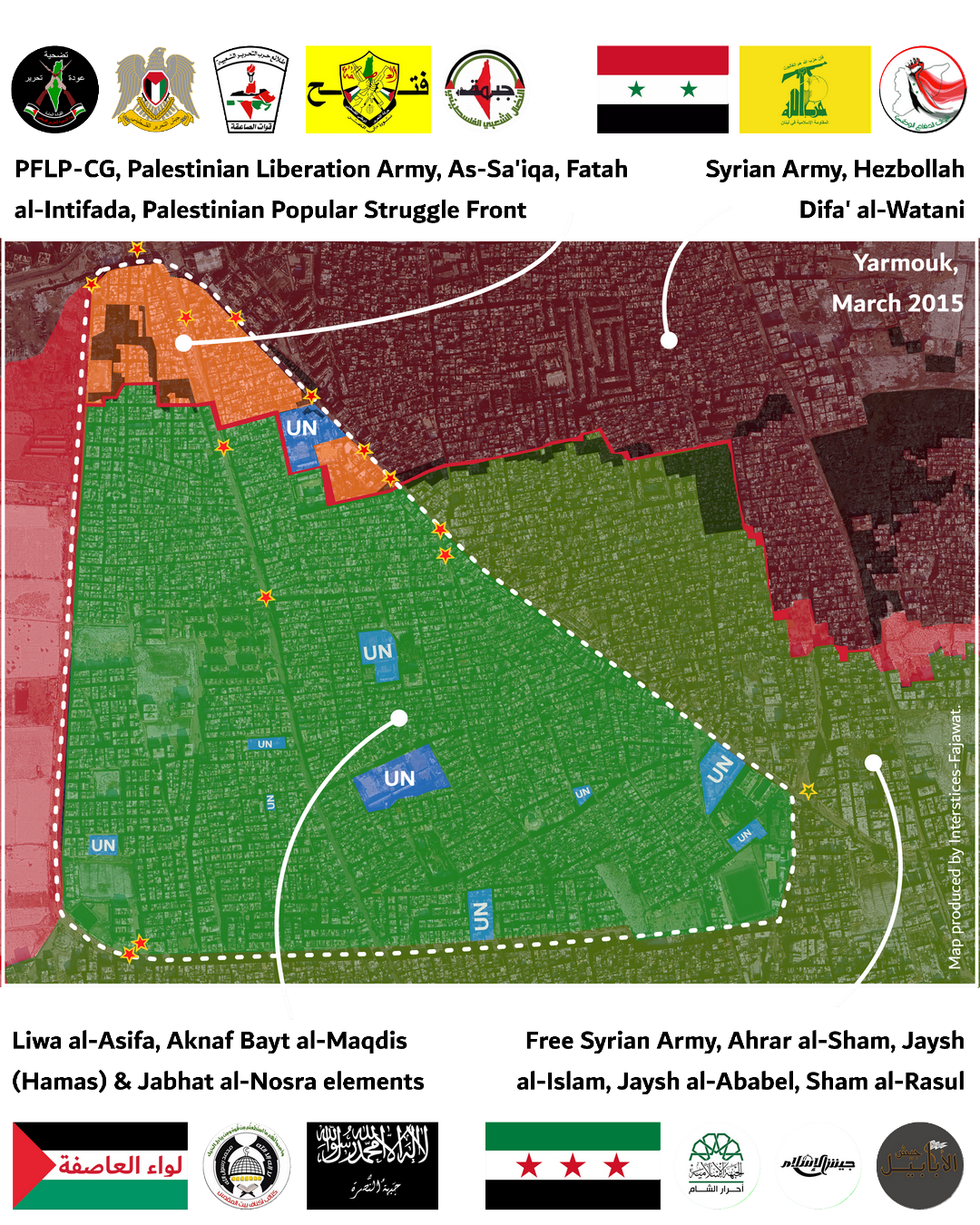
Map No. 7: Yarmouk – Areas of influence at the beginning of 2015

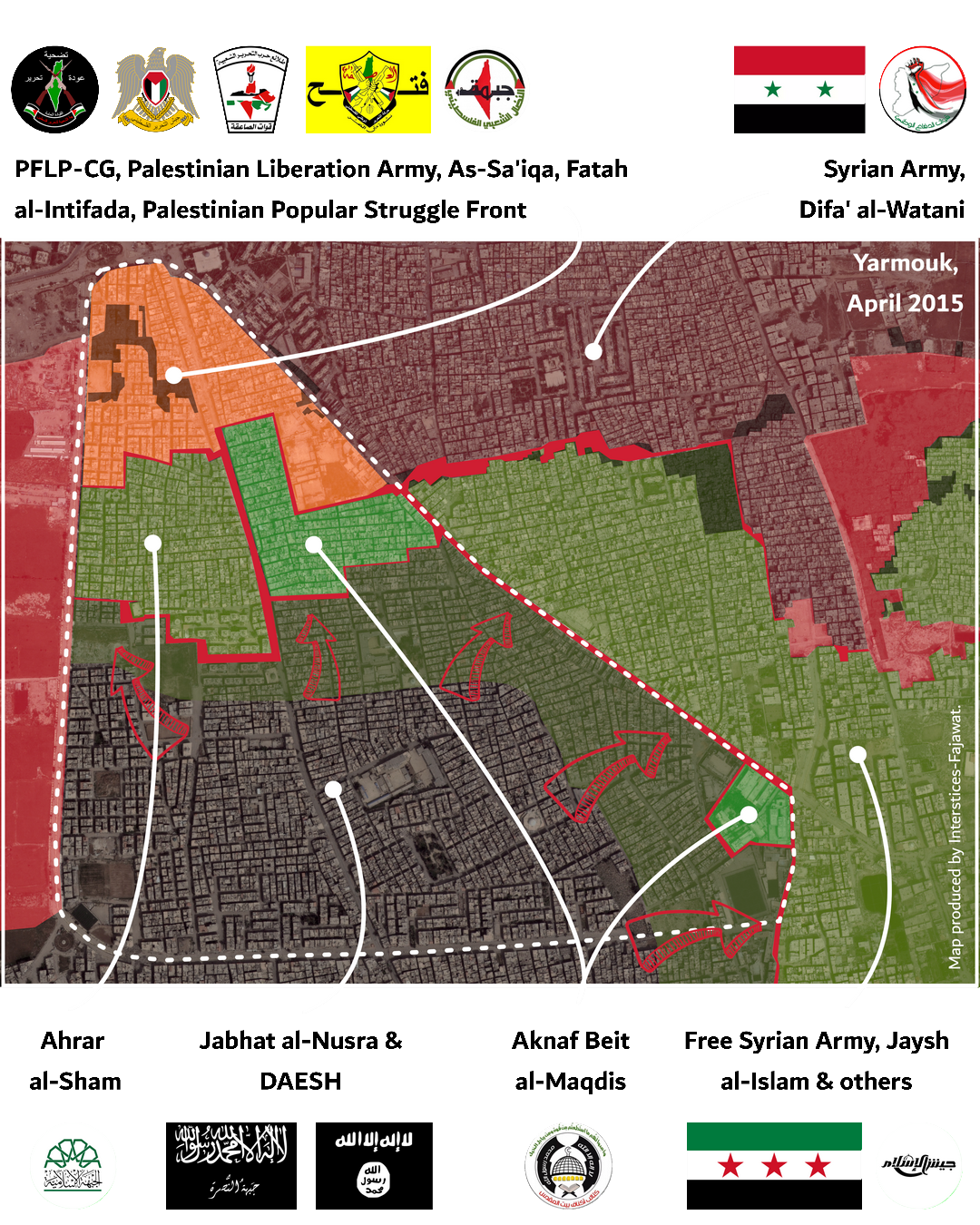
Map No. 8: Yarmouk – Offensive by Islamic State and Jabhat al-Nusra, April 2015

2016–2018: Decay. Birds of prey fight over the carcass.

In January 2016, relations between IS and Jabhat al-Nosra began to deteriorate. The latter was then confined to the western part of the camp, between 30th Street and Saffouriyeh Street.

In 2016, the millionaire Qashlak signed an agreement with Fatah al-Intifada for the “Free Palestine Movement” to gain control of a segment of the front line managed by the latter, in exchange for a substantial sum of money. He hoped to increase the symbolic power of his mercenaries, who were now on the front line in the fight against IS.

On July 8, 2016, the regime began negotiations with Jabhat al-Nusra with a view to evacuating it from Yarmouk to Idlib. At the end of the month, Jabhat al-Nusra changed its name to Fatah al-Sham.

In the following months, IS laid siege to Fatah al-Sham and issued an ultimatum to residents of the area under its control, ordering them to leave before it was completely sealed off. At the same time, IS evacuated the area around Al-‘Urubeh Street between Yalda and al-Hajar al-Aswad during clashes with the FSA and Jaysh al-Islam. [1]

ISIS thus transformed Yarmouk into a fortified camp, while paranoia increased on both sides. On December 4, 2016, Fatah al-Sham executed Mohamed Aboud, known as “Abu Ali Khamseen,” accused of collaborating with ISIS.

By the end of 2016, an additional 6,250 residents had fled Yarmouk.

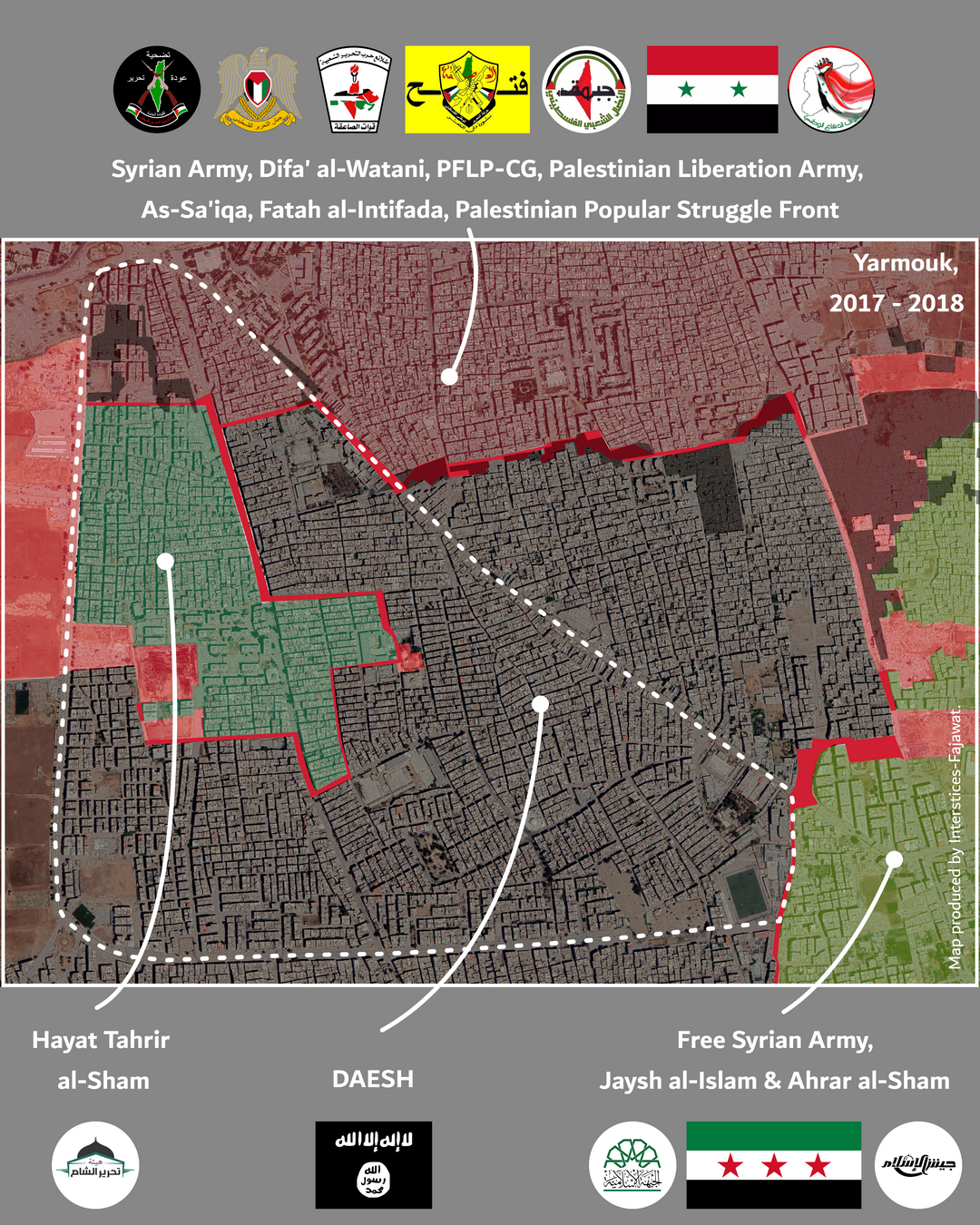
In January 2017, Fatah al-Sham became Hayat Tahrir al-Sham (HTS).

On May 8, 2017, around 50 HTS members, including 19 wounded, were evacuated by ambulance and bus to Idlib as part of the “Four Cities Agreement” initiated the previous year between the group and the regime. Three months later, the regime established a “new military zone” along its front with HTS, leading to the evacuation of several families and the conversion of their homes into military positions, while a Syrian Red Crescent mission escorted by the PFLP-GC was allowed to enter the HTS-held area on September 7. In addition, a truce was then in effect between the regime and IS. [2] [3]

On September 14, 2017, ISIS imposed a new siege on residents living in the HTS-controlled sector, which at the time had around 200 fighters, before launching an assault on Jaysh al-Islam and FSA factions (Liwa Sham al-Rasul, Jaysh al-Ababil, Kataeb al-Shuhada al-Islam, and the Islamic Union Ajnad al-Sham) south of Yarmouk, capturing the area where the hospital was under construction. At the same time, Jaysh al-Islam and the FSA signed a truce with the regime as part of the “de-escalation” agreements adopted in Cairo under the auspices of Egypt and Russia, which came into force on October 12. The next day, the regime resumed a series of airstrikes against IS positions in Al-Hajar al-Aswad, followed by skirmishes between Jaysh al-Islam and IS at the ‘Urubeh-Beirut checkpoint between Yalda and Yarmouk. [4] [5]

On November 11, 2017, the regime threatened the FSA with closing the Babbila-Sidi Miqdad checkpoint, the only link between the areas under regime control and the area under FSA control, if the FSA did not close the checkpoint Urubeh-Beirut was the only access point to the Yarmouk camp, which the rebels had reopened on November 4 but which could only be used by 10 to 15% of the population of Yarmouk, estimated at less than 8,000 people at the time. The FSA therefore temporarily closed access to the area controlled by ISIS, but reopened it in the following hours under pressure from Yarmouk residents who had taken refuge in Yalda. In response, the regime carried out its threats and closed the Babbila-Sidi Miqdad checkpoint on November 12, causing prices in the enclave to rise by 20%. It was not reopened until two months later. [6] [7]

On December 8, 2017, pro-regime militias launched an attack to recapture the Al-Rijeh district under HTS control, but to no avail. That same month, ISIS secured the signing of an initial agreement for the evacuation of 19 of its wounded fighters to the desert and Turkey, in exchange for easing the siege imposed on the district under HTS control to allow food to enter. [8] [9]

On December 13, ISIS launched an attack in Tadamon and seized a block of buildings controlled by the pro-regime militia Difa’a al-Watani for the first time since 2015, before the latter recaptured it and bombed Yarmouk for several weeks in retaliation. [10]

By the end of 2017, only 6,000 residents remained in Yarmouk.

[1] Action Group for Palestinians in Syria, ISIS evacuates one of Yarmouk Streets from its Residents and starts Violent Clashes with the Opposition, 16 Août 2016, accessible à https://www.actionpal.org.uk/en/post/3762/news-and-reports/isis-evacuates-one-of-yarmouk-streets-from-its-residents-and-starts-violent-clashes-with-the-opposition

[2] Al-Jazeera, Deal sees Nusra fighters evacuate from Syria’s Yarmouk, 7 Mai 2017, accessible à https://www.aljazeera.com/news/2017/5/7/deal-sees-nusra-fighters-evacuate-from-syrias-yarmouk

[3] Zaman Al-Wasl, Wounded Nusra fighters evacuated from Yarmouk camp, 8 Mai 2017, accessible à https://en.zamanalwsl.net/news/article/25955

[4] The New Arab, Syrian rebel groups ‘agree to Damascus truce’ in Cairo, 12 Octobre 2017, accessible à https://www.newarab.com/news/syrian-rebel-groups-agree-southern-damascus-truce

[5] Tom Rollins, Escalation Threatens South Damascus “De-Escalation” Deal, Atlantic Council,  27 Octobre 2017, accessible à https://www.atlanticcouncil.org/blogs/syriasource/escalation-threatens-south-damascus-de-escalation-deal/

[6] Ammar Hamou & Madeline Edwards, A ‘war of crossings’ in south Damascus as checkpoint closure cuts off encircled districts, Syria Direct, 13 Novembre 2017, accessible à https://syriadirect.org/a-war-of-crossings-in-south-damascus-as-checkpoint-closure-cuts-off-encircled-districts/

[7] Siege Watch, Ninth Quarterly Report on Besieged Areas in Syria, Janvier 2018, accessible à https://siegewatch.org/wp-content/uploads/2015/10/pax-tsi-siegewatch-9.pdf

[8] Zaman Al-Wasl, 19 ISIS fighters evacuated by regime from southern Damascus, some reached Turkey, 14 Décembre 2017, accessible à https://en.zamanalwsl.net/news/article/31704

[9] Action Group for Palestinians in Syria, ISIS allows the besieged residents of west Yarmouk camp to enter food, 29 Décembre 2017, accessible à https://www.actionpal.org.uk/en/post/6375/articles/isis-allows-the-besieged-residents-of-west-yarmouk-camp-to-enter-food

[10] Siege Watch, Ninth Quarterly Report on Besieged Areas in Syria, Janvier 2018, accessible à https://siegewatch.org/wp-content/uploads/2015/10/pax-tsi-siegewatch-9.pdf

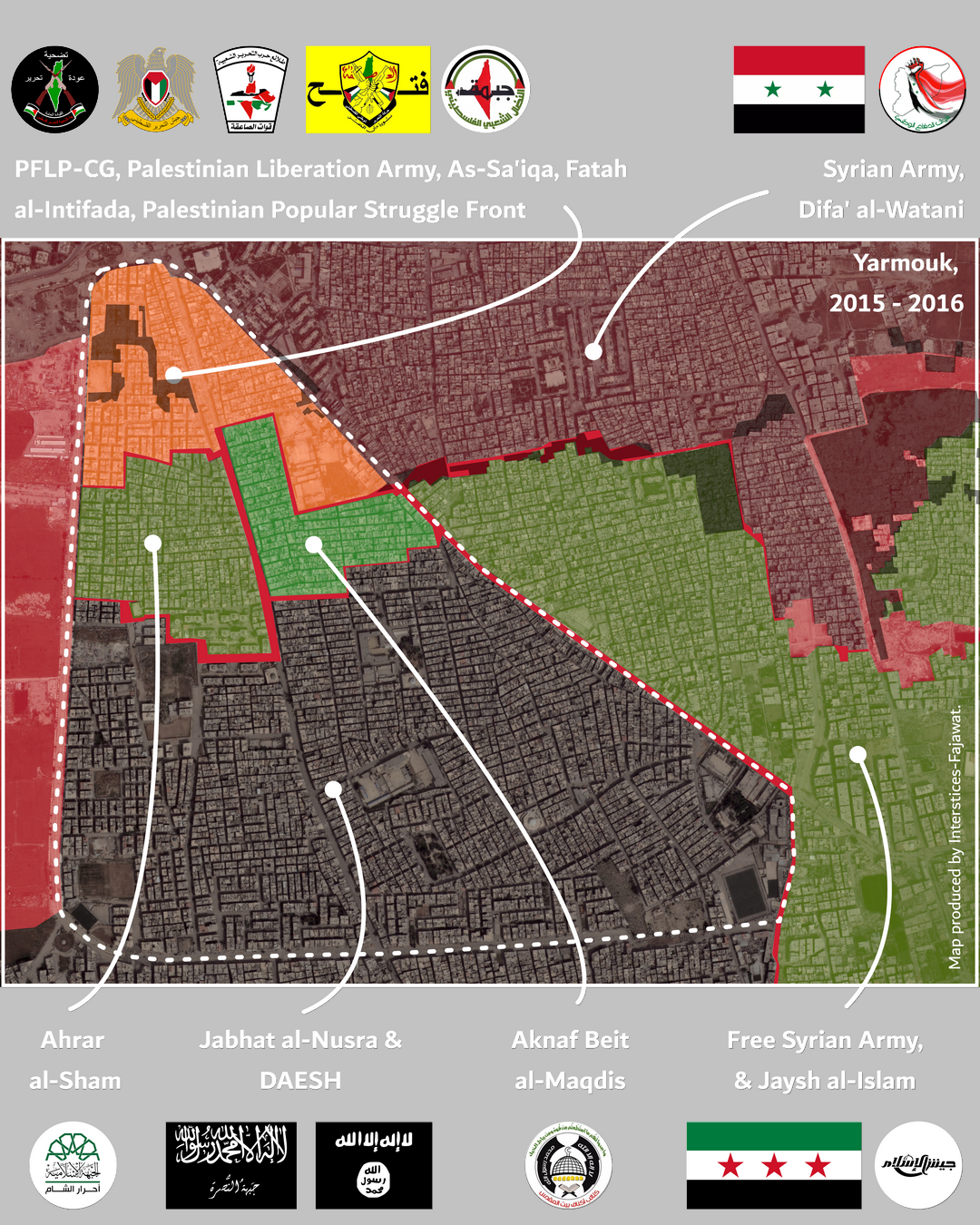
Map No. 9: Yarmouk – Areas of influence between 2015 and 2016

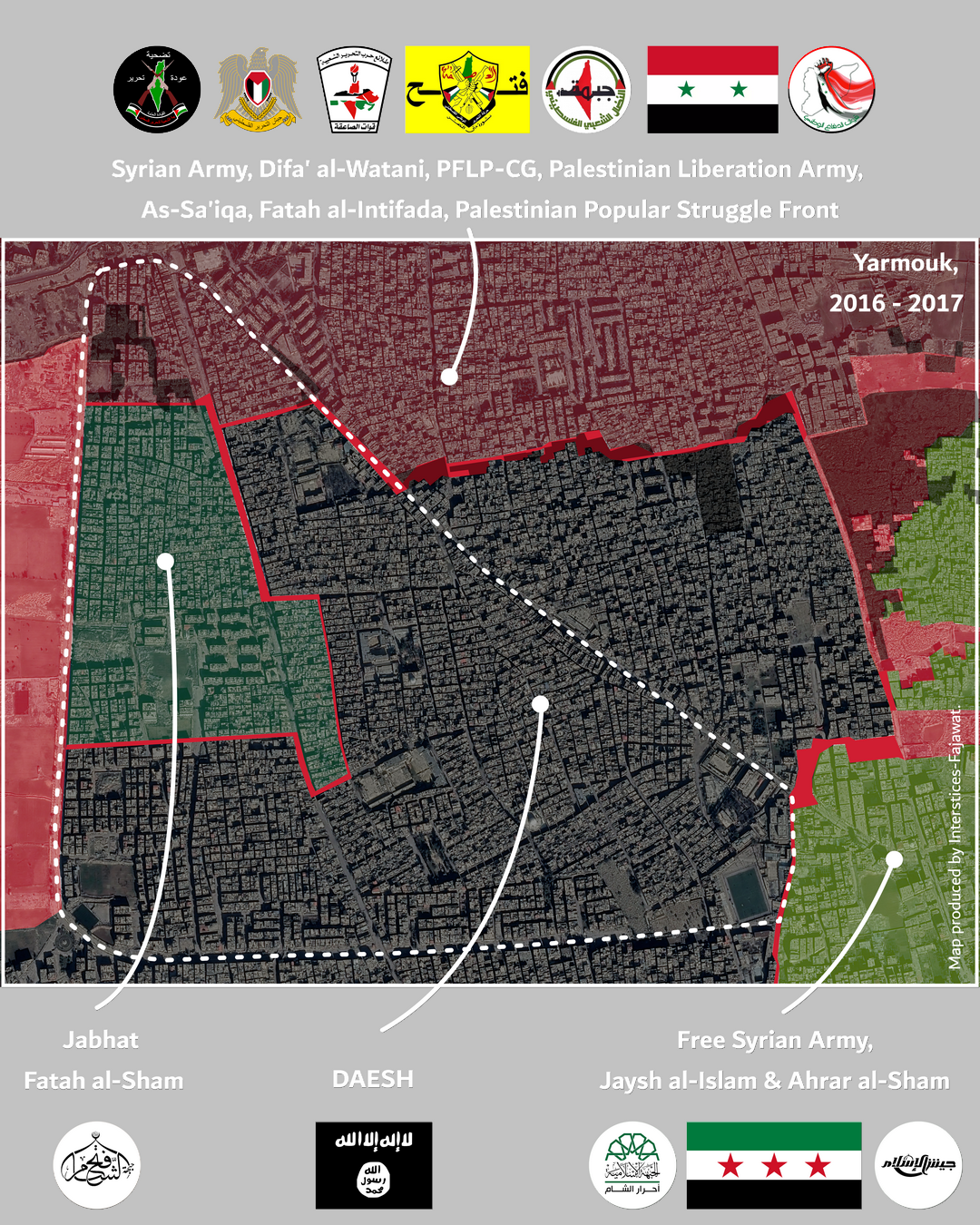
Map No. 10: Yarmouk – Areas of influence between 2016 and 2017

2018: Liquidation. The Islamists go for a bus ride.

On January 5, 2018, Jaysh al-Islam attempted a final offensive against ISIS from Yalda, without success.

Between 2016 and 2018, ISIS gradually imposed its totalitarianism and violence on the camp’s residents, banning the consumption or sale of cigarettes, breastfeeding, applause during weddings, ball games, photography, and the sale of wood for heating, while imposing strict dress codes for both women and men (length of trousers). IS also closed all schools within the camp (August 3, 2016) and prevented any school activities outside its control, while a curfew was imposed during prayer times, for which attendance at the mosque was mandatory. After finding that residents had circumvented the closure of schools in the camp, IS banned all students from attending alternative schools in adjacent towns (March 6, 2018), then forced all residents to attend Sharia law classes (April 16, 2018). Those who violated these rules were flogged, mutilated, or even executed: Musa al-Badawi, accused of being a spy for HTS (February 27, 2018); an unidentified man accused of insulting Allah (April 13, 2018); and Khaled Adnan Ahmed, accused of fighting alongside the regime (April 23, 2018).

In April, sensing increasing pressure from the regime, ISIS evacuated the Martyrs’ Cemetery neighborhood following clashes with the Free Palestine Movement in order to transform it into a military defense zone. [1] [2]

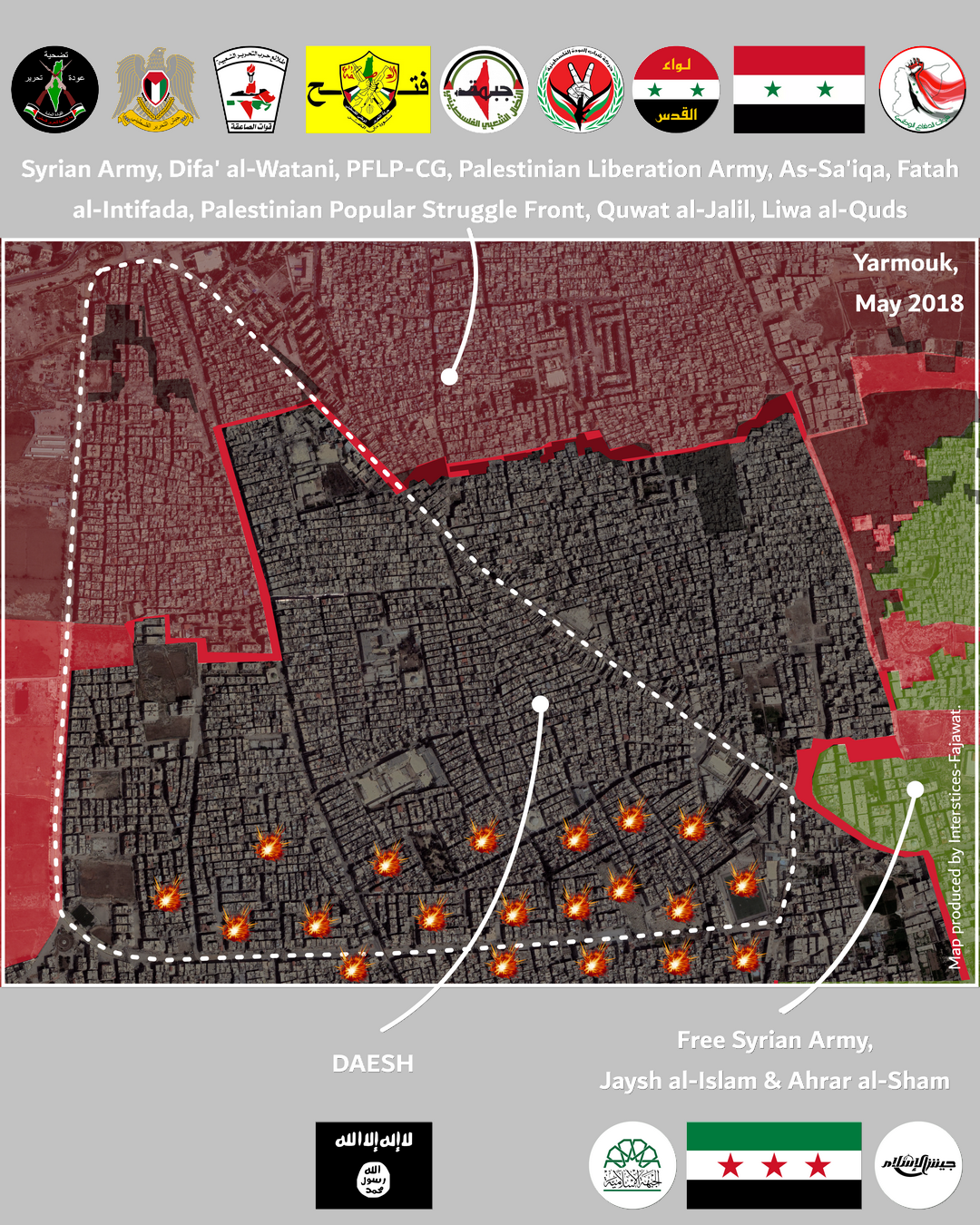
On April 19, 2018, the Syrian regime and its allies (PFLP-GC, Fatah al-Intifada, Liwa al-Quds, Difa’a Al-Watani, Jaysh At-Tahrir Al-Falasteen, Quwaat Der’a Al-Qalamun, etc.) launched a major offensive to recapture the outskirts of Damascus. This was accompanied by intensive and frenzied bombing of the Yarmouk, Tadamon, Hajar al-Aswad, and Yalda by the Russian air force (400 air strikes and the massive use of explosive barrels, mortar shells, and surface-to-surface missiles, including Russian UR-77 “Serpents Gorynysh” destroyers). 5,000 residents of Yarmouk fled to the Yalda-Babbila area, leaving fewer than 1,200 people behind. [3]

The next day, the air force violently struck Jaysh al-Islam positions between Yalda and Hajar al-Aswad, forcing it to withdraw from its front line with ISIS and allowing regime forces to move into the gap. At the same time, regime forces surrounded the camp and made several attempts to capture the area held by HTS with the support of heavy weapons and armored vehicles, but were held back. IS, for its part, fought fiercely on all fronts, against both HTS and regime forces and their allies. [4]

On April 27, a first group of 15 wounded Jaysh al-Islam fighters was evacuated to northern Syria as part of a transitional agreement with the regime, while negotiations continued for the complete evacuation of the area. At the same time, regime forces carried out 165 airstrikes on the area on the same day, burning down around 100 homes in Yarmouk and Tadamon.

On April 29, an agreement between the regime and HTS on the one hand, and the FSA on the other, provided for the imminent evacuation of HTS, Jaysh al-Islam, Aknaf Beit al-Maqdis, Sham al-Rasul, and Jaysh al-Ababil. The Uruba-Beirut checkpoint was transferred to Russian forces, while the Babbila-Sidi Miqdad checkpoint was partially reopened for civilians to pass through.

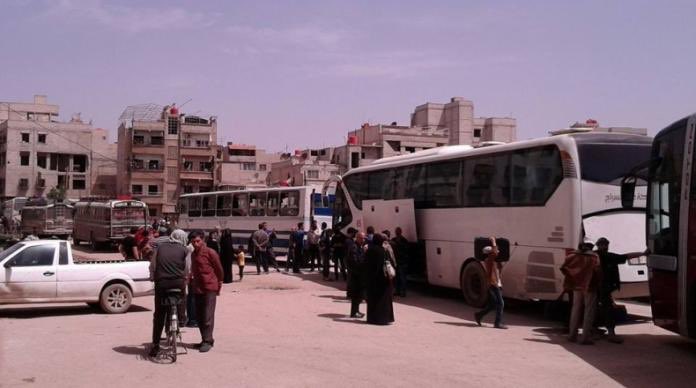
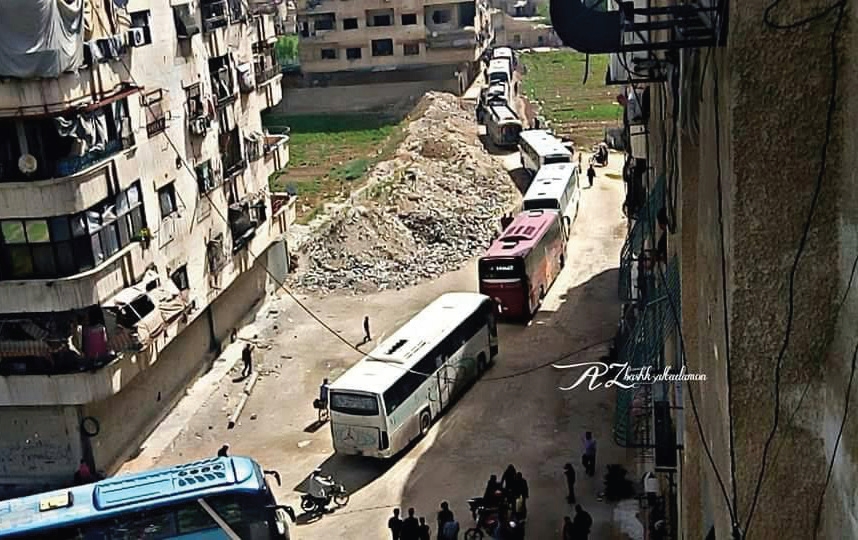
On May 1, 2018, the 150 HTS fighters and their families (425 people) were evacuated from Yarmouk first from the northern entrance of the camp, followed from May 3 to 7 by the 1,700 fighters from the FSA, Jaysh al-Islam, and Aknaf Beit al-Maqdis factions accompanied by their families (9,250 people out of the 17,000 planned), evacuated from Yalda, Babbila, and Beit Sahem to Al-Bab (Idlib) in seven convoys of 61 buses in total. In parallel with these evacuation operations, the regime continued its intense bombardment of IS positions. [5] [6] [7] [8] [9] [10]

From May 8 to 13, around 20 residents of Yarmouk seeking to flee the bombing were held for several days by government forces at the Uruba-Beirut checkpoint, most of them over 60 years old, before the militias in charge of the checkpoint opened fire on the crowd, killing three people.

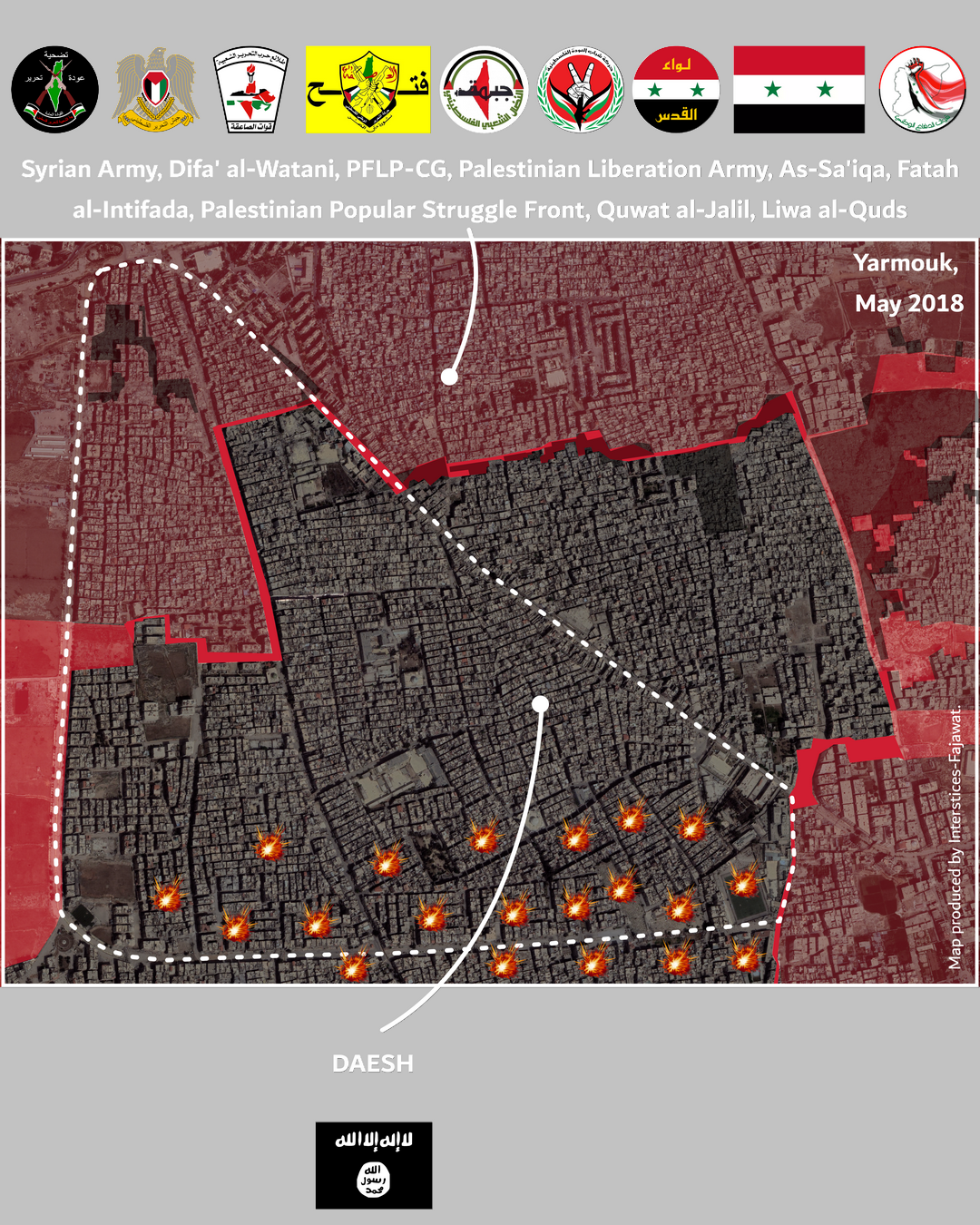
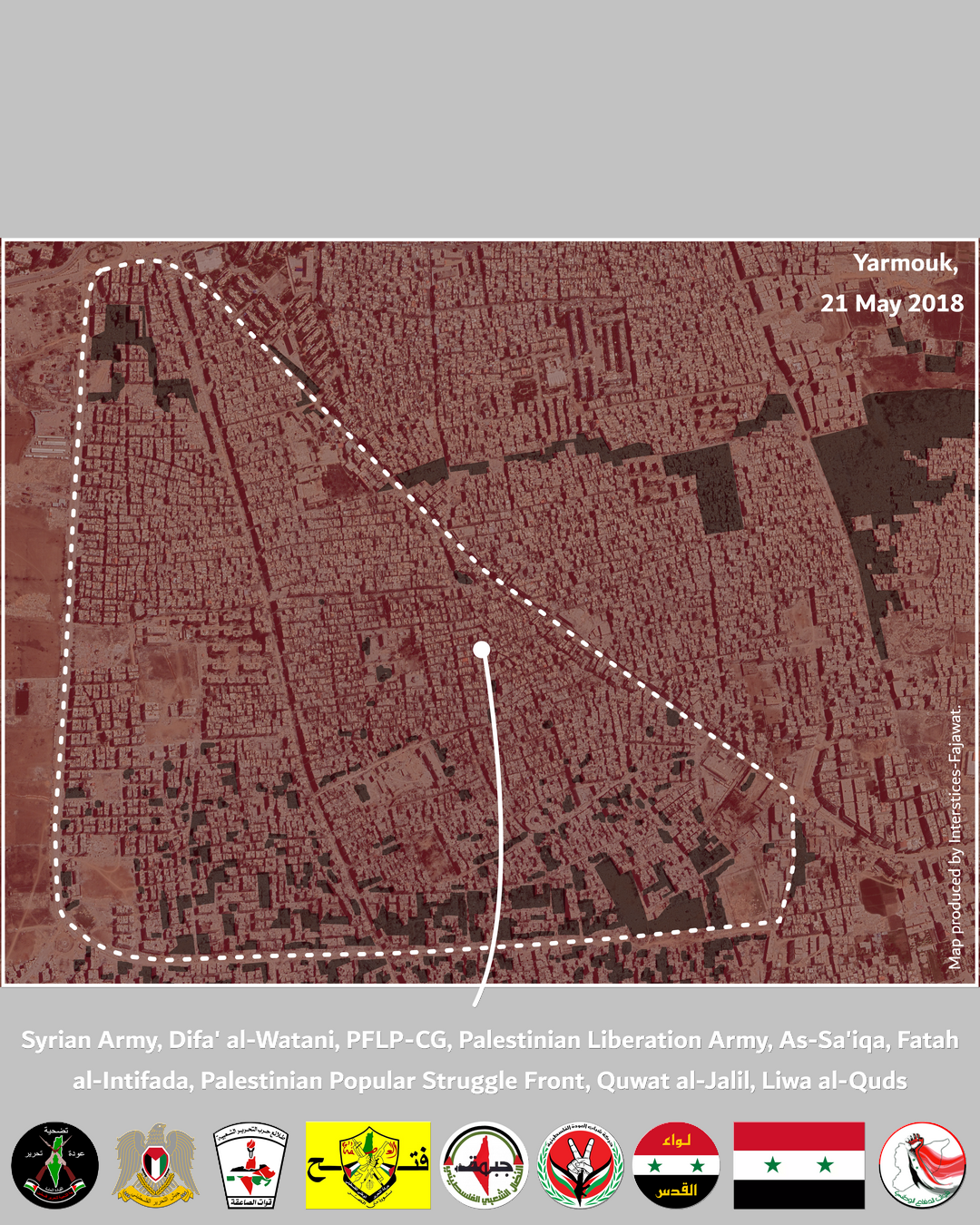
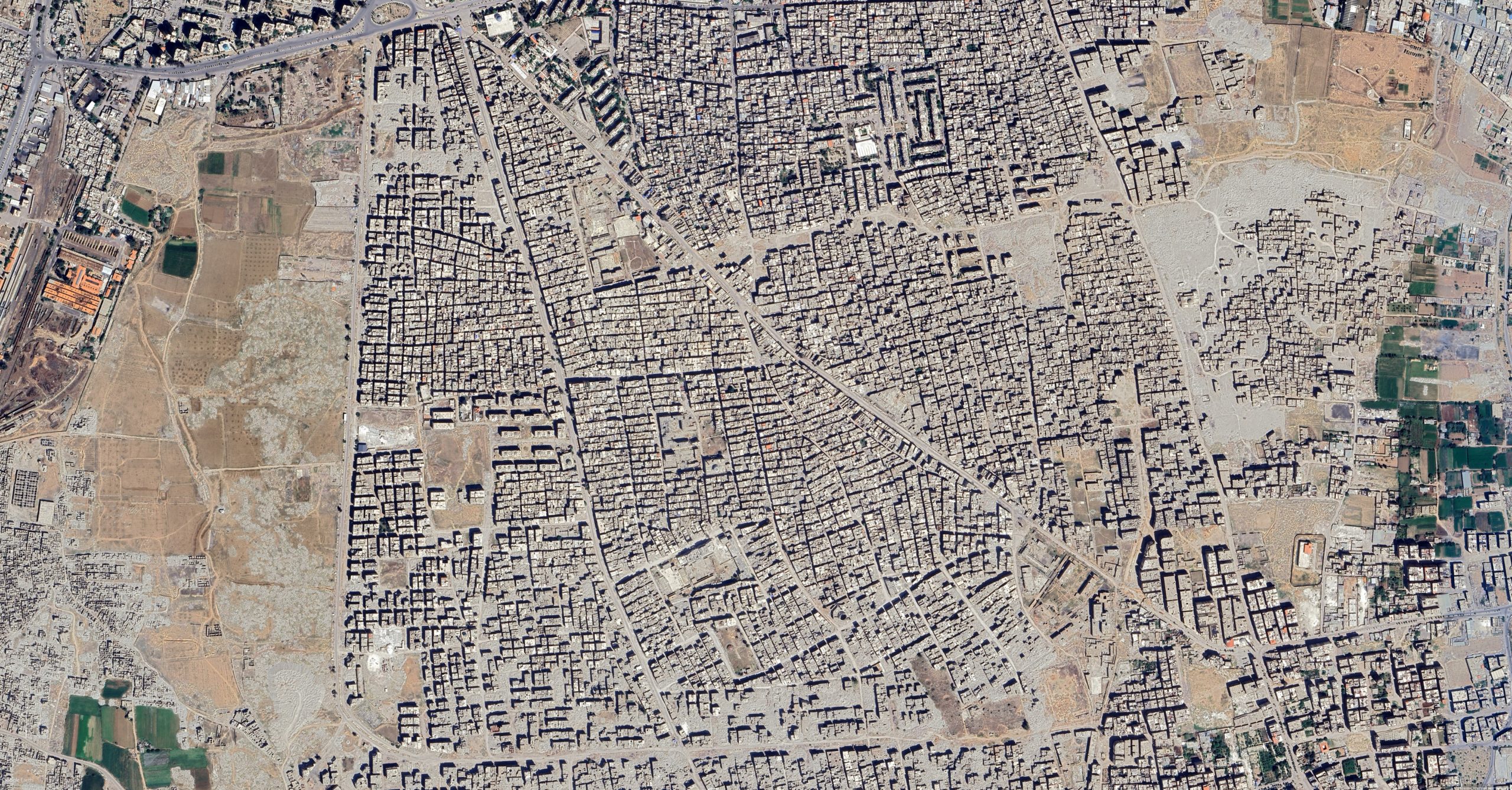
Finally, a new agreement, a secret one this time, between ISIS and the regime planned the evacuation of its 1,200 fighters still stationed in Yarmouk, along with their families (600 people). The evacuation was finally carried out on May 20, 2018, using around 50 buses to transport IS to the desert east of Suwayda. The regime thus regained full control of the Yarmouk camp and its surroundings after more than five years and ten months of clashes and bombings that left 80% of the camp’s buildings and infrastructure destroyed. [11] [12]

On May 22, 2018, the UN reported that an agreement to which it had not been party had led to the displacement of 400 Palestinian refugees to the province of Hama.

In May and June, the regime’s army organized the systematic looting of the camp’s infrastructure and buildings under the supervision of the infamous “Fourth Division,” arresting and summarily executing several residents who tried to resist, including two children: Rami Mohammed Salman (15) at the “Tabah” checkpoint and Mahmoud Bakr in Al-‘Urubeh Street [13]. Some buildings were also set on fire after being looted, as in Lubya, Safad, and Al-Ja’ouneh Streets [14] [15]. In addition, it imposed heavy fines (US$50 to US$150) for passing through the checkpoints, preventing hundreds of residents from accessing their homes [16]. At the same time, the regime prevented residents from recovering the bodies of at least 30 civilians killed during the bombings and left in the rubble [17]. It was not until 2019 that the regime allowed residents to return to Yarmouk.

In July, the Action Group for Palestinians of Syria counted 1,392 victims among its Palestinian residents during the period 2011-2018, their deaths resulting from bombing, siege, sniper fire, or torture in the regime’s prisons. [18]

Thus, Yarmouk was “liberated” by the Assad regime, a great defender of the Palestinian cause…

[1] Action Group for Palestinians in Syria, Fighting between ISIS and the Free Palestine Movement on the Martyrs’ sector axis in Yarmouk camp, 1 Mars 2018, accessible à https://www.actionpal.org.uk/en/post/6700/action-group-for-palestinians-of-syria/fighting-between-isis-and-the-free-palestine-movement-on-the-martyrs-sector-axis-in-yarmouk-camp

[2] Waleed Abu al-Khair, ISIS in Yarmouk prepares for Syrian regime onslaught, Diyaruna, 13 Avril 2018, accessible à https://diyaruna.com/en_GB/articles/cnmi_di/features/2018/04/13/feature-03

[3] Action Group for Palestinians in Syria, Victims and large-scale destruction after the hysterical bombardment of Yarmouk camp, 21 Avril 2018, accessible à https://www.actionpal.org.uk/en/post/6981/victims-and-large-scale-destruction-after-the-hysterical-bombardment-of-yarmouk-camp

[4] Siege Watch, Tenth Quarterly Report Part 2 – The Culmination of “Surrender or Die”, Mai 2018, accessible à https://siegewatch.org/wp-content/uploads/2015/10/PAX-report-Siege-Watch-10b.pdf

[5] Action Group for Palestinians in Syria, Explosive barrels and air raids on Yarmouk camp, and violent clashes on all its axes, 7 Mai 2018, accessible à https://www.actionpal.org.uk/en/post/7074/articles/explosive-barrels-and-air-raids-on-yarmouk-camp-and-violent-clashes-on-all-its-axes

[6] Maureen Clare Murphy, Armed insurgents evacuate Yarmouk, The Electronic Intifada, 1 Mai 2018, accessible à https://electronicintifada.net/blogs/maureen-clare-murphy/armed-insurgents-evacuate-yarmouk

[7] Ammar Hamou, Mohammed Al-Haj Ali & Tariq Adely, Parallel evacuations to begin in two besieged pockets as Syrian government moves to clear remaining rebels from capital, Syria Direct, 30 Avril 2018, accessible à https://syriadirect.org/parallel-evacuations-to-begin-in-two-besieged-pockets-as-syrian-government-moves-to-clear-remaining-rebels-from-capital/

[8] Ersin Celik, Evacuation convoy from Syria’s Yarmouk reaches Al-Bab, Yeni Safak, 4 Mai 2018, accessible à https://www.yenisafak.com/en/world/evacuation-convoy-from-syrias-yarmouk-reaches-al-bab-3360548

[9] Burak Karacaoglu, Esref Musa & Mahmoud Barakat, 4th convoy leaves Syria’s Yarmouk under evacuation deal, Anadolu Agency, 7 Mai 2018, accessible à https://www.aa.com.tr/en/middle-east/4th-convoy-leaves-syrias-yarmouk-under-evacuation-deal/1137840

[10] Ersin Celik, Evacuations remain underway from Syria’s Homs, Yarmouk, Yeni Safak, 9 Mai 2018, accessible à https://www.yenisafak.com/en/world/evacuations-remain-underway-from-syrias-homs-yarmouk-3380935

[11] Middle East Eye, Syrian army moves into Yarmouk after IS evacuation deal, 21 Mai 2018, accessible à https://www.middleeasteye.net/news/syrian-army-moves-yarmouk-after-evacuation-deal

[12] The Defense Post, Syrian army says Damascus ‘completely secure’ after taking Yarmouk camp from ISIS, 21 Mai 2018, accessible à https://thedefensepost.com/2018/05/21/syria-army-control-damascus-isis-ousted/

[13] Palestinian Refugees Portal, (ARABE) Camp de Yarmouk : Un deuxième enfant tué par les forces du régime après s’être opposé au « pillage », 26 Mai 2018, accessible à https://shorturl.at/eNev0

[14] Action Group for Palestinians in Syria, (ARABE) 70 % des bâtiments et des quartiers du camp de Yarmouk sont détruits ; les pilleurs volent les câbles électriques souterrains, 29 Mai 2018, accessible à http://www.actionpal.org.uk/ar/post/9879

[15] Palestinian Refugees Portal, (ARABE) Camp de Yarmouk : Incendie des maisons et pillage du sous-sol, 4 Juin 2018, accessible à https://shorturl.at/D6iWk

[16] Action Group for Palestinians in Syria, (ARABE) « Des sucreries pour la libération », un nouveau mode de chantage de l’armée du régime contre les résidents du camp de Yarmouk, 31 Mai 2018, accessible à http://www.actionpal.org.uk/ar/post/9899

[17] Palestinian Refugees Portal, (ARABE) Camp de Yarmouk : Des corps sous les décombres des installations de l’UNRWA… Pourquoi n’intervenez-vous pas pour les récupérer? , 30 Mai 2018, accessible à https://shorturl.at/f0KaG

[18]

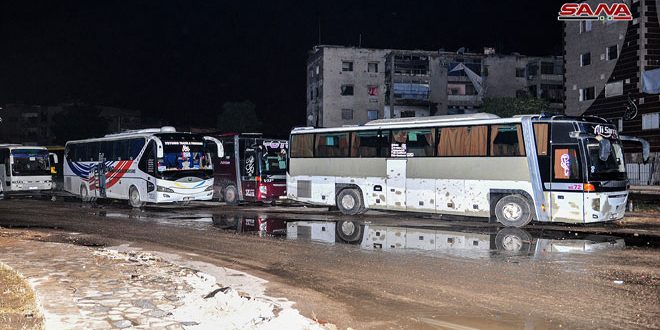
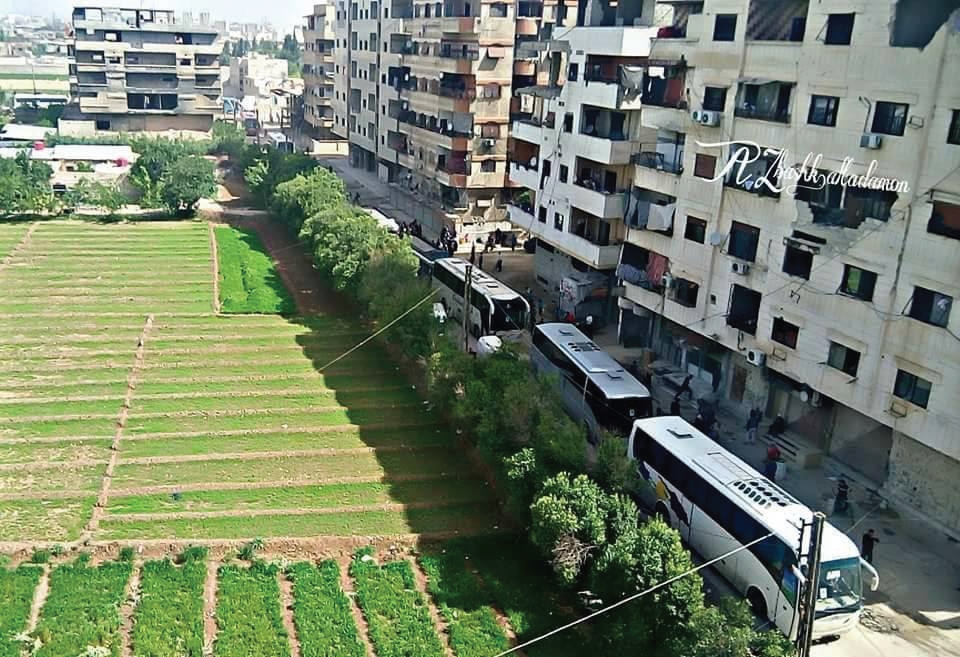
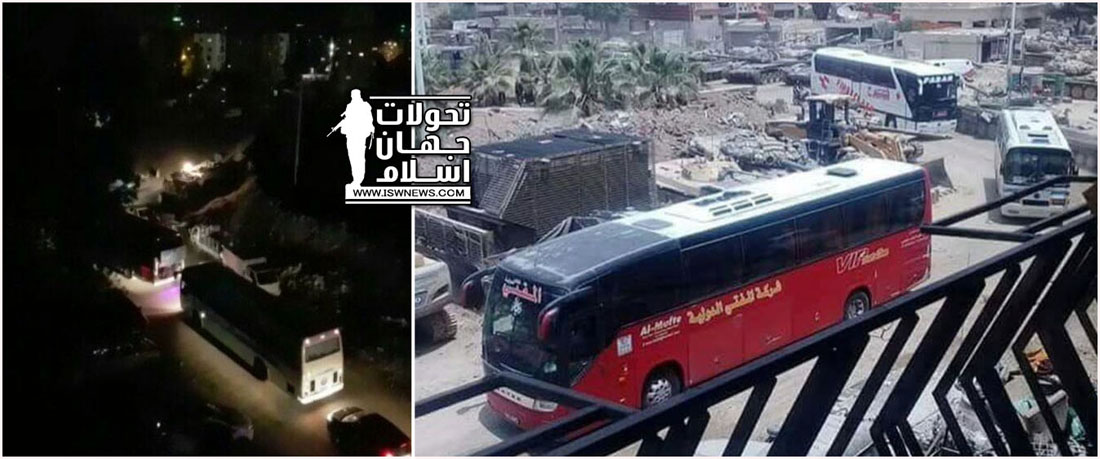
Photos of various evacuation operations carried out by HTS, factions associated with the FSA, and Islamic State.

Map No. 11: Yarmouk – Areas of influence between 2017 and May 2018

Map No. 12: Yarmouk – Areas of influence between May 2 and May 7, 2018

Map No. 13: Yarmouk – Areas of influence between May 10 and May 21, 2018

Map No. 14: Yarmouk – Total takeover of Yarmouk by the regime on May 21, 2018

2024: Recovery. Yarmouk, a ghost town.

Over the next five years, only 15,300 residents, 80% of whom were Palestinian refugees, were able to return to their homes (4,500 families) or at least to the ruins of their former homes, after applying for permission to return. This permission was granted sparingly, only to those whose homes were deemed viable and who could provide proof of ownership or other documentation proving their previous residence. Those who had previously been arrested, convicted, called up for military conscription, or had links to the armed factions that had controlled the territory were excluded from the procedure, the latter criterion being entirely subjective and left to the discretion of the Fourth Division agents.

The Rehabilitation Oversight Committee estimated that 40% of the buildings were in good condition, 40% needed reinforcement and repairs, and 20% were completely destroyed and needed to be cleared and rebuilt.

The management of the camp was entrusted to the “General Authority for Palestinian Arab Refugees,” a body under the auspices of the Yarmouk branch of the Ba’ath Party, led by Ali Mustafa. This body was regularly criticized by residents for its inaction and corruption, one of the main problems being the prohibitive prices of real estate and the lack of rehabilitation of vital infrastructure (water, electricity, sewage). The 12 municipal employees were notably accused by residents of blackmail and corruption.

When the regime fell in December 2024, 736 Palestinians from Yarmouk had been taken prisoner and 1,530 killed out of the 1,600 Palestinians from Syria taken prisoner and 3,685 killed since 2011. Among them, 94 members affiliated with Hamas had been executed, including Mamoun Al-Jaloudi. [1] [2]

* * *

Yarmouk is a symbol. The Assad regime must be held primarily responsible for the annihilation of Syria’s largest Palestinian refugee camp, whose violent assault beginning in the second half of 2012 was a continuation of that of the Palestinian camps in Dera’a and Latakia a few months earlier. Contrary to what the regime’s propaganda has repeatedly claimed in order to discredit the popular opposition movements and the armed rebellion, the spread of takfiri/jihadist groups was not the cause and justification for its use of violence, but its consequence: in Yarmouk, Jabhat al-Nusra—along with its offshoots Fatah al-Sham and Hayat Tahrir al-Sham – and the Islamic State took advantage of the vacuum and chaos left by the indiscriminate bombing at the end of 2012, followed by the exhaustion of the anti-Assad Palestinian self-defense militias during the two years of siege that followed, to seize a camp that had been transformed into a ghost town without encountering any resistance. And when their task of eliminating any possibility of future resistance was accomplished, the regime systematically moved them elsewhere by bus so that they could attack other rebel pockets or unyielding communities, as was the case with the Druze of Suwayda in July 2018. Throughout the process of destroying Yarmouk, the Palestinian militias loyal to Assad demonstrated their deep corruption and abject complicity in the regime’s crimes. This position, contrary to the interests of Palestinian civilians, can only be explained by these factions’ desire to preserve their existence and their political and military influence: none of them wanted to suffer the fate of Arafat’s Fatah and its fedayeen. Their survival depended on the regime as much as the regime’s survival depended on Iran and Russia. By allying themselves with the latter to crush Yarmouk, they placed themselves on the same level as Hezbollah and Bashar’s shabiha, serving the interests of their masters rather than those of the people. Paradoxically, the true defenders of the Palestinian people of Yarmouk, members of the Coordination Committees and micro-factions who did not give in to either the regime or the Islamists and fought alongside civilians from within the camp, have been virtually forgotten. It is now up for us to restore their memory.

The Palestinian, Syrian, Lebanese, and Jordanian peoples are one, and everything that divides them is merely the result of Western colonialism and its maneuvers to prevent progressive Arab forces from prevailing over conservative forces. The point of junction between the four peoples lies on the slopes of the Golan Heights, and none of them can be liberated without the liberation of all. It is up to each of us to understand the meaning of this conclusion, at a time when the Zionist colonial army is seizing the Litani and Ruqqad valleys after having militarily annexed those of the Jordan and Arabah.

[1] The New Arab, Nearly 4,000 Palestinians ‘killed’ in Syria’s brutal war, 28 Mars 2018, accessible à https://www.newarab.com/news/nearly-4000-palestinians-killed-syrias-brutal-war

[2] The New Arab, Assad’s regime executed dozens of Hamas members without trial, intelligence documents reveal, 7 Janvier 2025, accessible à https://www.newarab.com/news/dozens-hamas-members-executed-assads-syria-prisons

REPORTS ABOUT YARMOUK:

  • Palestinians of Syria, Between Bitterness of Reality and the Hope of Return – Action Group for Palestinians in Syria, Juin 2014.
  • Palestinians of Syria, The Bleeding Wound – Action Group for Palestinians in Syria, Février 2015
  • Yarmouk Siege has not ended – Action Group for Palestinians in Syria, 23 Juin 2015
  • Palestinians of Syria, Bloody Diary and Unheard Screaming – Action Group for Palestinians in Syria & Palestinian Return Center, Septembre 2015
  • Yarmouk, the Full Truth – Action Group for Palestinians in Syria, Juillet 2015.
  • Palestinians of Syria and The Closed Doors – Action Group for Palestinians in Syria, 2017
  • Status Report on Yarmouk Camp – The Carter Center, 14 Novembre 2017.
  • Yarmouk, The Abandoned Pain – EuroMed Monitor, Juillet 2018.
  • Yarmouk Camp set on Fire – Action Group for Palestinians in Syria, Democratic Republic Studies Center, Syrian Center for Media and Freedom of Expression, 22 Avril 2018.
  • Status Report on the Conditions of Yarmouk Camp 2024 – Action Group for Palestinians in Syria, Décembre 2024.


Northern entrance to Yarmouk Street and Palestine Street from Fawzi Al-Kawikji Street, April–June 2025.
Yarmouk-1
previous arrow
next arrow
 
Yarmouk-1
Yarmouk-1
Yarmouk-6
Yarmouk-22
Yarmouk-17
Yarmouk-26
Yarmouk-55
Yarmouk-29
Yarmouk-70
Yarmouk-81
Yarmouk-83
Yarmouk-110
Yarmouk-162
Yarmouk-148
Yarmouk-86
Yarmouk-96
Yarmouk-98
Yarmouk-72
Yarmouk-105
Yarmouk-133
Yarmouk-41
Yarmouk-34
Yarmouk-68
Yarmouk-134
previous arrow
next arrow

Is Ahmed Al-Sharaa mocking the Syrians? (to translate)

Is Ahmed Al-Sharaa mocking the Syrians? (to translate)

About the author: Cédric Domenjoud is an independent researcher and activist based in Europe. His research areas focus on exile, political violence, colonialism, and community self-defense, particularly in Western Europe, the former USSR, and the Levant. He is investigating the survival and self-defense of Syrian communities and developing a documentary film about Suwayda, as part of the Fajawat Initiative.
 

The fall of the Assad regime on December 8, 2024 was an undeniable liberation for millions of Syrians, who suddenly and unexpectedly emerged from fifty years of totalitarian barbarism that had transformed Syria into a field of ruins doubling as a concentration camp archipelago, since which several hundred thousand civilians have disappeared or been forced into exile. However, six months after this historic overthrow, all signs suggest that beyond the coup, the promise of a better future is rapidly fading.

Liberation, not revolution

As early as December 9, Ahmed al-Sharaa proclaimed himself leader of the new Syria, categorically rejecting all forms of power-sharing, decentralization and federalism, while taking care never to use the term democracy, before declaring in an interview with Syria TV on December 15 – just one week after the fall of Assad – that it was now “crucial to abandon the revolutionary mentality”. It is legitimate to ask: When was Al-Sharaa ever revolutionary?

On December 29, Al-Sharaa asserted that no elections could be held for another four years, which is understandable given the deplorable situation of Syrian civil society, but not at all reassuring coming from a person who rejects the very concept of democracy, whatever its form. At the same time, he announced the forthcoming adoption of a new constitution at a hypothetical National Dialogue Conference, which would bring the transition period to a close. At this stage, the most optimistic were still waiting to “see what happens”.

On January 29, Al-Sharaa was appointed President of the Syrian Arab Republic by the Syrian General Command (embodied by himself) at a “Victory Conference”. The Syrian constitution and all the institutions inherited from the Baath Party and the Assad dictatorship were subsequently abolished. No one will regret them.

On February 12, Al-Sharaa set up a 7-member preparatory committee[1] to organize the National Dialogue Conference, which took 10 days to prepare and opened on February 24. It brought together 600 people – many of whom had been invited less than two days earlier by SMS – and excluded any representation from the Syrian Northeast Autonomous Administration and the Syrian Democratic Forces. The discussions lasted just one day, and objectively achieved nothing, apart from a superficial reaffirmation of the needs already formulated by everyone: transitional justice, respect for public and political freedoms, the role of civil society organizations in rebuilding the country, constitutional and institutional reform, respect for national sovereignty and the State monopoly on arms. To this was added a symbolic declaration condemning the Israeli incursion.

On March 2, Al-Sharaa set up a 5-member committee[2] to draft a proposed constitution, which was drawn up in 10 days and adopted on March 13 for a 5-year transitional period. The new constitution stipulates that the president must be of Muslim faith and makes Islamic jurisprudence a pillar of constitutional law, while pledging to “protect minorities”, as Bashar al-Assad had also pledged. Four days later, several hundred Alawite civilians were massacred on the coast.

On March 29, Al-Sharaa dissolved the provisional government led by Prime Minister Mohammed al-Bashir, replacing it with a Transitional Government and appointing 23 ministers[3], nine of them from HTS. With civil society insisting on respect for diversity and women’s rights, Al-Sharaa appointed the only woman in the government, also a Christian, to the post of Minister of Social Affairs. If he’d wanted to be cynical, he couldn’t have done a better job. In addition, all ministers are now appointed directly by the President, while the position of Prime Minister has been abolished. It should be pointed out that a presidential regime without a prime minister is not very different from a monarchy.

In less than three months, Ahmed al-Sharaa has subtly and without opposition established himself as head of state, implementing a presidential regime that can best be described as autocratic.

Political transition in the shadow of the Astana agreements

Since 1970, Syria has followed in the footsteps of its Russian sponsor. If we are familiar with the Russian system of power and analyze the Syrian system under Assad, we discover the same modes of predation, plunder and clan-based corruption, the same cynical contempt of the loyalist elites for the majority of the people, the same policy of abandonment and voluntary impoverishment of the country, but also and finally the same collective cult of the leader, Even if he clearly lacks charisma. Ironically, Assad came to power at the same time as Putin, becoming both his copy and his disciple. Since the start of the popular revolution in 2011, Assad has acted exactly as Putin does or would do in his own country in the event of an insurrection, by denying the very existence of the revolt and causing half the country’s population to die, disappear or flee, rather than engaging in any semblance of reform that might win back a modicum of popular support. Obstinacy and criminal denial are what Assad and Putin have most in common. The only real difference between them is that Putin has not yet experienced a full-scale popular uprising, and has therefore not had the opportunity to deploy his totalitarian know-how to the full.

In reality, nothing could be worse than the Assad regime, and the only valid comparison would be with the Stalinist dictatorship. The model remains Russian, always. Consequently, the shadow of Russia will not cease to hang over the lives of Syrians overnight. What’s more, it’s legitimate to think that Assad’s downfall could only have been achieved with Putin’s cooperation or consent. Before crying conspiracy, let’s recall a few facts we all know.

Russia has no friends, only clients, vassals and debtors. Syria has lived on Russia’s and then Iran’s credit for several decades, and their interventionism in the Syrian civil war was motivated by the need to repay the debts contracted by the Assad clan. Like the United States, Turkey and the Gulf petro-monarchies, each has placed its pawns on the Syrian chessboard, modifying alliances and geostrategic priorities according to circumstances and their fluctuating interests. Against their will, or even without their knowledge, Syrian communities and factions have become the proxies of a game that has quickly overtaken them. And any attempt to detect a logic based on polarized alliances, axes or camps with clear demarcations is bound to be misguided or mistaken. There are no friendships or solidarities between states, only opportunities and maneuvers.

From the outset of the popular uprising in 2011, Iran and Hezbollah were the first to intervene to protect the Syrian regime and keep control of the routes between Iraq and Lebanon, while developing their military-commercial hold in Syria. The USA, Saudi Arabia, Qatar and Turkey, with logistical support from Jordan, Great Britain and Israel, intervened in parallel, supplying arms to nearly fifty groups linked to the Free Syrian Army and the Syrian opposition embodied by the Syrian Interim Government in exile (in Turkey), including Islamist groups linked to the al-Nosra Front and united from 2015 under the umbrella of the Army of Conquest. Qatar and Turkey are thus among the main creditors of the al-Nosra Front (2012-2017), then Jabhat Fatah al-Sham (2016-2017) and Hayat Tahrir al-Sham (2017-2025).

With the Russian intervention, the capture of Kobane and the Paris attacks by the Islamic State in 2015, the strategies of both sides have evolved. The Paris attacks, following on from Assad’s release of Islamist prisoners in 2011, largely contributed to the international community turning its gaze away from the regime’s barbarity to focus on the jihadist scarecrow. Each has thus justified its intervention in Syria by the fight against the Islamic State: the United States gradually withdrew its support for Salafist groups to redirect it in favor of the Kurdish YPG/YPJ, then the FDS, with a focus on the fight against the Islamic State, while Russia sent its Wagner mercenaries to recruit Syrians into the “ISIS hunters” battalion before sending them to secure the regime’s oil farms or serve as cannon fodder in Libya (which Turkey also did). But in reality, the Islamic State was struck with one hand and fed with the other by Turkey, Russia and the Assad regime alike, which never ceased to dispose of jihadist cells as it suited them, moving them from right to left to commit atrocities to divert attention from their own crimes and intrigues, destabilizing certain areas or populations that bothered them, or to legitimize the use of force where they lacked sufficiently valid reasons. The jihadist is a practical tool.

And contrary to popular belief, Russia, the United States and its allies (Jordan, Israel and Turkey) have not clashed militarily on Syrian soil[4]. On the contrary, in 2016 and 2017, the US, Russia and Turkey reached an agreement to set up joint air operations aimed at striking Islamic State and al-Nosra Front[5] [6]positions. Following on from this, Russia signed agreements with the USA, Israel and Jordan in 2017[7] [8] to keep the Islamists (Hezbollah and Islamic State) out of the Golan Heights and the Jordanian border, which led to the recapture of Deraa by the Syrian regime and Russia in 2018, culminating in the elimination of the Islamic State pocket in the Yarmouk basin and the surrender of the Deraa rebels as well as their integration into the normalization processes with Assad. It should be noted that all the agreements signed by Russia were signed with the consent of Bashar al-Assad[9]. Without going into further detail, it is quite clear that in the Syrian context there has never been any real duality between the “axis of evil” and the “axis of resistance”.

As early as 2015, two influential figures close to the Syrian and Russian regimes, Randa Kassis and Fabien Baussart, had begun suggesting the implementation of a peace process for Syria at a conference in Astana, Kazakhstan. After two years of fruitless talks in Geneva under the aegis of the UN, Astana finally established itself in 2017 as a negotiating space between Russia, Turkey, Iran, the Assad regime and a dozen Syrian rebel factions, led by Jaysh al-Islam, with the UN relegated to observer status. Russia and Turkey clearly showed their leadership in the discussions, with Russia even proposing a draft constitution for the future “Republic of Syria”, introducing a decentralized, federalist and secular system that would abolish Islamic jurisprudence as the source of law.  Turkey, the Arab League, the pro-Turkish opposition and Al-Assad were categorically opposed to any form of federalism. To better understand the content and outcome of these talks in the light of recent events, it may be useful to recall that Russia had proposed Assad’s resignation back in 2012, but that this proposal had been refused by the USA, Great Britain and France on the pretext that Assad was “about to be overthrown” (sic). It seems that Turkey has taken the lead over Russia in these negotiations between 2019 and 2023, before designing in its corner the modalities of the political transition in Syria. Russia has been stymied by Bashar Al-Assad’s obstinacy in believing himself invincible and obstructing any proposals for constitutional reform, particularly since his return to the international stage at the Arab League summit in Jeddah in June 2023.

On the eve of the regime’s fall, Russia, Turkey and Iran met in Doha in the presence of 5 members of the Arab League (Egypt, Saudi Arabia, Iraq, Jordan and Qatar) to declare the end of hostilities. In the wake of this, the Russian air force suddenly halted its strikes after nine years of incessant bombing, and Russian troops peacefully withdrew to their bases in Hmeimim and Tartus, where they remain to this day in application of the Doha agreements. Under these agreements, Russia gave Assad, his clan and his allies guarantees of security and amnesty in exchange for the general withdrawal of his army, while Iran negotiated the protection of Shi’ite holy sites. On the evening of December 7-8, Assad’s inner circle packed their bags, before being efficiently evacuated by plane from Syria to Russia and the Gulf States, including Bashar Jaafari, the main negotiator of the Astana agreements and Syria’s ambassador to Russia[10]. All without Israel shooting down their aircraft in flight, obviously.

As early as December 29, 2024, Al-Sharaa declared that Syria shared deep strategic interests with Russia, evacuating out of hand its manifest complicity with the Assad regime and the latter’s responsibility for the massacre of thousands of civilians since 2015[11].

At the end of January 2025, a Russian delegation led by Foreign Minister Mikhail Bogdanov and Russian Special Envoy to Syria Alexander Lavrentyev came to Damascus to set the framework and criteria for further bilateral relations. Al-Sharaa then laid down its conditions, demanding financial compensation for the crimes committed and the extradition of Assad to Syria, knowing full well that Russia would never agree.

At the beginning of March, just as the massacres on the coast had driven hundreds of Alawite civilians to take refuge on the Hmeimim base, Russia hypocritically offered its help to stabilize the situation in Syria. The following month saw the beginnings of a new military cooperation with Turkey and Russia, with Al-Sharaa admitting that the bulk of Syria’s military equipment was supplied by Russia, that Syria remained dependent on numerous contracts with Russia in the food and energy sectors, and that its veto power at the United Nations posed a serious threat to the prospect of lifting the sanctions that were heavily affecting the country.

What we can conclude from all this data is that the destiny of the Syrians will remain intimately linked to the desiderata of Erdogan and Putin. We could call this constraint the “Curse of Astana”.

What about foreign jihadists?

First, a few biographical and contextual facts.

Ahmed al-Sharaa was born in 1982 in the same place as Osama bin Laden – Riyadh, Saudi Arabia – and lived in Syria between 1989 and 2003. Before the start of the American invasion of Iraq, he went to Baghdad, where he joined the Iraqi branch of Al-Qaeda, which its leader Abu Musab al-Zarqawi had just founded after pledging allegiance to Bin Laden. Arrested in 2006, he then spent five years in American prisons. Released after bin Laden’s elimination on May 2, 2011, his successor Ayman al-Zawahiri sent al-Sharaa to Syria in August to establish the Syrian branch of al-Qaeda, Jabhat al-Nusra, in collaboration with the Islamic State in Iraq then led by Abu Bakr al-Baghdadi. As fate would have it, at exactly the same time, Bashar al-Assad amnestied and released hundreds of Islamists from Sednaya prison, including a number of notorious militants[12] who simultaneously set up, within a quarter of their release, the main Salafist groups responsible for the fragmentation and subsequent Islamization of the Free Syrian Army (FSA): Liwa al-Islam, Suqour al-Sham and Ahrar al-Sham.

In the world of Islamist armed groups, armed confrontations, wars of power, alliances of circumstance and recompositions have followed one another unceasingly, culminating in large-scale mergers in 2017 within the Syrian National Army (Jaysh al-Watani as-Suri) and the Levant Liberation Organization (Hayat Tahrir al-Sham, HTS), under the aegis of Turkey. These recompositions coincide with international negotiations within the framework of the Astana process mentioned above. This was the moment when a number of Islamist factions, faced with a stalemate in their trench warfare with the Assad regime, were prompted to change their strategy and adopt a nationalist and revolutionary rhetoric, while cleaning up on their most radical wings. Al-Sharaa’s associate and accomplice since 2011, Anas Hassan Khattab, held the position of HTS intelligence officer[13], a position he retains in the Syrian government. In this position he was responsible for eliminating HTS rivals in the Idleb pocket, notably Hurras al-Din and DAESH cells, an operation he carried out in collaboration with Turkish and US intelligence services.

Their jihadist approach was then gradually abandoned in favor of a political and technocratic management of the areas under their control, embodied in particular by the new Syrian Salvation Government. Clearly, Turkey and Russia exerted a major influence on the evolution of the Syrian rebellion at this time, even though the two main factions forming HTS did not participate in the Astana negotiations[14]. Nevertheless, no one is deceived by the role played by the two imperialists in this cynical game of chess.

At that time, Ahmed al-Sharaa was still Abu Mohammad al-Joulani, and whatever his populist strategy of “Syrianization” to become a credible interlocutor on the international stage, everyone knows very well that he could never have kept control of the situation without keeping at his side the jihadist dogs of war that have always formed the core of his troops. And among them, the hundreds of international jihadi hitmen whom he would need to thank should he win the final battle to topple Al-Assad.

This is precisely what happened after the fall of the regime. In late December 2024, Al-Sharaa appointed several Syrian and foreign jihadists[15] and war criminals from its inner circle to positions of authority in the new army, referring to the forthcoming dissolution of the Hayat Tahrir al-Sham group as a precondition for lifting sanctions against the HTS leadership and Syria. A month later, 18 armed factions declared that they were disbanding to join the new national army, although no official list of the factions concerned was made public.

In concrete terms, hundreds of criminals benefited from a general amnesty and the normalization of jihad. A month later, the transitional government announced that it was considering granting citizenship to foreign anti-Assad fighters who had lived in Syria for several years, a decision that would not prevent the lifting of sanctions against Syria, even though this appeared to be a central demand on the part of the United States.

Rewarding its mercenaries seems more important than finally alleviating the suffering of Syrians: normalizing international jihad or Syrian revolution, Al-Sharaa seems to have chosen. We can also read in the background that the new strongman of Damascus may not have a complete choice, and that after years of trying to purify his ranks of the most extremists following the wise advice of his Turkish godfather, nobody knows better than he does that the only way to continue reigning supreme over a furious horde is to keep it close to you and share pieces of the feast with it. Nor is he unaware that many jihadists want him dead, especially now that he’s shaking hands with all their sworn enemies.

To illustrate this nepotism, the provisional government announced a few days earlier that it had begun the process of revoking the citizenship of almost 740,000 foreign pro-Assad fighters, including Iranians, Iraqis, Afghans, Pakistanis and Lebanese. Where there’s a will, there’s a way. Rather than guaranteeing justice for all crimes committed against Syrians, Al-Sharaa’s decision confirms that all foreign mercenaries are not treated equally. Hence, his own can continue to persecute infidels and heretics in peace.

Sectarianism and tribalism: the twin scourges of Syria

When Turkey whispered in Al-Sharaa’s ear that federalist demands must not be given free rein, it was a clear message not only to the armed Kurdish factions, but also to all other armed and political forces drawn from minorities. Everyone immediately thought of the Alawites and the Druze. The former have no armed factions attached to communal demands, apart from the remnants of the regime who are still hiding here and there, but who neither represent nor protect their community. The latter, on the contrary, benefit from powerful community self-defense structures embodied by more than twenty factions committed to protecting the integrity, interests and cultural identity of their community, while enjoying solid solidarity networks among Druze communities abroad, particularly in occupied Palestine, Lebanon and among the diaspora in the rest of the world.

For the new authority in Damascus, the three communities represent a considerable balance of power and diplomatic stakes, and even a threat to the hegemonic, centralized and mono-confessional state project defended by Al-Sharaa and its main international sponsors: Turkey, Qatar and Saudi Arabia. On the other hand, Russia, the United States and Israel are on the lookout to exploit the three communities’ demands for autonomy or decentralization, while Europe and the UN are eternally applying the same paternalistic schemes that would have us believe that minorities need protectors – and therefore a protectorate – even though a majority of the populations we’re talking about don’t wish to be chaperoned or protected by foreign powers. But whatever the true opinion of the various populations, the sectarianism that the Assad regime has promoted for several decades continues to prevail over any egalitarian or democratic consideration. Conspiracy theories, binary analyses and even analyses clearly based on sectarian or xenophobic biases combine with the aggressive propaganda of the various imperialisms to produce a constant media noise in which it is impossible to see clearly and keep a cool head. In contrast to 2011, when instant communication was still relatively undeveloped, social networks are now joining the traditional media in conveying and giving resonance to the most implausible rumors, which are nonetheless credible enough to incite anyone to violence and denial of the crimes committed. This is how, when the regime fell, the paranoid fantasies of the West about the massacre of minorities came true in part, like self-fulfilling prophecies, but less suddenly than predicted.

Before continuing, it is absolutely essential to distinguish between the scenario of the Syrian Coast massacres in early March and the violent confrontations targeting the Druze community in early May. In the former case, it was the remnants of the deposed regime, united in groups called the “Coastal Shield Brigade”, the “Military Council for the Liberation of Syria” and the “Syrian Popular Resistance”[16], who initiated the confrontation with the central authority in Damascus. Several sources suggest that these groups, made up of war criminals and torturers who remained loyal to Assad, were supported by Russia and/or Iran in an attempt to foment a takeover of power on the coast, or even beyond. In any case, these few hundred remnants launched a coordinated offensive against checkpoints, government buildings and hospitals, seizing entire districts in the towns of Jableh, Baniyas and Qardaha and indiscriminately attacking civilians and the Security forces who had arrived to put an end to the insurgency. In the bosom of General Security and in response to its call for volunteers on Telegram[17], thousands of radical fighters more or less affiliated to Salafist groups, themselves more or less affiliated to the Syrian National Army and Hayat Tahrir al-Sham, rushed to the coast with the intention of punishing loyalists as well as the entire Alawite civilian community from which they hail. Among these, there are still groups that have not disbanded, and are even hostile to Al-Sharaa, but regard General Security as one of the armed wings of the Sunni community seeking revenge. The loyalist insurrection and the ensuing ethno-confessional cleansing resulted in the massacre of between 823 and 1659 civilians and the death of around 260 fighters on each side[18], with both sides participating in the massacre of civilians.

In the second case, it all started with the broadcasting of a false recording insulting the Prophet Mohammed and attributed to a Druze clerick, Marwan Kiwan. From a polemic on social networks, the situation quickly evolved into a sectarian and xenophobic riot at Homs University, initiated by petro-engineering student Abbas Al-Khaswani, who had taken part in the bloody offensive against the Alawite community the previous month. This student was filmed delivering a hate speech against the Druze, Alawites and Kurds, followed by a mob of students circulating around the university grounds, randomly attacking seemingly non-Muslim students. The transitional government initially thanked the rioters for their religious zeal in defense of the Prophet, before timidly denying the authenticity of the audio recording. In the 48 hours that followed, armed groups stormed the predominantly Druze (and Christian) towns of Jaramana, Sahnaya and Ashrafiyet-Sahnaya, although it is not clear who these groups were composed of. However, a number of corroborating sources point the finger at networks of Bedouins and Islamist fighters from Deir Ez-Zor, Dera’a and Ghouta. In response, Druze factions in Suwayda mobilized and a convoy set off on the road to Damascus to support local factions in Sahnaya. The convoy was then ambushed, resulting in the death of more than forty Druze fighters, before a further ten villages in the Suwayda region were attacked for three days by groups from Dera’a and the region’s Bedouin tribes. General Security finally deployed its forces all around the governorate to prevent further groups from entering from Dera’a, but this stranglehold on the region was accompanied by pressure on Druze leaders to agree to the disarmament of factions and the entry of General Security forces into Suwayda, which was refused. In exchange, an agreement was reached on the activation of the police and General Security in the governorate, on the sole condition that all its members be from the region. When General Security withdrew from the only village it had occupied, residents found their homes and holy places burnt and looted. Two days after the end of hostilities, dozens of Suwayda students left their universities in Damascus and Homs, while the road to Damascus remains threatened by armed groups who have fired on vehicles and placed a checkpoint under their control, while General Security seemed powerless or complicit. At the same time, the transitional government has surprisingly appointed three Bedouin tribal leaders from Deir Ez-Zor to head the intelligence, anti-corruption and supreme council of Syrian tribes and clans[19]. It’s legitimate to wonder whether this is voluntary gratification or the result of blackmail and pressure tactics exerted by the powerful Bedouin tribes of the Al-Uqaydat confederation to reclaim a slice of the cake.

What these events say about Syria today is that you can’t remain President of Syria without, on the one hand, exacerbating intra-community prejudices and tensions in order to retain control over the regions, and, on the other, being endorsed by the country’s most reactionary forces and their allies abroad. It also demonstrates that Syrian society has not yet healed, nor is it likely to do so in the near future, from the diseases of sectarianism and the clanism that goes with it. After decades of intellectual regression and depoliticization accomplished with the whip of the Ba’ath’s national socialism, Syria has gradually returned to its pre-existing tribal and feudal reflexes. In this fertile breeding ground, the Islamic model – which rejects secularism, democracy and popular representation – once again gives free reign to the heads of large families (sheikhs), warlords and other Emirs, whose ability to impose a balance of power will determine their proximity to this power and their legitimacy in sharing its usufruct. Al-Sharaa’s own seizure of power demonstrated that all it takes to be legitimate is to be the strongest. And whoever can demonstrate military strength as well as loyalty will be duly thanked. This is what the leaders of the armed groups who fought for the fall of the regime have obtained, and who have agreed to dissolve their groups within the national army. It’s also what the Al-Uqaydat confederation may have just obtained, after responding to the call to teach the “heretics” of Suwayda a lesson, while agreeing to withdraw once the government had obtained an initial compromise from the Druze leaders.

The virile, archaic adventure of crossing the desert to subjugate unsubmissive neighbors in order to demonstrate allegiance to the sultan and his pashas reflects a return to the feudal model that preceded the French colonial mandate. What distinguishes it, and gives the current situation an all the more terrifying dimension, is the persistence of the racist and genocidal dehumanization practices introduced by the Western colonialists, adapted to the local context by the jihadists[20] since the 1980s and brought to a climax by the Assad dictatorship. Perhaps the most notable expression of these new modes of virilist terror is the filming of Alawite men barking while Druze men have their moustaches shaved, before taking them away in shackles to an unknown destination. In truth, there is nothing to distinguish this racist practice from that of Israeli soldiers against Palestinian Arabs, which reinforces the idea that it is indeed an import from the West. Thus, a significant part of the younger generation of Sunni Muslims who did not participate in the 2011 revolution but grew up during the civil war seem to be following a similar path of fascization to that of Bashar’s shabiha[21], notably by flooding news feeds and social networks with sectarian publications and comments advocating revenge and murder in the name of defending their allegedly threatened ethno-confessional identity. The paranoid logic of believing that everyone around you wants to destroy you naturally induces a reflex of withdrawal into oneself and around the charismatic leader who is supposed to guarantee your protection. So it’s not surprising to see Al-Sharaa presented by Sunni Muslims – especially the younger ones – as the providential hero of a revolution carried out exclusively by and for their community, while other communities are denied their participation in the revolution against Assad. The Revolution of all Syrians appears to have been hijacked by apologetic and mystical discourses presenting HTS’s seizure of power as a divine achievement, likened to the return of the Umayyads for some, or the Ottomans for others.  It’s the Ummah rewarded. We shouldn’t be surprised, therefore, that Al-Sharaa celebrated its victory at the Umayyad Mosque, and that old takfirist Imams such as Sheikh Adnan al-Arur – who is known for systematically peppering his sermons with interfaith hatred – are invited back to Syria after years of exile and welcomed there as masterminds of a Sunni revolution that would have prevailed over “45 years of minority rule[22]”. Meanwhile, in the shadows, a majority of moderate, progressive and pacifist Sunni Muslim Syrians – including the federalist Kurds – are once again essentialized by the extremism of a minority that agitates in the spotlight, and holds power by force of arms.

The ultra-confessional interpretation of social and political relations by fundamentalist clerics, to which members of the government and their supporters continue to belong, leads to dangerous simplifications that result in the Assad family being absolved of responsibility for its dictatorship by an entire community, the Alawites, or even all the minorities associated with them: Shi’ites, Druze, Ismailis or even the Murshidis[23], of whom hardly anyone ever hears, but of whom a dozen members have been executed since December by “unidentified individuals” in Latakia, Hama and Homs.  Similarly, several hundred civilians, including children and women, have been murdered since the fall of the regime, particularly in the Homs countryside where some villages have seen several of their residents executed on the same day by armed groups intervening as part of or alongside the “security operations” carried out by General Security[24]. So it’s not a revolution that has been taking place in Syria since December 2024, but the revenge of 50 – 60% of Syrians against everyone else. As a result, we can better understand the new authority’s reluctance to implement the transitional justice mechanisms needed to complete the revolution: not only is this not a priority, since it would highlight the persecution of all communities without exception, but also because it would lead to many of the new authority’s representatives themselves being incriminated and prosecuted for their crimes [25].

No transitional justice, no peace

The demand for justice was pounded out by the collectives of families of the disappeared from the very first hours after the fall of the regime, when the world was pretending to discover for the first time the extent of the horror it had represented. Syrian society, which has suffered violence without being in a position to inflict it, is unanimous: no social peace or regime that respects Syrians can exist without transitional justice. If Syrian communities are to heal from half a century of dictatorship and live together once again, the representatives of the new government have no choice but to arrest as quickly as possible all the dignitaries of the regime and all those who actively participated in the disappearance, torture and murder of tens of thousands of Syrians. Obviously, when we refer to justice, we’re not speaking of summary executions, show trials, closed-door hearings and public killings that reproduce the traumas generated by Takfirist barbarism, but of transparent justice that respects the fundamental principles of the right to defense and the dignity of the accused. Avenging blood and humiliation with blood and humiliation is not what Syrian society needs. On the contrary, in order to regenerate itself and emerge from the cycle of violence, it needs to demonstrate fairness and integrity, but also severity, towards those who have shown nothing but sadism and cruelty towards it. The objective must remain resilience, not the mere primary satisfaction of revenge instincts.

It is also clear that the systematic prosecution of all members of the deposed regime’s army and militias is not possible and would be an extremely dangerous undertaking, leading to large-scale purges and endless settling of scores. A very instructive interview with the Director of the Syrian National Network for Human Rights, Fadel Abdul Ghani, published by the Syrian media Enab Baladi[26], describes the transitional justice process that could potentially be implemented in Syria. In it, Abdul Ghani distinguishes between a judicial component and a civil component, the latter taking the form of “Truth and Reconciliation” commissions. He estimates the number of perpetrators of war crimes and crimes against humanity linked to the former regime at 16,200, 90% of whom would be military personnel, and considers that only first- and second-rank army officers could be concerned by criminal proceedings, while third- to sixth-rank officers would be included in the program of reconciliation commissions. Non-military officials, including businessmen, would not be exempt from prosecution.

It is currently impossible to know whether this coherent framework has been accepted and implemented by the new authorities. Beyond the brief communication from the Ministry of the Interior on its Telegram feed at the time of their arrest, there is no transparent mechanism for determining the fate of those under investigation. No special court has been mentioned, nor any judicial deadline. For the past four months, the self-proclaimed government has shown a deplorable lack of commitment to this issue, and the impunity enjoyed by some of the former regime’s high-ranking criminals is helping to erode Syrians’ confidence. The diplomatic evacuation of the Assad clan to Russia and the United Arab Emirates was already a first betrayal of the Syrians and the Revolution. The appointment of a whole series of takfirists and war criminals to positions of responsibility, while promising foreign takfirists access to citizenship, was a second.

Beyond these highly flawed decisions taken in the name of short-term stability, the new authority has also arrested a number of notorious criminals from the former regime, only to release them due to “lack of evidence”, “ regularizing” their situation or even granting them outright amnesty. The best example is undoubtedly that of the Commander-in-Chief of the National Defense Forces (Quwat ad-Difa’a al-Watani), Fadi Ahmad aka “Fadi Saqr”, who is directly responsible for numerous massacres, the best known of which is that of Tadamon in April 2013, or that of Talal Shafik Makhlouf, Commander-in-Chief of the Republican Guard and Director of the Office of the Commander-in-Chief of the Army and Armed Forces, responsible for the murders of numerous demonstrators during the peaceful protests in Douma, Harasta, Nawa and Dera’a in 2011. To these can be added the cases of Mohammad Ghazi al-Jalali, former Minister of Communications and then Prime Minister, and Mohammad al-Shaar, former Minister of Interior[27], as well as a number of other high-ranking figures in the repressive apparatus of the Assad regime, who have since benefited from so-called “regularization” measures in exchange for their collaboration. Thus, on February 7, 2025, the residents of Tadamon reacted angrily to Fadi Saqr’s visit to the scene of his own crimes in the company of General Security officials, with the stated aim of “coming clean” by denouncing his former accomplices[28].  Two months later, the authorities were conspicuous by their absence from the commemoration of the April 16 massacre, while no security perimeter or forensic investigation of any significance has been set up on the block of buildings that served for several years as the National Defense’s “execution zone”, and where mass graves still undoubtedly exist. On the contrary, Fadi Saqr was appointed to head a reconciliation commission sent to the Syrian coast following the massacres of early March, a position from which he negotiated the release of former Assad regime officers arrested on that occasion. To say the least, empathy and consideration for the trauma of victims and survivors are not hallmarks of the new authorities. More recently, other notorious servants of the ousted regime have continued to make public appearances and use their privileged social position, even ostentatiously appearing alongside representatives of the new authorities[29].

Finally, and perhaps most disturbingly, the new authorities ostensibly disregarded the file on prisoners and the disappeared[30], leaving families without support or answers[31], while neglecting for many weeks to protect the archives of over 800 security services and places of detention, before finally deciding to partially restrict public access[32]. The al-Marjeh square in Damascus, where relatives of the disappeared used to meet in the weeks following the fall of the regime to support each other and gather information, was suddenly cleared of hundreds of photos of the disappeared in January as part of a vast clean-up campaign initiated by the Civil Defense and entitled “Damascus, we’re back”, while a collective called ‘The Hands of Mercy’ caused a scandal by covering the inscriptions left by inmates on the walls of a prison with paintings in praise of the revolution, with the prior approval of the authorities. The indifference and negligence of the latter, or even their eagerness to wipe the slate clean, is not reassuring, even if the most optimistic find good reason to persuade themselves that it’s normal and natural for things to take time, that the authorities are doing their best or that the processes underway offer encouraging signs. With five months to go since the fall of the regime, this persistence in relativism and lack of critical judgment regarding the carelessness, but also the nature and liabilities of most of the representatives of the new state apparatus, has become almost naïve and reckless. As for the relatives of victims and missing persons, they continue to be animated by the same hope that has enabled them to survive all these years. Nothing is really being done, in action or in words, to enable them to find peace.

Syria, a deprived society in the grip of Islamist neo-conservatism

The disastrous state in which Assad has left the country testifies not only to the incredible resistance and resilience of the Syrian people, but also to the inestimable capacity of human beings to survive in the most abominable circumstances. When we look at the Syrian economy, we realize just how devastated the country is and how much its infrastructure has been destroyed. And when we say destroyed, the word is inadequate: Syria is a hollowed-out, rusting wreck whose skeleton was already beginning to be eaten away before the fall of the regime. The regime’s soldiers were selling furniture and looted goods to feed themselves, and when the end came, they didn’t even wait for the enemy to approach before abandoning their weapons and uniforms, while the population was already rushing into all public buildings to loot absolutely everything they could. What’s most astonishing about the Syria afterwards is the absolutist nature of the looting: it’s not just the furniture that’s been taken away, but also the cables, pipes, doors, windows, tiles and bricks that have been ripped out, and now also the metal beams, bricks and breeze-blocks that make up the very structure of the buildings. Let’s not even mention vehicles (including tanks) and trees, which have been methodically removed or chopped up, transforming the entire public domain into a wild wasteland. And if you look closely at the cities and districts razed to the ground by the bombs, you’ll see that every single building in ruins has been absolutely stripped of every single small object, as if every single one of the thousands of apartments demolished in this way had been conscientiously purged of everything it contained. This was carried out by the regime’s own agents and soldiers, as certain districts were off-limits until the fall of Assad. Between Damascus and the governorate of Suwayda, the looters went so far as to knock down high-voltage pylons, cutting them up and severing the power cables that supply thousands of homes with electricity. Everywhere, it’s hallali[33] and the smallest piece of the beast has a value.

Looting is one of the main afflictions plaguing the new Syria. The phenomenon existed before the fall of the regime and cannot be blamed on the new authorities, although it has only increased and absolutely nothing seems to have been done to put a stop to it or to protect the infrastructure. The only progress that could put an end to this self-sabotage by the Syrian population itself is the restoration of a stable economy, or at least a perceptible improvement in it. Yet it seems that the Syrian Central Bank has decided to apply a risky method, restricting liquidity[34] while refusing to intervene on the exchange rate[35] and curb illegal speculation on the Syrian pound, resulting in intense exchange rate volatility and considerable money losses for Syrians, in a country where 90% of the inhabitants continue to live below the poverty line.  The main beneficiaries are speculators, while neither local investment and production nor exports have increased. The government does not print new currency, nor does it intervene to limit currency exchange to official exchange offices, with hundreds of small traders resorting to this activity to make a profit. Meanwhile, markets have begun to be flooded with low-priced products from Turkey and elsewhere, threatening the already fragile local production[36], while Syrians’ incomes have not seen any significant rise and the unemployment rate exceeds 25%. The new government seems to be relying exclusively on foreign investment. The current situation therefore foreshadows the capitalist predation to come, and with it another form of widespread looting, which will benefit speculators rather than the mass of Syrians. The pattern is well known: just look at the situation in Lebanon and Greece.

From this opportunistic perspective, international diplomacy did not wait two weeks to resume its normal course, as capitalist predators from the Arabian Peninsula and Europe were the first to flock to the presidential palace in Damascus with a view to restoring economic relations with Syria as quickly as possible and making the greatest possible profit from the new regional situation. On December 23, 2024, Qatar was the first foreign state after Turqui[37] to send a delegation to Syria to meet the new Syrian authorities, while Al-Sharaa made his first foreign visit on February 2, 2025, with a much-publicized trip to Saudi Arabia, during which he visited Mecca and introduced his partner Latifa al-Droubi to the world, before flying directly to Turkey[38].  Beyond the show, these visits testify to the desire to place Saudi Arabia and Qatar at the forefront of Syrian foreign policy. The two states plan to take back control of the energy sector by reviving electricity production fuelled almost exclusively by fossil fuels from the Gulf. That’s going to burn lots of gas[39]. Both began by delivering tons of humanitarian aid to Syria the day after their first official meetings, and also pledged to pay Syria’s $15 million debt to the World Bank, which foreshadows major investments: nothing is free. Germany and France were then the first European states to show up at the ex-jihadist’s door on January 3, 2025[40], followed by Italy on the following January 10, the three countries having been the main beneficiaries of Syrian oil exports[41] on the eve of the 2011 revolution.  They were also the first to implement the suspension of asylum procedures for Syrians the day after the fall of the regime, and to advocate the lifting of sanctions against Syria, while France was the first European country to welcome Al-Sharaa on May 7, 2025, despite his continued blacklisting as a terrorist suspect. For Macron, the state of exception is a mode of government, and signing juicy contracts is worth turning a blind eye to the suffering of the Syrian people. All that al-Sharaa has been asked to do is to make a few symbolic statements in favor of the protection of human rights and justice. But like the Universal Declaration of Human Rights, a declaration is not binding and remains a mere promise whose primary aim is to buy social peace, and to deceive the most credulous liberals. Syria’s economic partners will never bother to make the restoration of trade relations conditional on the strict implementation, under international supervision, of a democratic system representative of Syria’s diversity, and of transitional justice excluding the death penalty and inhuman and degrading treatment. Instead, as mentioned earlier, we’ll just demand an oral commitment from Al-Sharaa to “protect minorities” and “neutralize the Islamic State”, as has already been the case for a decade with Bashar al-Assad. No big deal.

In the capitalist system, it’s all about deals and compromises. The conclusions of the commission of inquiry into the massacres on the Syrian coast can wait a few more months, until the sanctions against Syria are lifted and al-Sharaa can quietly retract its promises once international trade is restored. We are currently witnessing a historic transition towards a fusion of economic liberalism and societal conservatism, such as occurred in the United States under George Bush and his son George W. Bush, but in its Islamic version already in power in Saudi Arabia. So we shouldn’t be surprised if Syria’s fate depends on the relationship between Ahmed al-Sharaa, Donald Trump and Mohammed Ben Salman. Our article is timely, as all three are scheduled to meet in Saudi Arabia in a few days’ time…

Sharia is capitalism-compatible, and so is Ahmed al-Sharaa.

NOTES:

[1]  Maher Alloush (1976, Homs), writer and researcher specializing in political, social and economic issues, as well as Transitional Justice, Hassan al-Daghim (1976, Idleb), graduate in Islamic studies and comparative jurisprudence, Mohammed Mustat (1985, Aleppo), graduate in electronic engineering, political science and Islamic studies, Youssef al-Hijar, Mustafa al-Moussa, pharmacist and member of HTS, Hind Kabawat (1974, India), Master’s degree in Law and International Relations and Houda Atassi, civil engineer with degrees in Architecture and Information Technology.

[2] Abdul Hamid al-Awak, PhD in Constitutional Law; Yasser al-Huwaish, recently appointed Dean of the Faculty of Law at Damascus University; Ismail al-Khalfan, PhD in International Law; Mohammad Reda Jalkhi, PhD in International Law; Bahia Mardini, the only female journalist with a PhD in Law.

[3] Anas Khattab (1987, Rif Dimashq), Minister of Interior; Murhaf Abu Qasra (1984, Hama), Minister of Defense; Asaad al-Shaibani (1987, Al-Hasakeh), Minister of Foreign Affairs and Expatriates; Mazhar al-Wais (1980, Deir Ez-Zor), Minister of Justice; Mohammed Abu al-Khair Shukri (1961, Damascus), Minister of Awqaf; Marwan al-Halabi (1964, Quneitra), Minister of Higher Education; Hind Kabawat (1974, India), the only woman, Minister of Social Affairs and Labor; Mohammed al-Bashir (1984, Idleb), Minister of Energy; Mohammed Yisr Barnieh, Minister of Finance; Mohammad Nidal al-Shaar (1956, Aleppo), Minister of Economy and Industry; Musaab Nazzal al-Ali (1985, Deir Ez-Zor), Minister of Health; Mohammed Anjrani (1992, Aleppo), Minister of Local Administration and Environment; Raed al-Saleh (1983, Idleb), Minister of Emergency and Disaster Management; Abdul Salam Haykal (1978, Damascus), Minister of Communications and Information Technology; Amjad Badr (1969, As-Suwayda), Minister of Agriculture and Land Reform; Mohammed Abdul Rahman Turko (1979, Afrin), Minister of Education; Mustafa Abdul Razzaq (1989), Minister of Public Works and Housing; Mohammed Yassin Saleh (1985), Minister of Culture; Mohammed Sameh Hamedh (1976, Idleb), Minister of Youth and Sports; Mazen al-Salhani (1979, Damascus), Minister of Tourism; Mohammad Skaf (1990), Minister of Administrative Development; Yaarub Bader (1959, Latakia), Minister of Transport; Hamza al-Mustafa, Minister of Information.

[4] Except by proxies.

[5] https://www.independent.co.uk/news/world/middle-east/deal-for-joint-military-action-with-us-in-syria-could-elevate-russia-as-well-as-defeat-isis-a7237256.html

[6] https://www.middleeasteye.net/fr/news/russia-and-turkey-agree-deal-coordinate-strikes-syria-1427197601

[7] https://arabcenterdc.org/resource/jordan-and-the-us-russia-deal-in-southern-syria/

[8] https://www.dohainstitute.org/en/PoliticalStudies/Pages/Israel-Reacts-to-US-Russian-De-Escalation-Agreement-in-Syria.aspx

[9] See the history of Ahmad Al-Awda’s 8th Brigade – https://middleeastdirections.eu/new-publication-med-the-eighth-brigade-striving-for-supremacy-in-southern-syria-al-jabassini/

[10] He is currently still in charge.

[11] Between 4356 and 6456 civilians killed according to airwars.org; 8763 civilians killed according to the Syrian Observatory for Human Rights.

[12] Zahran Alloush (founder of Liwa al-Islam in September 2011, which became Jaysh al-Islam in 2013); Ahmad Issa al-Sheikh (founder of Suqour al-Sham in September 2011); Abu Khalid al-Suri and Hassan Aboud (founders of Ahrar al-Sham December in 2011).

[13] Anas Hassan Khattab is also said to be a liaison officer for the Turkish intelligence service (MIT). He is believed to be operating under the control of MIT officer Kemal Eskintan, known to jihadists under the pseudonym Abu Furqan, himself under the orders of Hakan Fidan, then Ibrahim Kalin, heads of Turkish intelligence from 2010 to 2023 and since 2023. After 15 years of close collaboration, Ibrahim Kalin and Hakan Fidan were the first foreign officials to visit Damascus after the fall of the Assad regime. The former was seen praying with Al-Sharaa at the Umayyad Mosque on December 12, 2024, while the latter celebrated Turkey’s victory with Al-Sharaa on the heights of Qassiun on December 22, 2024.

[14] Opposition leaders present in Astana include Mohammed Alloush (Jaysh al-Islam – Army of Islam), Fares Al-Bayoush (Jaysh Idleb al-Harr – Free Army of Idleb), Nasser al-Hariri (Syrian National Coalition of Opposition Forces and the Syrian Revolution), Abu Osama Joulani (Southern Front, made up of 58 rebel factions). Eleven other groups are taking part in the negotiations.

[15] Abdul Rahman Hussein al-Khatib a.k.a. » Abu Hussein al-Urduni » (Jordanian, General de brigade) ; Omar Mohammed Jaftashi a.k.a. » Mukhtar al-Turki » (Turc, General de brigade) ; Abd al-Aziz Daud Khudaberdi a.k.a. » Abu Mohammed al-Turkistani » ou » Zahid » (Chinese ouïghur, General de brigade) ; Abdel Samriz Jashari  a.k.a. » Abu Qatada al-Albani » (Albanais, colonel) ; Alaa Muhammad Abdul Baqi (Egyptian, colonel) ; Moulan Tarson Abdul Samad (Tadjik, colonel) ; Ibn Ahmad al-Hariri (Jordanian, colonel) ; Abdulsalam Yasin Ahmad (Chinois Ouïghur, colonel) …

[16] The leaders of these groups are, respectively, former Assad Republican Guard commander Moqdad Fteha, former head of the Syrian Arab Army’s 4th Armored Division Ghiath Dalla and Mundir W.

[17] Realizing the scale of voluntary participation in the offensive – and no doubt the genocidal chaos that ensued from the very first hours of clashes – the Authorities subsequently announced that this support was no longer necessary.

[18] Figures vary according to the two main sources: Syrian Observatory for Human Rights (SOHR) and Syrian Network for Human Rights (SNHR).

[19] Hussein al-Salama as head of intelligence, replacing Anas Khattab, Amer Names al-‘Ali as chairman of the Central Control and Inspection Authority (anti-corruption) and Sheikh Rami Shahir al-Saleh al-Dosh as head of the Supreme Council of Tribes and Clans. All three hail from the town of Al-Shuhayl in the governorate of Deir Ez Zor, which has a population of less than 15,000.

[20] Which are nothing other than an Arab-Muslim version of European fascism.

[21] The chabiha are the regime’s supporters, henchmen and mercenaries, most of whom have been integrated into the National Defense Forces and other paramilitary groups.

[22] In the words of Syria’s new Foreign Minister Asaad al-Shaibani during his speech at the 9th Donors for Syria Conference in Brussels on March 17, 2025.

[23] The Murshidis are a recent religion founded in 1923 in the Latakia region by Salman al-Murshid. This religion derives from Alawism, and its members exist only in Syria, where they are estimated to number between 300,000 and 500,000.

[24] See our mapping of incidents listed by the Syrian Observatory for Human Rights on the home page of our website: https://interstices-fajawat.org/fr/accueil/

[25] As is already the case for the Jaysh al-Islam faction, whose members Majdi Nema aka Islam Alloush and Essam Al-Buwaydani aka Abu Hammam were arrested and prosecuted in international legal proceedings before being granted diplomatic immunity.

[26] https://english.enabbaladi.net/archives/2025/02/transitional-justice-in-syria-steps-to-diffuse-tension/

[27]  https://english.enabbaladi.net/archives/2025/02/former-syrian-interior-minister-mohammad-al-shaar-surrenders-to-authorities/

[28] In the wake of this controversial visit, General Security quietly arrested the commander of the local branch of the National Defense Forces, Ghadeer Salem, then – with more media noise – three of his subordinates, Mundhir Al-Jaza’iri, Somar Mohammed Al-Mahmoud and Imad Mohammed Al-Mahmoud.

[29] These include : Farhan al-Marsumi, chief of a Bedouin tribe in Deir Ez Zor, actively involved in drug trafficking to Iraq in collaboration with Maher al-Assad’s 4th Division and Iranian militias; Agnès Mariam de la Croix, Mother Superior of the Carmelite monastery of “Saint-Jacques le Mutilé” in Homs, an accomplice and active propagandist for the Assad regime; Dr. Tammam Al Yousef, cardiac surgeon and brother of Brigadier General Ali Mu’iz al-Din Youssef al-Khatib, head of the Idleb air force intelligence service, suspected of corruption and embezzlement in cooperation with the Assad regime; Safwan Khair Beyk aka “Safwan Shafiq Jaafar”, mafia boss from Jableh and leader of the National Defense Forces, linked to the Assad family through Bashar al-Assad’s cousins, Mundhir al-Assad and Ayman Jaber – Source: Zaman al-Wasl – https://www.zamanalwsl.net/

[30] The number of missing is estimated between 96,000 and 158,000, including enforced disappearances attributed to the Assad regime, the Islamic State, the Syrian Democratic Forces, armed opposition factions, the Syrian National Army and Hayat Tahrir al-Sham.

[31] It was only through public appearances and rallies in the three months following the fall of the regime that the families of the disappeared represented by The Syria Campaign obtained an appointment with Al-Sharaa in February 2025 – https://diary.thesyriacampaign.org/my-father-is-still-missing-join-wafas-struggle-to-uncover-the-truth-about-syrias-disappeared/

[32] As early as December 20, 2024, the Association of Detainees and Missing Persons in Sednaya Prison (ADMSP), Amnesty International, Human Rights Watch and the Independent International Commission of Inquiry set up by the UN Human Rights Council urged the transitional government to take steps to protect the archives and evidence of mass atrocities – https://reliefweb.int/report/syrian-arab-republic/syria-preserve-evidence-mass-atrocities-enar

[33] The hallali is the decisive moment in hunting when the impatient or excited herd of hounds rushes to the exhausted prey to put an end to the hunt.

[34] Withdrawals from ATMs have been frozen, while a large number of civil servants are no longer receiving their salaries.

[35] The exchange rate fluctuated between 10,000 and 12,000 pounds per dollar during the first four months of 2025, compared to a rate of 14,750 pounds before the fall of the regime, 15,000 the day after and an exceptional drop to 8,000 at the beginning of February – ttps://www.sp-today.com/en/currency/us_dollar/city/damascus

[36] https://english.enabbaladi.net/archives/2025/02/turkish-goods-undermine-local-products-in-syria

[37] The Turkish embassy in Damascus reopened on December 14 after a 12-year interruption in diplomatic relations, and its foreign minister, Hakan Fidan, officially visited Al-Sharaa on December 22, on the eve of Qatar’s visit.

[38] Syria’s relationship with Turkey must be distinguished from its relationship with Qatar and Saudi Arabia. While the former is characterized more by a form of military and strategic dependence, implying a form of colonial extension and Turkish security hold over Syria, the latter is primarily economic.

[39] The Deir Ali power plant is expected to generate 400 megawatts daily by burning natural gas supplied by Qatar via Jordan.

[40] Ahmad al-Sharaa remains on the international terrorism list with his war name of “Abu Mohammed al-Jawlani”, but the promise of a $10 million reward for his capture has been revoked by the USA.

[41] The main importers of Syrian crude oil in 2010 were Germany (32%), Italy (31%), France (11%), the Netherlands (9%), Austria (7%), Spain (5%) and Turkey (5%).

The Druze of Lebanon and Syria, a long history of insubordination (to translate)

The Druze of Lebanon and Syria, a long history of insubordination (to translate)

About the author: Cédric Domenjoud is an independent researcher and activist based in Europe. His research areas focus on exile, political violence, colonialism, and community self-defense, particularly in Western Europe, the former USSR, and the Levant. He is investigating the survival and self-defense of Syrian communities and developing a documentary film about Suwayda, as part of the Fajawat Initiative.
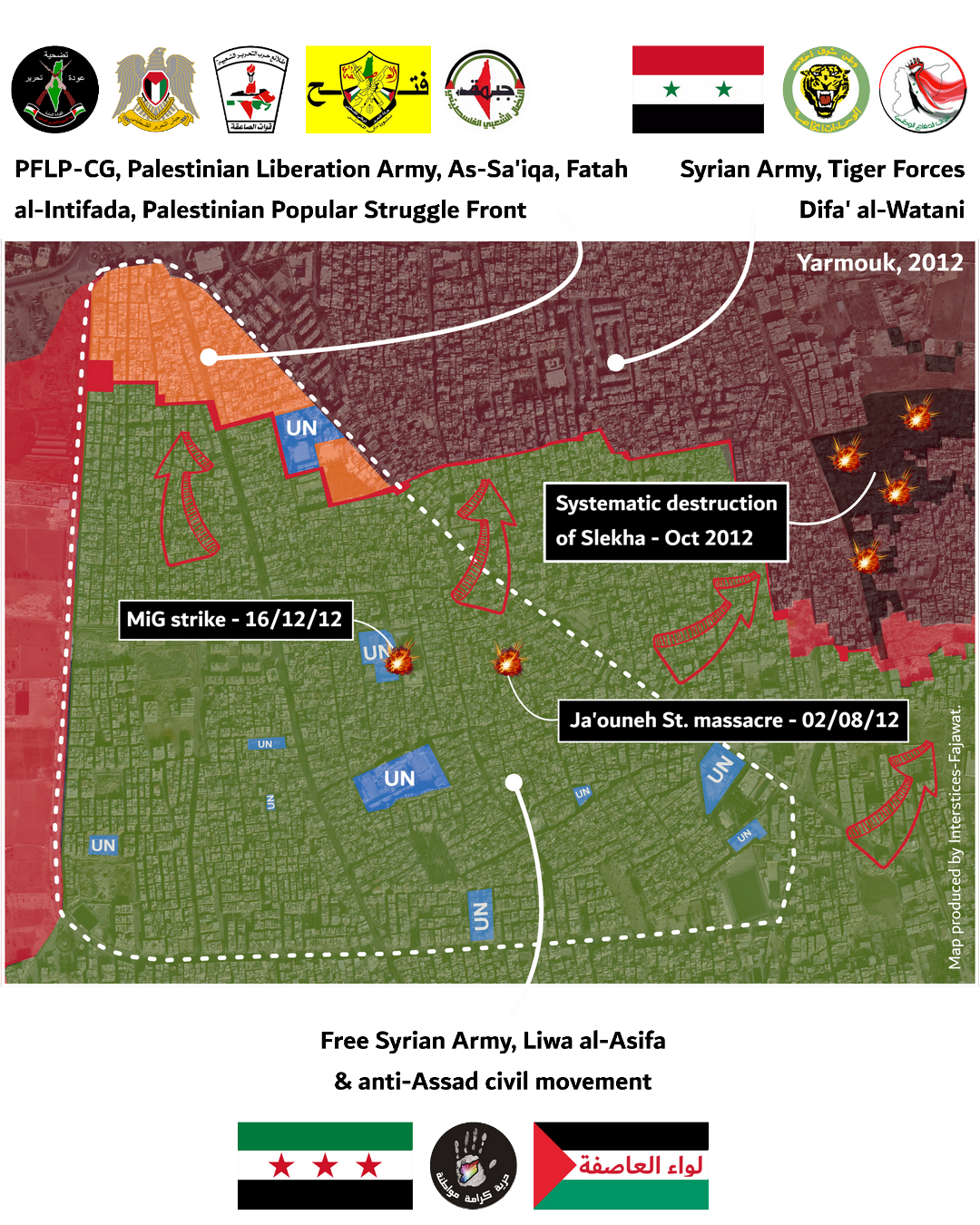
 

With the Assad regime having just fallen and the issue of disarming the Druze and Kurdish communities making headlines, it is worth recalling the highly political history of the Druze community in Syria and Lebanon. Here are a few key points.

The Druze are a religious community attached to a heterodox creed of Ismaili Shi’ite Islam, which originated in Egypt under the leadership of Imam Hamza ibn Ali ibn Ahmad in the early 11th century. The Druze faith takes its name from the preacher Muhammad ad-Darazi, although some of his followers do not recognize Ad-Darazi and he was disowned by Hamza ibn Ali before being executed on the orders of the caliph Al-Hakim bi-amr Allah. The Druze prefer to define themselves as “Muwahideen” (Unitarians) or “Banu Ma’ruf” (Children of Maarouf), although the origin of this term remains uncertain.

The Druze religion, like Sufism, takes a philosophical and syncretic approach to faith, recognizing neither the rigid precepts nor the prophets of Islam. Although this belief spread to Cairo under the Fatimid caliphate of al-Hakim, who was deified by the Druze, it was soon persecuted by the rest of the Muslim community after al-Hakim’s death in 1021, and so the Druze were exiled to Bilad el-Cham (present-day Syria, Lebanon, Jordan and Palestine), particularly to Mount Lebanon and the Hauran. But it was around the beginning of the 19th century that the Druze community in Hauran gained strength, after a large part of the community had been expelled from Mount Lebanon by the Ottoman authorities. The Hauran mountain was then named jebel al-Druze.

The main Druze families and clans in the 19th century

Today, Suwayda governorate is home to the majority of the world’s Druze community, some 700,000 people. The Lebanese Druze are the second largest community, numbering 250,000. In Syria, several Druze settlements also exist in Jebel al-Summaq (Idlib, 25,000 people), Jebel al-Sheikh and al-Juwlan (Quneitra, 30,000 people) and Jaramana (Damascus suburbs, 50,000 people). Finally, outside Syria and Lebanon, the largest Druze communities are to be found in occupied Palestine (Galilee and Mount Karmel, 130,000), Venezuela (100,000), Jordan (20,000), North America (30,000), Colombia (3,000) and Australia (3,000).

The Druze community is structured along traditional clan lines, with large families exerting a dominant influence. Until the mid-18th century, Hauran (or Jabal Druze) was dominated by the Hamdan family, whose hegemony was challenged in the 1850s by Al-Atrash family. The conflict between the two families and their respective allies between 1856 and 1870 was finally settled by the intervention of the Ottoman authorities, who divided the region into four sub-districts, the largest of which was that of Al-Atrash family, comprising 18 villages out of the 62 in Hauran at the time.

Zuqan al-Atrash

Rebellion against Turkish-Ottoman authority…


In 1878, the semi-autonomy acquired by the Hauran was called into question by Ottoman military intervention, which sought to put an end to the conflicts between the Druze and their neighbors in the plain (now Daraa). The Ottoman authorities imposed a new form of governance under the leadership of Ibrahim al-Atrash, and the payment of taxes to the Druze community, particularly to peasants. Between 1887 and 1910, a series of conflicts ensued, first between the region’s peasants and Al-Atrash family, then between Ibrahim’s brothers – Shibli and Yahia – and the Ottoman authorities. In 1909, the revolt against the Ottomans led by their nephew Zuqan al-Atrash failed at the battle of Al-Kefr, and he was executed the following year. His son Sultan took over at the time of the great Arab revolt of 1918…

During the 1914-1918 war, Ottoman rule left Jabal Druze relatively undisturbed. Sultan al-Atrash forged links with the pan-Arab movements involved in the great Arab revolt of the Hijaz (Saudi Arabia) and raised the Arab flag on the fortress of Salkhad, south of the Suwayda region, and on his house in Al-Qurayya. He sent a reinforcement of 1,000 fighters to Aqaba in 1917, then joined the revolt himself with 300 fighters at Bosra, before seizing Damascus on September 29, 1918. Sultan became a general in Emir Faisal’s army and Syria gained independence. This was short-lived, however, as Syria was occupied by the French in July 1920. Jabal Druze became one of the five states of the new French colony.

Sultan al-Atrash

Sultan al-Atrash

…then against French colonialism


Sultan al-Atrash first clashed with the French in 1922, when his host, Lebanese Shi’ite rebel leader Adham Khanjar, was arrested at his home in his absence. Sultan demanded his release, then attacked a French convoy believed to be carrying the prisoner. In retaliation for the attack, the French demolished his house and ordered his arrest, but Sultan took refuge in Jordan, from where he led raids against the French forces. Temporarily pardoned and allowed to return home, he led the Syrian revolt of 1925-1927, declaring revolution against the French occupiers. Initially victorious, the Great Syrian Revolt was finally defeated by the French army and Sultan was sentenced to death. He took refuge in Transjordan, before being pardoned again and invited to sign the Syrian Independence Treaty in 1937. He received a hero’s welcome in Syria, a reputation he retains to this day. When the treaty failed to secure Syria’s independence in May 1945, the Syrians once again revolted against the French occupiers, who sent in the army and killed around a thousand Syrians. In Hauran, the French army was defeated by the Druze under the command of Sultan al-Atrash, before the British intervention that put a definitive end to the French mandate on April 17, 1946.

Editor’s note: the commitment of the Al-Atrash family must be seen in the context of Arab conservatism and nationalism, which did not challenge traditional clan, patriarchal and authoritarian structures. However, their constant opposition since the 19th century to foreign imperialism and the abusive authority of central powers made them precursors in the anti-colonial struggles of the second third of the 20th century. Their struggle can also be seen as carrying within it the seeds of community struggles for autonomy and self-defence, which will be discussed in Suwayda in the recent period (years 2010-2020). Sultan al-Atrash is also known for his stance in favor of multiculturalism and secularism.

الدين لله، والوطن للجميع

Religion is for God, Homeland is for everyone

Resistance to Israeli colonialism


When the British transferred their domination of Palestine to Zionist settlers in Europe and America, and the latter began ethnically cleansing the Palestinians from December 18, 1947, Sultan al-Atrash called for the formation of the Arab Liberation Army of Palestine. Under the command of future Syrian president Adib Shishakli, this army entered Palestine from Syria on January 8, 1948, as part of the First Arab-Israeli War.

Kamal Jumblatt

Only a year apart, on May 1, 1949, Druze intellectual and political leader Kamal Jumblatt founded the Progressive Socialist Party, then he called for the first convention of Arab Socialist Parties in May 1951 and began to establish links with the Palestinian Left Resistance, embodied by the Fedayeen movement. Jumblatt then turned the PSP into an armed movement integrated into the Lebanese National Movement, a coalition of 12 left-wing parties and movements founded in 1969 to support the Palestine Liberation Organization, itself created five years earlier and then led by Yasser Arafat. Jumblatt is the leader of the Lebanese National Movement (LNM).

The entire period between 1952 and 1975 was characterized by growing sectarian tensions between secular left-wing movements – anti-imperialist and pro-Palestinian – and the pro-Western Christian Maronite elites, who dominated the Lebanese political landscape at the time. From 1970 onwards, these tensions were heightened by the significant increase in the number of Palestinian fighters in Lebanon, following their expulsion from Jordan, and leading to a considerable increase in the influence of Palestinian movements in the country. These tensions culminated in the massacres of Palestinian civilians by Christian Phalangists (Kataeb) at Ain el-Rummaneh on April 13, 1975 (30 dead) and at Karantina (between 1,000 and 1,500 dead), followed by the massacre of Christian civilians at Damour (150 to 580 dead) in January 1976.

Syrian President Hafez al-Assad – whose Ba’ath party had until then supported the Palestinian left and its allies – took up the cause of the Christian Falangists and proposed an agreement involving the reduction of Palestinian influence in Lebanon. The PLO refused, and in March 1976, Kamal Jumblatt went to Damascus to express his disagreement to Hafez al-Assad. The following month, the LNM and the PLO took control of 80% of Lebanon, but in June the Syrian army intervened in Lebanon. During the summer, the Christian militias who had been besieging the Palestinian camp of Tell al-Zaatar since the beginning of the year, massacred between 2,000 and 3,000 civilians with Syrian military support. At the end of a six-month confrontation with the PLO and the LNM, a temporary ceasefire was signed, establishing the long-term occupation of Lebanon by the Syrian army and leading to the gradual – then definitive ten years later (1987) – annihilation of the Palestinian Resistance in Lebanon.

On March 16, 1977, Kamal Jumblatt was assassinated by gunmen hired by Hafez al-Assad’s brother, Rifaat. Many left-wing personalities attended his funeral, and Yasser Arafat delivered a powerful eulogy for his ally and friend.

Excerpt from the film “Greetings to Kamal Jumblatt”, Maroun Bagdadi, 1977, 57 mm

Editor’s note: We are not here to idealize Kamal Jumblatt’s character, and we believe that leaders should never be heroes. However, we do not believe that Kamal Jumblatt is guilty of any crimes, nor that he has propagated feelings of hatred based on the ethnic or religious affiliation of his opponents, contrary to what has been conveyed by certain media affiliated to the Lebanese right. Nevertheless, it must be recognized that any armed movement has at one time or another been associated with or directly involved in the commission of crimes or acts of vengeance. This was notably the case with the Palestinian armed factions, and therefore their allies, as in Damour in January 1976. It’s also important to admit when a leader betrays the interests of his community, as in the case of Kamal Jumblatt’s son, Walid Jumblatt. His political choices following his father’s death and up to the present day are relatively dubious, and he does not seem to us to be worthy of his father’s political legacy.

Armed resistance to authoritarian centralism in Damascus


When the 2011 revolt against Bashar al-Assad broke out, Syria’s Druze joined the rest of the Syrian population in demonstrating in the streets of Suwayda and Jaramana, the Druze community district of Damascus.

And when the armed struggle took over from the peaceful demonstrations, Druze officer Khaldun Zein Ad-Din defected from the regime’s army on October 31, 2011. He publically declared his allegiance to the Free Syrian Army and created the «Sultan Basha al-Atrash» batallion, made up of 120 Druze fighters.

Khaldun Zein Ad-Din

Fadlallah Zein Ad-Din

Amira Abu Bahsas

He was joined by his brother Fadlallah Zein Ad-Din in July 2012. Denounced by informers, they are besieged and Khaldun is killed with 16 other of their companions in Tall al-Maseeh on January 13, 2013. His brother announced his death in a statement ten days later. The Progressive Socialist Party of Lebanon organized a ceremony in their honor, and he became the symbol of the revolutionary and opposition movement in Suwayda. On March 21, 2013, his wife Amira Abu Bahsas publicly declared that she too would join her late husband’s battalion, becoming the first woman from Suwayda to join the Free Syrian Army.

During anti-regime demonstrations in Suwayda between 2023 and 2025, Khaldun Zein Ad-Din’s portrait is displayed in Dignity Square, where his parents Sami and Siham actively participated in the protests.

Another form of resistance to Assad’s dictatorship emerged in 2013 in Suwayda, following the forced recruitment of several dozen young men from the region. An influential sheikh in the community, Waheed al-Balous, refused to accept the community’s participation in the war against other Syrians and opposed forced recruitment. He founded the Men of Dignity Movement (“Rijal al-Karami”), which gained in popularity over the years and prevented the conscription of between 30,000 and 50,000 young men from Suwayda.

دم السوري على السوري حرام

A Syrian must not shed the blood of another Syrian

In 2015, Balous openly denounced the dictatorship, leading to his assassination in a double bomb attack on September 4, 2015. On the evening of his death, riots broke out in the region and the statue of Hafez al-Assad that had stood in Dignity Square was removed. It was never replaced. His brother Raafat, wounded in the attack, temporarily replaced him before giving up his position. Waheed al-Balous’s sons, Laith and Fahd, created a splinter group from Rijal al-Karami, the Sheikhs of Dignity (Sheikh al-Karami), which they intended to be politically more radical than their father’s movement. Despite frequent disagreements, the two movements continued to carry out joint actions, even as Rijal al-Karami drew closer to another major faction, the Forces of the Mountain (Quwwat al-Jabal). In December 2024, they joined the Southern Room for Military Operations, which also included other Druze factions and took part in the liberation of Damascus.

Waheed al-Balous

Raafat al-Balous

Laith al-Balous

Fahd al-Balous

Editor’s note: While here too we must refrain from idealizing one faction or another, we nevertheless consider that Rijal al-Karami and associated groups have, in recent years, embodied the Druze community’s imperative for self-defense and self-determination. Whether in the face of attempts by the regime’s army to impose itself by force or coercion, in the face of Islamist aggression or in the face of the predation of the gangs that have proliferated in the region, these factions have succeeded in protecting the civilian population and the general interest without committing exactions or abuses of power. Their leaders have generally answered the call of threatened communities and taken a clear stand against any outside force threatening community security. They also acted as protectors of popular demonstrations and revolts, before spontaneously joining the offensive against the regime in December 2024.

Suwayda at the heart of the revolutionary path from 2011 to 2025


Beyond the few emblematic examples of armed resistance to the authoritarian centralism of Damascus, civil society in Suwayda has never ceased to take a critical or hostile stance towards central power and the Assad dictatorship. Contrary to unfounded rumors that regularly portray the Druze as loyal to the regime, numerous examples demonstrate that the community has always succeeded in reconciling its tradition of resistance with a refusal to take sides in a conflict that very early on became confessionalized – with a very large Islamic religious component within the Free Syrian Army as early as 2012 – and which would have resulted in its annihilation.

Few remember that the people of Suwayda were involved in the 2011 uprising right from the start. As mentioned in our first article, the Suwayda Lawyers’ Guild organized one of the first public demonstrations in March 2011, and as elsewhere in Syria, the Jabal Druze took to the streets in the weeks that followed. To give just a few strong and symbolic examples, let’s recall that one of the main songs of the revolution is “Ya Heif!” (يا حيف – “What a Shame!”), composed and sung by Druze singer Samih Choukheir (Listen by clicking here).

At the beginning of this text, we also mentioned the influence of the Al-Atrash family in the region. Sultan al-Astrash’s daughter, Muntaha al-Atrash, took an early stand against Ba’athist tyranny. In 1991, she publicly tore up a photo of Hafez al-Assad to denounce his involvement with the Coalition in the Iraq war. Saved from prison by her father’s reputation, she joined the Sawaseya Human Rights Organization, becoming its spokeswoman in 2010. At the start of the revolution, she visited rebel areas and publicly called on the Syrian people to join the revolution, before receiving death threats serious enough to convince her to stop appearing in public.

Samih Choukheir

Her daughter Naila al-Atrash, a university drama teacher with close ties to the Syrian Communist Party, was regularly threatened by the regime for her activities, which were deemed subversive. Dismissed in 2001, placed under house arrest in 2008, she took part in the beginning of the 2011 revolt by organizing support groups for people displaced and affected by the conflict, before leaving Syria in 2012. To this day, Naila remains an active supporter of the liberation of Syrians.

Finally, since the assassination of Waheed al-Balous in September 2015, the resistance and revolt against the Assad regime has continued to take shape. It has taken the form of an armed resistance embodied by several popular militias, as mentioned above, but has also largely developed in civil society, with the multiplication of demonstrations and actions that have increased in intensity and regularity since 2020, also as a consequence of the explosion in prices and the cost of living.

To reread in detail the unfolding of these revolts, read our first article published in October 2023:In Southern Syria, the uprising of Dignity has begun”.

Muntaha al-Atrash

Naila al-Atrash

Hikmat al-Hajari

Hamoud al-Henawi

Youssef Jarboua

It is also necessary to know more about the structure of Druze society to understand that the population is not necessarily subservient to the decisions of a political or spiritual leadership. In Suwayda, religious leadership is embodied by three sheikhs, the “Aql Sheikhs”: Hamoud Al-Henawi, Hikmat Al-Hajari and Youssef Jarboua. The political positions of these three sheikhs are neither identical nor immutable, and their relationship with the Assad regime has varied according to periods and events.

Following the assassination of Waheed al-Balous and the attack on Suwayda by the Islamic State in 2018, the dissensions between the three sheikhs became even more aggravated. Initially neutral or relatively loyal to the Assad regime, they began to become more critical, particularly sheikh Hikmat al-Hajari, who took a clearer stance against the regime and gradually established himself as the charismatic leader of the community.

Editor’s note: The positions taken by the spiritual leadership are not binding on the Druze community, which is predominantly secular and does not follow its commandments as may be the case for other religious communities that accept that religion dictates social and political life. Regularly, Druze sheikhs have publicly declared that they support and follow the community’s choices. More recently, Hikmat al-Hajjari’s cautious yet firm stance on Ahmed al-Sharaa’s transitional government, and in particular on the disarmament of factions, has been much criticized by many people, often ignorant of or hostile to the ways of the Druze community, or even hostile to the Druze in general, out of nationalism or religious zeal. Within the community, his positions are also criticized by supporters of factional disarmament, who see it as the main cause of violence within society and seem to trust (a little too much) in the new Islamist central power not to (re)become a threat to the Druze minority…

The Druze, Israel and the Islamists


This last chapter is essential in view of recent events concerning the Druze communities in Syria and Palestine, and the controversies and rumors that have accompanied them. The two most persistent misconceptions concern the Druze’s supposed loyalty to the Assad regime on the one hand, and their supposed sympathy for Israel on the other. If we have invalidated the first theory in the preceding chapters, it seems to us that we need to add some more recent information than that concerning Kamal Jumblatt’s time to invalidate the second as well.

It should first be pointed out that the Druze communities of Palestine (Mount Carmel and Galilee) were integrated by the Israeli colony in 1948, in the wake of the ethnic cleansing of the Palestinians (Nakba). As such, the Palestinian Druze have Israeli citizenship and are subject to compulsory military conscription. Many of them have now accepted this assimilation to the point of supporting the Zionist project and its genocidal policy towards other Palestinians. Their spiritual leader Muafak Tarif is a perfect example of integrationism, cultivating a friendly relationship with the colonial administration and its representatives. He is also quite close to Benyamin Netanyahu.

Muafak Tarif et Benyamin Netanyahu

Location of Druze communities in the Levant

The other Druze community colonized by Israel is that of the Golan Heights, occupied during the Six-Day War in 1967 and officially annexed in 1981. Of the 130,000 Syrians living in the Golan before the invasion, only 25,000 Druze now live on the plateau, in five communes: Majdal Shams, Buq’ata, Mas’ade, Ein Kenya and al-Gager. However, the Druze of the Golan have never accepted assimilation, and almost 80% of them still refuse to take Israeli citizenship.

Israeli leaders persist in trying to win the sympathy of the Golan Druze and never miss an opportunity to claim that they support Zionism, but reality contradicts the propaganda. When, on July 27, 2024, Hezbollah fired a rocket at a soccer field in Majdal Shams, killing 12 children from the community, the opportunistic visits of Benyamin Netanyahu and Bezamel Smotrich to the site and to the funeral were refused by the residents, who booed and branded them murderers.

Finally, when in December 2024 the Israeli army crossed the 1967 border and invaded the Druze villages of Mount Hermon (Jabal al-Sheikh), Zionist as well as anti-Zionist (and campist) propaganda shared the same false information claiming that the residents of Hadar village were in favor of their annexation by Israel. This rumor was initiated by Nidal Hamade, a pro-Hezbollah Lebanese propagandist exiled in France, who posted on his X account a decontextualized video showing a Druze man declaring that he wanted Hadar annexed.

Yet on the same day, representatives of Hadar’s Druze community published a video containing a statement affirming their refusal to be occupied by Israel and denying the false accusations against the Druze.

Unfortunately, rumors often spread more widely than their denials…

For both sides, perpetuating this lie is useful: where Israel has an interest in legitimizing the occupation of Syria’s Arab lands by claiming that its inhabitants want it, the pro-Iranian camp has a clear advantage in keeping alive the myth that Syria’s minorities needed Assad and Hezbollah to protect them from Islamists, otherwise they would turn to Israel. This binarity of analysis feeds on the same campist and feudal logic of thought: “If you don’t place yourself under my protection, then you deserve to be oppressed by my enemy”. And for both sides, the Islamist scarecrow is used to justify the subjugation of civilian populations, insecurity and fear of barbarism (terror) being the colonial powers’ main resources for legitimizing their violations of the conventions and laws of war.

Assad, for his part, has never ceased to present himself as the protector of minorities, using Islamists as pawns to, on the one hand, disrupt the popular revolt against his regime, and, on the other, inflict terror among minorities when and where he needed to in support of his prophecy: “It’s either me, or chaos”.

Hadar residents’ statement, December 13, 2024, Al-Araby TV

In the weeks leading up to the Islamic State’s bloody attack on Suwayda in July 2018 (258 dead and 36 hostages), Assad ostentatiously withdrew all his troops from the region. Then, after the attack, when the population criticized him for not having intervened immediately to block the road to the Islamic State, he responded that it was the fault of the Druze who refused to send their young men into the army. But worst of all, the Islamic State fighters had been transported by bus from Yarmouk (a Palestinian camp on the outskirts of Damascus) to the Suwayda desert a month before the attack as part of a surrender agreement. And, as if that weren’t enough, in November of the same year, a new agreement was signed with the Islamic State resistance pocket in the Yarmouk basin (on the border with Jordan and the Israeli-occupied Golan Heights) for a new humanitarian evacuation to the desert in exchange for the release of the Druze hostages taken by the Islamic State after their attack on Suwayda. It should be noted that these two agreements between the regime and the EI were organized under the patronage of the Russians, who had at the same time made a commitment to Israel to keep any threat from Islamists, including Hezbollah, away from its border.

We discuss the attack on Suwayda by the Islamic State in more detail in our first article published in October 2023: «In Southern Syria, the uprising of Dignity has begun«

And to conclude: As Islamists have often been the useful idiots of imperialism on all sides, it should come as no surprise that the Druze of Suwayda are in no hurry to hand over their weapons to the new power in Damascus, since Ahmad al-Sharaa has been the representative of the two Islamist movements, DAESH and Jabhat Al-Nosra, which have violently attacked the Druze over the past decade. And that certainly doesn’t make them Israel’s allies, whatever supporters of Iran and Israel may think.

Anti-Arab hatred and white supremacy, the seeds of Zionism (to translate)

Anti-Arab hatred and white supremacy, the seeds of Zionism (to translate)

About the author: Cédric Domenjoud is an independent researcher and activist based in Europe. His research areas focus on exile, political violence, colonialism, and community self-defense, particularly in Western Europe, the former USSR, and the Levant. He is investigating the survival and self-defense of Syrian communities and developing a documentary film about Suwayda, as part of the Fajawat Initiative.
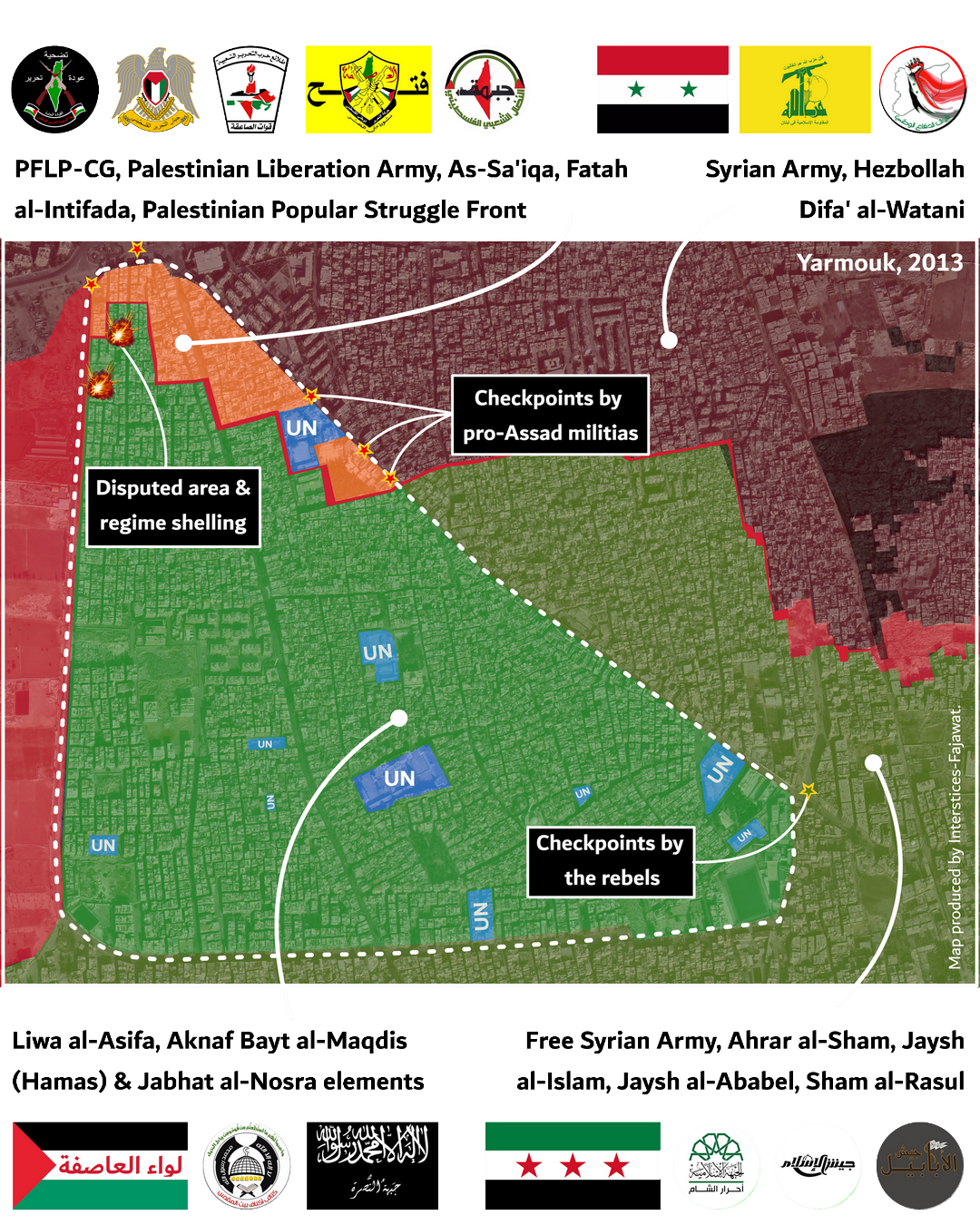
 

This article, authored by an individual whose personal trajectory has been deeply influenced by his family history, employs a rigorously anti-fascist and anti-authoritarian analytical framework to argue that Zionism is historically rooted in traditions of white and Germanic supremacist thought.

Context

The military operation in response to the bloody attack by the Palestinian resistance on the Israeli settlements adjacent to the Gaza ghetto on 7th October 2023 quickly became the scene of war crimes against the Palestinian civilian population. Let’s start by recalling the true toll of the Hamas attack on several military bases and settlements in southern Israel[1] on October 7, 2023, as well as a music festival: in the course of the armed action, 1,139 people were killed, including 695 civilians (among them 71 foreigners and 36 children) and 373 members of the security forces (305 soldiers, 58 policemen and 10 members of the Shin Bet intelligence service)[2]. Hamas also captured 251 hostages (including numerous military personnel) in order to exert pressure on the State of Israel, in particular to obtain the release of hundreds of Palestinian prisoners, over 1,300 of whom were being held without charge or trial before October 7th[3].

In retaliation, the Israeli army claims to have killed over a thousand Hamas fighters who took part in the attack, while independent investigations, as well as the testimonies of a number of surviving Israeli civilians, also blame the IDF for the death of a significant number of Israeli civilians, among those officially attributed to Hamas. Experts refer to the application of the “Hannibal Protocol”, a 1986 Israeli directive which advocates avoiding as far as possible the need to negotiate the release of hostages, even if it entails killing one’s own nationals held hostage during the planned assault to free them. One thing is certain: this bloody adventure by Hamas has legitimized an unprecedented outpouring of violence by Israel, which has been condemned by the International Court of Justice for acts of genocide against the Palestinians of Gaza.

The rules of conventional warfare were in fact widely violated, first by the proscribed practice of siege, blocking the population’s water, electricity and food supplies, then by the combined use of weapons banned by international conventions (chemical weapons such as white phosphorus), snipers and killer drones targeting unarmed civilians, as well as the carpet bombing of residential areas, refugee camps, humanitarian NGO vehicles and premises, places of worship, schools and hospitals. On the top of that and from the very first weeks of the operation, dozens of humanitarian workers, working doctors and journalists were killed or arrested and transferred to detention centers without trial.

Social media tell the truth

The images produced by the Israeli regime’s and army’s communication services have not sought to conceal the use of inhuman and degrading treatment against the prisoners, who do not benefit from the status of prisoners of war, nor of hostages, either status implying the adoption of specific procedures and negotiations for their continued detention or their release within the framework of negotiations between the parties to the conflict. The IDF soldiers themselves did not stop communicating from the first day of the operation on social media, and in particular on Tiktok and Telegram, boasting almost daily of committing crimes and broadcasting damning videos testifying to their dehumanization of the Palestinians. More on this aspect further on.

War crimes have therefore been fully documented by the international community, NGOs and the media, including the Israeli media. In addition to conventional institutions and structures, social media have also widely reported on these crimes, and must be considered legitimate sources of information insofar as they transmit raw testimonies from an area directly affected. As such, these resources have as much evidential value as the testimonies of victims and civil parties, as well as the confessions of perpetrators in criminal trials, regardless of the subsequent use made of the images thus made public. What’s more, user accounts, as well as the locations and dates of video recordings, can easily be verified and fact-checked by experts and investigators, making it impossible to consider them fabricated or manipulated: the vast majority of the thousands of megabytes of data from Gaza CANNOT be the result of fake news and computer-generated images, as some claim. Societies have evolved, and taking modernity into account means recognizing new information and communication modalities as legitimate, not least because they guarantee a greater diversity of sources than the mainstream and national media.

However, we know how embarrassing it is for governments to have to deal with media that avoid their control, hence their constant efforts to obtain total censorship of critical content shared on social networks.

Self-defense or retaliation?

Once we have ruled out the negationist or revisionist hypothesis, which implies denial of the reality of the crimes committed by the Israeli army against the Palestinians, what remains to be examined is the motivations behind these crimes and their intentional nature.

The notion of intentionality is crucial for several reasons. Firstly, because it makes it possible to distinguish self-defence from revenge or retaliation, and secondly, because it makes it possible to identify the real purpose of the act of violence or crime. Self-defence, a basic rule at the crossroads of natural and positive law, defines the circumstances in which a person can be killed or harmed without fear of punishment. To define precisely the circumstances in which self-defence can be invoked, the law has identified a number of criteria which must be met for self-defence to be deemed legitimate: the threat must be real (not imagined or supposed) and imminent (not prior to the moment of response), the response must be immediate (confined to the source of the threat and without delay, otherwise it would be retaliation), necessary (there must be no other way to avert the threat) and proportionate to the threat (just enough to neutralize the threat). At its origins, this rule was thought to enable the individuals lacking legal authority to protect themselves in the event of aggression, but also to be protected from any sanctions or legal proceedings if they have used violence to defend themselves from others violence. Over the past decade, however, the legal authorities (whom we would like to believe to be legitimate), i.e. the State and its representatives, have progressively changed the discourse and laws to appropriate rules of law reserved exclusively for those subject to the law.

If we take a step back and refer to the overall theoretical context in which these developments took place, we can only draw parallels with the argument mobilized by the State of Israel and its allies to legitimize the relentless massacre of Gaza’s Arabs, based exclusively on its “right to defend itself” following the Hamas attack of October 7th 2023. The highly pragmatic questions the world should have been asking were: Was the threat posed by the population of Gaza to Israeli society a real one? Was the response – the total annihilation of an enclave inhabited by over two million people – necessary and proportionate? If the criteria of imminence and immediacy are indeed met on the surface, it would have been necessary to ask a final question to invalidate Israel’s argument regarding the legitimacy of its response: Was the Hamas attack part of an ongoing context of oppression and colonial violence on the part of Israel, or was it a gratuitous act of aggression responding to no threat to the people of Palestine?

Before answering this question, it is absolutely necessary to recall historical events such as the Warsaw ghetto uprising of 1943 (against Nazi siege) or the Soweto township riots of 1976 (against South African apartheid regime), and to draw the necessary parallels: The state of Israel is neither colonized nor oppressed; it is the colonizer and the oppressor. As such, it can under no circumstances claim self-defense, for if we follow this logic, France would have been legitimated in erasing the entirety of Iraq and Syria from the map following the Islamic State’s attacks on Paris in 2015. And in response, any Arab country would be justified in bombing Western cities whenever NATO armies forcefully interfere in its national affairs. Clearly, the logic legitimizing mass arabicide doesn’t hold water. And yet, this is exactly the logic that led the United States to permanently destroy Iraq between 2003 and 2011, on the pretext of a nuclear threat which the best analysts knew to be totally implausible. The West always has a fallacious motive for destroying Arab societies.

Beyond the violence and horror of the Hamas attack, no one can decently deny the absence of any compelling necessity justifying the annihilation of the Gaza Strip from October 8th onwards, nor the total disproportionality of the means employed to this end, given that the attackers on October 7th were largely decimated or taken prisoner during their attack (1809 fighters according to Israel) and that the 5000 rockets fired by Hamas were largely intercepted, killing no more than five people in all: the main and imminent threat was therefore neutralized by the evening of October 7, and strict self-defence only applied to the Israeli response on the same day. Revenge, on the other hand, is characterized by premeditation and/or moral inflection, i.e. the anticipation or preparation (including mental preparation) of the crime, with the intention of not acting ethically. Lastly, while the real motivation or purpose of armed action is often unofficial, even secret, and therefore open to interpretation, in law there are what is known as “array of presumption”, which makes it possible to establish whether there are criminal motivations, particularly racist ones. In the context of Palestine, these grounds for presumption include acts and public declarations that demonstrate a desire to essentialize the entire population of Gaza and to assimilate it as a whole to a specific group, in this case Hamas. This essentialization involves the use of reductive and simplifying terminology that erases the complexity and diversity that characterizes any civilian population, especially if it includes several thousand people. In the case of Gaza, we’re talking about 2.23 million inhabitants, including a multitude of ethnic, religious and political minorities, as well as thousands of dual nationals and 1.046 million children under the age of 18 (48%).

Hamas is in power in Gaza, but the Gazans are not Hamas

If we go back to the origins of the Hamas movement, we note that it was born late in 1987, almost 40 years after the creation of Israel. Before it, Palestinian resistance had been embodied by nationalist, socialist and secular political movements, including Fatah, founded in 1959. These movements globally renounced armed struggle at the end of the first intifada (1987-1993) to invest in peace negotiations, while remaining in solidarity with popular resistance to the Israeli apartheid regime. The perpetuation of violent oppression of the Palestinians despite the peace talks was the primary reason for the emergence of Islamist forces in Palestine, which coincided with the confessionalization of territorial conflicts in the region during the Lebanese civil war (1975-1990). Israel played an active part in this confessionalization, notably by supporting the Lebanese Christian militias, while encouraging the emergence of Hamas to weaken the socialist and non-confessional Palestinian organizations (PLO: Fatah, PFLP, DFLP, PPP, PLF…).

The imprisonment and death of political leaders involved in negotiating the peace agreements[4], followed by the second intifada (2000-2004) and the Lebanese war in 2006, accelerated the rise of Hamas in Palestine and Hezbollah in Lebanon. Finally, in 2006, Hamas won the elections in Gaza with 44.45% of the votes cast, while the secular nationalist and socialist political forces remained in the majority but divided (Fatah + PFLP + The Alternative + Independent Palestine = 51.32% of the vote). If we look back at these elections in detail, and take into account the abstention rate of 22.82%, then just 32.61% of registered voters chose Hamas. If we consider that 34.17% of the Palestinian population was either not registered to vote or not of voting age, only 11.14% of the 3.95 million Palestinians at the time actually chose Hamas.

Over the following decade, Hamas established itself as a conservative force that is intolerant of criticism and represses all forms of opposition, making itself relatively unpopular, as evidenced by a poll carried out in June 2023 by the Palestinian Center for Policy and Survey Research : 73% of Gazans consider that there is corruption within Hamas, 59% believe that Hamas cannot be criticized without fear, 57% would vote for Marwan Barghouti (Fatah) if he were free rather than for the Hamas candidate, while 43% believe that neither Hamas nor Fatah deserve to represent the Palestinians. Furthermore, 47% of Gazans favor peaceful resistance over armed struggle[5]. Finally, since the last elections were held 18 years ago, almost 78% of the current population was not born (48%) or of voting age in 2006 (30%), not to mention the fact that part of the population, and therefore of Hamas voters, has died in the last 18 years. As a result, we can say that the population of Gaza in 2023 has little or nothing to do with the election of Hamas in 2006, nor much to do with the fact that it has held on to power by force ever since.

Hamas: a reactionary movement

What’s more – and this is often overlooked when talking about Palestinian resistance – the process of essentialization also affects Hamas militants themselves. Notably, Hamas’s historical affiliation with the Muslim Brotherhood (and therefore with political Islam) is denied, and it is compared with jihadist currents, or even regularly equated with Al Qaeda or the Islamic State. Numerous intellectuals and specialists, most of whom cannot be accused of being Islamist sympathizers, have written a multitude of university theses and books on the history of Islam, as well as on religious and political currents within Islam. All these studies make it possible to understand why the Muslim Brotherhood is not jihadist, and why the institutionalization of political Islam almost systematically leads these currents to moderate their exercise of power[6]. The orientalism that characterizes the analysis of Muslim and Islamist currents today also clashes with the reality experienced by Arab and Muslim populations confronted with these movements.

What this reality says is that the Muslim Brotherhood is a moderate threat, both to the population under its control and to its neighbors, or in other words just as pervasive as any authoritarian political party or movement in power. Indeed, Hamas’ despotism against the civilian population stems not specifically from its religious radicalism, but more from its desire to maintain a hegemonic hold over the Palestinian society. In the same way as any far-right current in the world, Hamas is an authoritarian party bearing conservative and retrograde values in many respects, but it is not a Salafist or Jihadist movement: Hamas, however violent, does not behead or burn anyone alive. Finally, the motivations behind the commitment of Hamas fighters must also be assessed in the light of the situation of strangulation and continual oppression of the Palestinian population for 75 years, as well as the blockade imposed on Gaza by Israel for 16 years, entailing an unemployment rate exceeding 45% and an overall lack of prospects for young people. Hamas militants aren’t waging jihad, they’re joining the only decolonial armed movement that claims to oppose normalization and build a balance of power with the Israeli apartheid regime. The number of fighters affiliated to Hamas is not known, the only figure given by Israel is 30,000. Given the reality of the region, and in particular the numbers of other Islamist militias (notably Hezbollah), it is unlikely that the real number of Hamas fighters exceeds 20,000 men, which does not indicate massive support for the movement among Gazans.

The anti-terrorist smokescreen

It’s easy to see why Israel, in its efforts to dehumanize the Palestinians and discredit Palestinian resistance, finds it comfortable to use anti-terrorist rhetoric: like all authoritarian and colonial regimes, Israel refers to those who resist its oppression as terrorists. This newly universally accepted semantics reveals not only the ignorance and narrow-mindedness of those who employ it, but also their intention to reduce any armed resistance or radical or revolutionary opposition to a mere threat. Under the guise of protecting the civilian population from a threat to their security – which is not its actual motivation – counter-terrorism is first and foremost a tool of counter-insurgency to protect the security and interests of the state. Henceforth, simply designating a group as terrorist is enough to instantly deprive its members of every right and protection normally guaranteed by the laws of war, humanitarian laws and international conventions for the respect of human rights and dignity.

Moreover, the term “terrorist” has no precise legal definition, making it a vague notion entirely open to interpretation. Thus, in addition to the term “barbarian”, it is used to deprive individuals of their status as human beings, making public humiliation, summary executions, torture, mutilation and bodily harm lawful and acceptable. France in Algeria, the USA in Vietnam, Afghanistan and Iraq, Russia in Chechnya and even China in Xinjiang have all contributed to the normalization of cruel practices that are illegal under UN conventions. When Israel crosses the red line even further, it does so by assimilating the entire civilian population of Gaza to terrorism, claiming complicity with Hamas, including under-age children who, as already mentioned, make up almost half the population of Gaza. By encouraging the dissemination of blatant lies about Hamas’s acts of cruelty during the bloody attack of October 7th 2023, and in particular the alleged beheadings of some forty children and serial rapes[7], Israel knew perfectly well that barbarity and terrorism would be the appropriate lexical register to legitimize all the war crimes that were to be committed in retaliation against Gazans. This is part of Israel’s propaganda strategy, the Hasbara, which is part of Zionist lobbying aimed at countering negative discourse delegitimizing Israel.

The demonization of the Palestinians in order to convince the world that their annihilation is justified is thus combined with historical revisionism regarding the way in which the State of Israel was built and imposed by violence, and denial of the crimes committed by Zionist militias before 1948 and by the Israeli army since. For instance, we’re supposed to forget that the Zionist Irgun militia carried out bomb attacks against civilians as well as the British police in the years before the creation of Israel[8], before its leader Menachem Begin became Prime Minister and then Minister of Defense of Israel thirty years later, conveniently cleared of his crimes. The State of Israel is therefore the best showcase of victorious, unpunished terrorism. Thus, the question is: who decides who is a terrorist, and for how long?

Nevertheless, the concept of terrorism is an extremely useful tool for designating popular resistance, whatever its ideological basis. Beyond that, it is the Arab communities as a whole that are targeted. The Arab has become the practical enemy number one, the scapegoat who bears responsibility for any popular resistance to the hegemonic and civilizing will of the West. A single armed attack by a marginal individual or group from Arab-Muslim communities is enough to legitimize the elimination of tens of thousands of Arab lives. Collective punishment has thus become normalized. And we can talk about the slow death of the Palestinians because it’s in the news, but we mustn’t forget that Western interventions in the East since the late Middle Ages have all been guided by the same messianic desire to reclaim the “Holy Land” from the heretic or godless barbarians who inhabit it, that is to say the Arabs[9]. What changed in the second half of the 20th century was the rhetoric, but not the motivations. Ever since the Western nations set themselves up as the enlightened vanguard and promulgated their laws of war and all kind of humanitarian conventions, before granting independence to a number of countries after decades of racial supremacy, colonial plunder and slavery, they have indeed been forced to renew their rhetoric in order to continue justifying imperialist wars waged in the name of the Global Market, particularly where oil and gas abound. And what better theme than the familiar theme of the barbarian from the East? And yet not just any ordinary barbarian, fighting a battle that respects the laws of war, and whose cause is seen as legitimate by a section of the people and the Western left. No, rather it is the paroxysm of the barbarian, monstrous and cruel, who terrifies anyone who imagines him close to them. The West will call this barbarian a “terrorist” for simplicity’s sake. And if it doesn’t exist, we’ll have to help create it, or help it create itself, the crucial thing being that it frightens any ordinary people sufficiently for them to accept its death without further ado. This monster is the Muslim terrorist, who in the Western imagination resembles the vile and brutal Arab embodied by Mohammed Hassan aka Frank Lackteen in American movies of the 1930s-40s, as well as 78% of characters from the Near and Middle East appearing in American TV series[10].

Therefore, as soon as an Arab or Muslim launches a surprise attack or detonates a bomb here or there, it must be clearly understood that this is a specifically odious act, which has of course nothing to do with the attacks carried out by the Resistance to Nazism during the Second World War, the annihilation of Nagasaki and Hiroshima in 1945, the counter-insurgency actions applied by the French army and police against Algerian civilians between 1945 and 1962, the bombing of the American black group Move in the middle of the city by Philadelphia police in 1985, or the targeted assassinations regularly carried out using drones or remote-controlled missiles by the armies of the major democracies[11]. What sets them apart, though, is precisely the racist prism through which the perpetrators of these acts of violence are identified. Some, who can be described as villains, are by nature the aggressors, while the others, who are obviously good guys, necessarily act in self-defense. The former kill indiscriminately to terrorize and generate chaos, while the latter “neutralize targets” to restore peace and security. Beyond the ironic nature of these last sentences, we must realize just how close these caricatures are to the discourse commonly served up by the world’s political and media elites, and adopted by the majority without any real critical suspicion. There are no good terrorists, only bad Arabs and bad Muslims. But when a white man massacres dozens of children in an American school or stabs Arabs in a French town[12], nobody uses the term terrorist. It’s an “appellation d’origine contrôlée”.

Eretz Yisrael, a white Lebensraum in the Wild-East

In Gaza, Israël commits crimes, that has been established. The only thing that does not meet with consensus is the justification/legitimization of those crimes. We therefore need to look at what is known in law as the “motive for the crime”, which brings us back to the “array of presumptions” mentioned above. This requires an analysis of the organic relationship between Israel, Europe and North America. We won’t be going around the bush here: we want to address the ideological proximity of Zionism and German nationalism, both of which combine a colonial project with racial/national supremacism. In addition to considering the defended race or nation as superior or chosen by divine will (messianism/millennialism), both nationalisms agree on the possible – and therefore morally acceptable – subjugation or annihilation of other nations or races deemed backward or inferior. The more moderate versions of these nationalisms[13] are confined to evoking the need to bring progress and development to populations frozen in the past, usually under the guise of modernism. Such is the case with Zionism.

This ideological movement was initiated by the Austro-Hungarian journalist and writer Theodor Herzl (1860-1904) in 1897. Since then, numerous international Zionist congresses have been held, setting up structures to encourage the diaspora to perform its “aliyah” (ascent), i.e. to settle in Palestine, which had been under Ottoman (Seljuk Turkish) rule since 1517, and then under British occupation from 1920. Herzl’s personal views were deeply influenced by German supremacist theories, and he saw his move to Palestine as a hygienic project aimed at civilizing Eastern peoples, including the indigenous Jews. His anti-Zionist detractors, such as Abraham Shalom Yehuda (1877-1951), a Jew from Palestine, and Reuven Snir (b. 1953), a Jew from Iraq, mentioned some eloquent passages in Herzl’s memoirs, published in 1960: “It is God’s will that we return to the land of our fathers, we shall in so doing represent Western civilization, and bring the hygiene, order and pure customs of the West to this pestiferous and corrupt piece of the East […] It is with the Jews, an element of German culture that will approach the eastern shores of the Mediterranean […]. The return of the semi-Asiatic Jews under the rule of authentically modern people must undoubtedly mean the restoration of health in this neglected part of the East”. In this respect, we can draw a clear parallel with the thoughts and writings of Herzl’s contemporaries, the geographer Friedrich Ratzel (1844-1904) and the philosopher Karl Haushofer (1869-1946), and in particular with their theory of “Lebensraum” (living space). This theory largely inspired the supremacist theories developed by Hitler in Mein Kampf, even though Ratzel imagined a colonial settlement of the German people in the heart of Africa (Mittelafrika), rather than in Eastern Europe as advocated by the ideologues of Nazism. In any case, both Ratzel and Herzl placed their colonial and civilizing ambitions beyond the Mediterranean, which makes them similar to many Western imperialists of the 19th and 20th centuries.

What the end of the twentieth century brought was a renunciation of the overtly racialist approach of Western imperialism, and with it, a certain (albeit relative) moralization or weighting of essentialist discourses relating to the populations of the South from the late 1970s onwards. However, the turn of the 1990s and the emergence over the last two decades of Arab[14] and Islamist terrorism have renewed Western supremacist discourse, which, while failing to openly display its racist bias, has imposed the idea that the defense of Western democracy can only be achieved through the suppression of Arab nationalism, which is always conveniently equated with Islamist fundamentalism, even though the two are often opposed. The idea of the besieged citadel and the rampart against barbarism from the East, which has its origins in the pre-medieval period, has found a new lease of life: it is no longer the Roman Empire that is in danger, but Western Democracy in its broadest sense, which implies that the stakes go beyond the safeguarding of European and North American societies alone to become the preservation of the entire “civilized world”, the boundaries of which nevertheless remain very blurred.

Good versus Evil, or the civilization versus the desert

Hannah Arendt (1906-1975) was a German philosopher, political scientist and journalist of renowned reputation, who conducted an in-depth analysis of the forces driving modernity and totalitarianism, based in particular on the experience of Nazi horror. While many know or claim to know her work on the banality of evil, namely that the worst atrocities are often permitted or committed by ordinary, even insignificant people, few actually give due importance to her analysis of the complicity of victims in their own persecution, through cowardice, naivety or wait-and-see attitude. In particular, Arendt had revealed the involvement of the Jewish Councils (Judensräte in German) in the deportation of Jews to Auschwitz, provoking a heated controversy that cost her some of her friendships[15]. Without going into the details of the controversy, which testifies to the inability of most people to put aside their own egos and survive their withering[16] in the face of the revelation of a truth that is painful to hear or facts that are difficult to admit, her writings tell of the impossibility for Western societies to conceive and accept the idea that barbarism has its source largely within themselves. It’s interesting to note that the advance of the desert[17] that Hannah Arendt also spoke of, describing the rise of totalitarianism from within Western societies, can be the result of a population that is in itself a victim of such totalitarianism. In this respect, it is extremely revealing that, having been persecuted for millennia in the West, a considerable part of the Jewish community has become convinced that, by moving beyond its borders, it could not only find peace and security there, but that it would also constitute an outpost of democracy in the face of barbarism, at the very limits between civilization and the desert. It would be nothing less than civilizing the East while re-civilizing the West. In any case, this is how Zionism perceives its presence in Palestine, and how the United States justifies its unconditional support for Israeli colonization: Israel would be the bulwark of the moralized (yet unlivable for Jews) West against the unbridled violence of Arab “Mordor”[18] – which by the way did not take part in the Holocaust. It’s comfortable to imagine an external enemy from which we can separate ourselves with a simple wall, when reality and historical experience demonstrate that more often than not the enemy is within us or among us. In the paradigm inversion represented by the Zionist colonization of Palestine, the conceptual desert of which Arendt spoke is embodied by these settlers from the West, while the natural and inhabited desert facing them is placed in the position of being subjected to their own totalitarianism. The paradox is such that the Zionists, who have come in search of greener pastures elsewhere, find themselves burning down centuries-old olive trees to plant conifers everywhere, contributing to the impoverishment of an entire ecosystem to which they are total strangers[19].

The fanatical settlers who are expanding their presence into the heart of the West Bank under Palestinian authority are making no secret about the fact that they’re setting up more and more – illegal – outposts there, in response to a supremacist imperative that sees Arabs as a population to be expelled or eliminated in the name of a metaphysical battle of Good versus Evil. The expression of this duality takes the form of violently racist rhetoric on a scale not dissimilar to that used by Nazi theorists against Jews. In 2009, Yitzhak Shapira and Yosef Elitzur, rabbis from the settlement of Yitzhar, located five kilometers south of Nablus, published a book entitled “Torat HaMelech” in which they defended the idea that Jews were authorized by religious edicts to kill non-Jews, including children, in certain circumstances. These genocidal writings were supported by Dov Lior, rabbi of Hebron and Kiryat Arba, and charismatic leader of the Israeli Zionist far right, who has also repeatedly justified the murder of non-Jews, inspiring a whole fringe of the Israeli right with his hate-filled speeches. In the same spirit, in 2012 Rabbi Eyal Karim, currently rabbi of the Israeli armed forces, had justified the use of rape by soldiers in wartime, considering the matter in these terms: “Since our priority is the community’s success in war, the Torah has allowed [soldiers] to satisfy their evil urges under the conditions it has stipulated in the name of the community’s success”. The “anti-Goyim” and anti-Arab preaching of these rabbis feeds the racism that justifies the commission of crimes in the name of the survival of the Jewish people, and has an immense influence on hundreds of thousands of Israelis. Since then, the religious fundamentalists who have made the colonization of Palestine a messianic issue have gradually infused their supremacist and fascist ideas into the highest levels of the Israeli state. Their racist, millenarian vision is perfectly illustrated by Israeli Prime Minister Benyamin Netanhayu’s speech, delivered on October 26, 2023 to justify his latest military offensive against the Palestinians of Gaza: “We are the sons of light, they are the sons of darkness, and light will prevail over darkness […] Remember what Amalek did to you [20]. When he invokes the extermination of the “seeds of Amalek” the reference is not religious but ethnic, insofar as Islam post-dates the period concerned by the use of this notion, designating an ancient people of Sinai in conflict with the Judeans: the Edomites (8th to 5th century B.C.). Beyond that, it’s a promise of vengeance that has its origins in national mythology. At the same time, many other representatives of the Israeli government and parliament have made one racist statement after another, condoning the mass murder of Palestinian Arabs, while the Israeli army has engaged in the deadliest military operation in Israel’s history, ethnically cleansing the Palestinians in Gaza, with no international body or state taking the necessary steps to stop the massacre[21]. But this is nothing new: for many years, the Revisionist Zionist current to which most members of the Netanyahu government claim to belong[22], including himself, has been multiplying public statements targeting Arabs. Long before October 7th, the Israeli right was marching in the streets with the slogan “death to the Arabs”, which has appeared more than once in the last decade on large banners carried by demonstrators. In addition, the practice of “price tag attack” initiated since 2008 by extremist settlers close to the current Minister Itamar Ben Gvir includes the spraying of hate graffiti and the commission of violently anti-Arab acts of vandalism. Ben Gvir, along with Bezamel Smotrich and other representatives of the Israeli government, have constantly called for the destruction of Arab communities, using openly racist rhetoric that has nothing to do with the fight against radical Islam or terrorism[23]. Their inflammatory rhetoric is not aimed at Islam, but very clearly at Arab ethnicity. The Pandora’s box opened by religious eminences and by the Israeli political representatives to whom they are close has legitimized the unbridling of public discourse in Israel, leading a number of public figures to express unmistakably racist and supremacist views without suffering any backlash. One of the most telling examples is TV presenter Tzofit Grant’s statement about Palestinians in Gaza during a TV show in December 2023: she called them “disgusting, stinky losers, walking with flip-flops. Repulsive people.” That says it all. Finally, when Yoav Gallant refers to the Gazans as “human animals”, the choice of lexicon is again socio-ethnic rather than religious. There’s no need to list all the racist statements made publicly by influential Israeli figures to understand that anti-Arab racism is the primary motivation behind Israeli policies.

Israel, the embodiment of white supremacy and anti-Arab racism

If I draw this parallel with the situation in Palestine, it’s because it perfectly embodies all the paradoxes of Northern (Western) societies in their relationship with Arab societies in particular, and of formerly colonized societies in general, but also because the majority of Israelis come from these Northern imperialist societies. As such, they are allochthones, importing into the Middle East an ultra-individualistic, ethnocentric and neoliberal way of thinking typical of Northern societies. Considering themselves to be at the cutting edge of civilization and democracy, the vast majority of Israelis (the Zionists) never conceive of the Arab world as their equal, and deny the very reality of Arab cultures and progressivism: for them, Arabs can be neither modern nor democratic. Arabs are merely an obstacle to capitalist modernity, and as such their eradication alone becomes the guarantee of social order and peace. With the genocide underway in Gaza since October 8th, 2023, Europe’s far right has massively united with the State of Israel, so much so that its approach to Arabs is a model of effective Arabicide. Hatred of Arabs and Muslims has overtaken their historical anti-Semitism, and they seem to have suddenly reconnected with the Jewish part of their Judeo-Christian identity, while denying the Semitic part of Arab identity.

Since September 11, 2001 and the launch of the U.S.-initiated War on Terror, the international community, made up of the most influential states (UN, NATO, G7, G20) and their client-states, have rallied behind the American neo-conservatives and their ideological and military crusade against the Muslim world. It should be pointed out that Arabs are not in the majority in the Muslim world, over 60% of Muslims being Asian (Indonesia, India, Pakistan, Bangladesh) and 15% sub-Saharan (Africa). However, the Western crusade against “terrorism” is essentially focused on the Arab world and the former Persia (Afghanistan, Pakistan, Iran). In any case, the accusation of terrorism is sufficient in itself to legitimize all forms of violence against targeted individuals or groups: administrative detentions without charge, extra-judicial assassinations, torture, sieges and cutting people off from food and resources, expulsions and deportations, as well as “carpet bombings” of residential areas accused of harboring or supporting terrorist groups[24]. The laws of war have been subject to so many derogations that they have become obsolete. War crimes are even legitimized by military doctrines such as the Dahiya doctrine outlined by Israeli Chief of Staff Gadi Eizenkot in 2010, after having been applied by the Israeli colonial army in Lebanon in 2006. This doctrine authorizes the asymmetrical and disproportionate use of force to put pressure on hostile regimes, notably by systematically destroying civilian infrastructure linked to the enemy, even if this bombardment involves the massacre of hundreds of civilians.

There can be no doubt that the strategy employed in Gaza since October 8, 2023 is the strict application of this doctrine, with the cities of Gaza, Jabalia, Deir-el-Balah, Khan Younis, Rafah and their outskirts (2.14 million inhabitants on 365 km², i.e. 5967 inhabitants/km²) having been bombed intensively, inducing the assumed massacre of 40,000 to 200,000 Palestinian civilians who obviously bear no responsibility for the October 7th attack. The very notion of “collateral victim”, which was already unbearable enough, is no longer put forward, as the genocidal Israeli government asserts without trembling that all Gazans are linked to Hamas and that they are “animals”[25]. It is therefore, in the Hebraic sense of the word, a holocaust[26], and therefore genocide.

This racist and genocidal rhetoric, implicitly endorsed by all Israel’s allies, led by all the former colonial powers, echoes the racist and Islamophobic rhetoric commonplace throughout the European political class, from the far right to the center left, and now also by the social democrats and liberals who still call themselves socialists in several countries. What’s more, even the radical left has long since taken up the clichés against terrorism, incapable of offering a serious, intelligent critique of the notion, the way it is used, but above all of the totalitarian slide that the abused use of this notion entails. Ethnocentrism of the Whites (let’s call a spade a spade) means that every time there is an armed attack against their people, their interests or their territory, a sacred union declares the homeland or democracy threatened, even though the main victims of terrorism since the 1970s have been Muslims. Afghanistan, Iraq, Somalia, Nigeria, Burkina Faso, Pakistan, Syria and Yemen have been the worst-affected countries over the past fifteen years. In Iraq and Syria, Islamist groups linked to Al Qaeda and the Islamic State have mostly killed Muslims[27]. And when the international community intervenes militarily in response to terrorism, it destroys civil societies already targeted by armed groups, and thereby sustains the disastrous breeding ground for hatred and fundamentalism. All the more ironic – and this is what societies in the North refuse to understand (or consciously deny) – is that “terrorism” is in reality a self-defense reflex of societies or individuals crushed by capitalism and the imperialism that flows from it.

What this reality continues to successfully conceal is that the motivation and objective of imperialist wars is never the establishment of peace and democracy, but rather the maintaining of a chaotic status quo entirely compatible with capitalist predation and the plundering of resources it entails. In none of the countries where the United States and its allies have intervened since the 1960s has a lasting democratic regime been established – quite the contrary. Any Arab democracy, on the contrary, would threaten the Western economy because it would be accompanied by self-management of its resources and a likely challenge to the economic hegemony of the countries of the North, while allowing its nationals to return home and travel freely, without continuing to constitute a workforce exploited exclusively by the former colonial powers. Conversely, several northern countries, but also the petromonarchies of the Arabic Peninsula, have actively supported Islamist armed groups in central and northern Syria, in the hope of destabilizing the Assad regime and its Russian-Iranian allies, while militarily supporting the Kurds in order to keep safe the oil resources of northeastern Syria, which make up 70% of the country’s total resources. In 2019, US President Donald Trump thus declared: “We’re keeping the oil, don’t forget that. We want to keep the oil. Forty-five million dollars a month.”

Western interventions are part of a colonial continuum whose stakes and objectives have never changed since the 19th century. One eloquent demonstration of this assertion is the international community’s total disinterest in the democratic, non-confessional revolt of the people of the Suwayda governorate in Syria, which began in August 2023 and is still going on more than a year later. The fact that the region is predominantly Druze, a minority that is impossible to associate with Islamism, and that it has no major resources on its territory, makes it a negligible issue for capitalist regimes accustomed to pitting ethnic and religious communities against each other in order to derive economic profit from the disorder engendered. There can be no Arab democratic movement that arouses the interest of Western democracies. For them, “democracy” and “Arab” are an oxymoron. Israel for instance, which presents itself as a democracy and has occupied the Druze villages of the Golan Heights since 1967, does not seem interested in encouraging the emergence of a democratic, non-confessional movement among the Druze Arabs living nearby. All the better.

We can legitimately assume that Israel’s existence is threatened less by the armed attacks of Hamas and Hezbollah than by the establishment of truly democratic Arab regimes on its borders. Indeed, a true Arab democracy could not suffer the presence of the colonial entity and would never cease to question its existence, at the very least out of solidarity with the Palestinians subjected to its violent apartheid regime. Those who believe that Israel promotes peace and democracy in the Middle East are mistaken: war is far more beneficial to it, and that’s why Israel has conscientiously sabotaged the peace agreements with the Palestine Liberation Organization (PLO), encouraging the assassination of its architects Yitzhak Rabin (in 1995) and Yasser Arafat (in 2004), before facilitating the emergence of Hamas with the avowed aim of defeating its moderate, non-confessional opponents from Fatah, notably the very popular Marwan Barghouti, imprisoned since 2002 following two failed assassination attempts. To this day, Israel has never protected democracy, but on the contrary promoted fascism to maintain its illegitimate existence, encouraged by its American and British sponsors, for whom Israel is the best outpost or Trojan horse in the Middle East.

The ongoing wars in the Middle East, but also the policies implemented in Europe and the United States, are thus accompanied by a permanent physical and cultural arabicide under the pretext of fighting terrorism, protecting democracy and defending “Western values”. Israel is part of the logical continuum of this supremacist/imperialist approach. Thus, focusing on Islamophobia rather than racist hatred and multipolar imperialism helps validate Western binary rhetoric and invites its opponents to identify more with specific religious or national groups than with more diverse popular liberation movements.

NOTES 

[1] Many of these settlements are kibbutzim, which doesn’t take away their colonial status.

[2] See the map produced by the October 7th Geo-visualization Project: https://oct7map.com/

[3] As of September 3, 2024, 117 hostages have been released, 100 of them following negotiations with Hamas. 97 hostages are still in Gaza, 33 of whom are presumed dead.

[4] Marwan Barghouti was kidnapped and life sentenced in april 2002 ; Yasser Arafat died in suspicious circumstances in november 2004

[5] https://pcpsr.org/en/node/944 

[6] Read Roy, Olivier; Volk, Carol (1996). The failure of political islam. Harvard University Press

[7] These fake news were debunked by several media, including the Israeli media Haaretz : lies were based on false statements by the Zionist NGO Zaka, which identifies victims of terrorism, road accidents and other disasters in Israel and around the world. It is worth recalling that its founder Yehuda Meshi-Zahav was prosecuted for a series of rapes and sexual assaults committed over several years, as well as embezzlement, before dying in a coma in 2022 following a suicide attempt. 

[8] Between 1937 and 1948, the Irgun carried out 60 attacks against Palestinian civilians and British colonial police, most often detonating bombs in markets, on public transport or in cinemas. The death toll from these attacks was almost 700, most of them civilians. On July 22, 1946, the Irgun detonated a bomb in Jerusalem’s Kings David Hotel, murdering 91 and wounding 46 people, including Arabs, British and Jews. The Irgun has been designated a terrorist organization by the Anglo-American Committee of Enquiry.

[9] The First Crusade of 1095-1096 also attacked the Jews. 

[10] According to the results of a study conducted in 2015-2016 by the MENA Arts Advocacy Coalition (MAAC): https://www.menaartsadvocacy.com/   

[11] These examples have been taken totally at random, but of course the list is much longer. 

[12] On February 1, 2024, two fascist militants from Lyon’s Les Remparts group, Pierre-Louis Perrier and Sinisha Milinov, stabbed three Arab people with twelve knives as they left a nightclub. 

[13] I include the “left-wing Zionism” of the kibbutzim in the category of moderate nationalism. 

[14] “Terrorism“ in the name of Arab nationalism was initiated in the 1970s by the Palestinian organizations Black September, founded in 1970 by members of Fatah, and Fatah Revolutionary Council (Fatah-RC), founded in 1974 by Sabri al-Banna (”Abu Nidal») at the instigation of Saddam Hussein. The former is known for the assassination of Jordanian Prime Minister Wasfi Tall on November 28, 1971, and the hostage-taking and execution of 11 Israeli athletes during the Munich Olympics on September 5 and 6, 1972. The second is held responsible for attacks and targeted assassinations that led to the deaths of over 300 people between 1972 and 1997. 

[15] See the film “Hannah Arendt” by Margarethe von Trotta, 2012. 

[16] One of the main criticisms levelled at Hannah Arendt is that she doesn’t “love the Jews”. In Hebrew, this specific love has a name, Ahavat Israel. 

[17] The desert is understood here as the place where that which constitutes “the world” disappears, i.e. that which connects human beings, namely the set of social relations where politics is born. 

[18] In J.R.R. Tolkien’s fantasy novel The Lord of the Rings, Mordor is a region in the far east of Middle-earth, the stronghold of the Dark Lord and the forces of evil. 

[19] The Jewish National Fund paid for the planting of 240 million trees, most of them pines considered invasive by naturalists, who blame them for impoverishing the soil and preventing other plant species from developing, as well as being a major cause of fires. 

[20] Netanyahu’s speech here refers to the Old Testament writings of Deuteronomy 25:17, which mention the attack on the Hebrews by the Amalekites, descendants of Amalek, during their exodus from Egypt. The Amalekites embody in Judaism the archetypal enemy of the Jews‧ives, without their existence as an ethnic or social group ever having been established by historians and archaeologists. And if this were the case, it’s unlikely that they had any connection whatsoever with either the Philistines or the Arabs of Palestine.  

[21] At the time of writing, exactly one hundred days after the start of the war, 40861 Gazans have been killed, including 16164 children and 10399 women, with a further 94100 wounded and 10000 missing. 220 UN employees, 172 journalists, 523 health professionals and 76 members of the civil defense forces were killed. Nearly 2 million Gazans were forcibly and repeatedly displaced in the southern part of the Gaza Strip, with no possibility of leaving the territory. 516,500 homes were destroyed, along with 439 schools, 763 places of worship and 19 hospitals. 

[22] Revisionist Zionism is a movement initiated by the Ukrainian Jew Ze’ev Jabotinsky, founder of the right-wing extremist movements Betar and Irgun. Inspired by Italian fascism, the movement advocated the emergence of a new Jew, the Hebrew, as distinct from the previous Jew, the Yid. In 1934, Jabotinsky founded the Betar naval academy in Italy with Mussolini’s support.

[23] It’s worth remembering that on February 26, 2023, hundreds of Israeli settlers aided by the Israeli army attacked the village of Huwwara, engaging in arson and intentional violence on such a scale that the international press described the attack as a pogrom. The Israeli Finance Minister, Bezamel Smotrich, expressed his wish that the Palestinian village be “razed to the ground”. This was just a foretaste of the racist, supremacist violence that unfolded during the Gaza offensive some eight months later. 

[24] The first examples of “carpet bombing” were the Fascist bombing of Guernica and Barcelona in 1937-1938 and the Japanese bombing of Chongqing (China) in 1938, before the practice became commonplace both by the Nazis (Warsaw, Rotterdam, London, Coventry) and the Allies (Hamburg, Dresden, Tokyo) during the Second World War, and then by the American air force in Vietnam in 1964-1965. 

[25] Remarks by Israeli Defense Minister Yoav Gallant on October 9, 2023: “We are imposing a complete siege on Gaza. There will be no electricity, no food, no water, no fuel. Everything will be closed. We are fighting human animals and we are acting accordingly.” 

[26] The Larousse dictionary states: “Holocaust (Low Latin holocaustum, from Greek holokaustos, from holos, whole, and kaustos, burnt) : In ancient Israel, a religious sacrifice in which the victim, an animal, was entirely consumed by fire; the victim thus sacrificed”. 

[27] My purpose here is not to deny the many Yezidi, Kurdish, Druze, Christian and other minority victims targeted by Islamists, but to compare the total figures in terms of proportions. The eight main jihadist groups (ISIL, Taliban, Boko Haram, Al-Shabaab, Tehrik-i-Taliban Pakistan, Fulani Islamists, Al-Qaeda in Iraq and Al-Qaeda) have claimed almost 100,000 victims since 2000. 

2023 – In southern Syria, the uprising of Dignity has begun (to translate)

2023 – In southern Syria, the uprising of Dignity has begun (to translate)

About the author: Cédric Domenjoud is an independent researcher and activist based in Europe. His research areas focus on exile, political violence, colonialism, and community self-defense, particularly in Western Europe, the former USSR, and the Levant. He is investigating the survival and self-defense of Syrian communities and developing a documentary film about Suwayda, as part of the Fajawat Initiative.
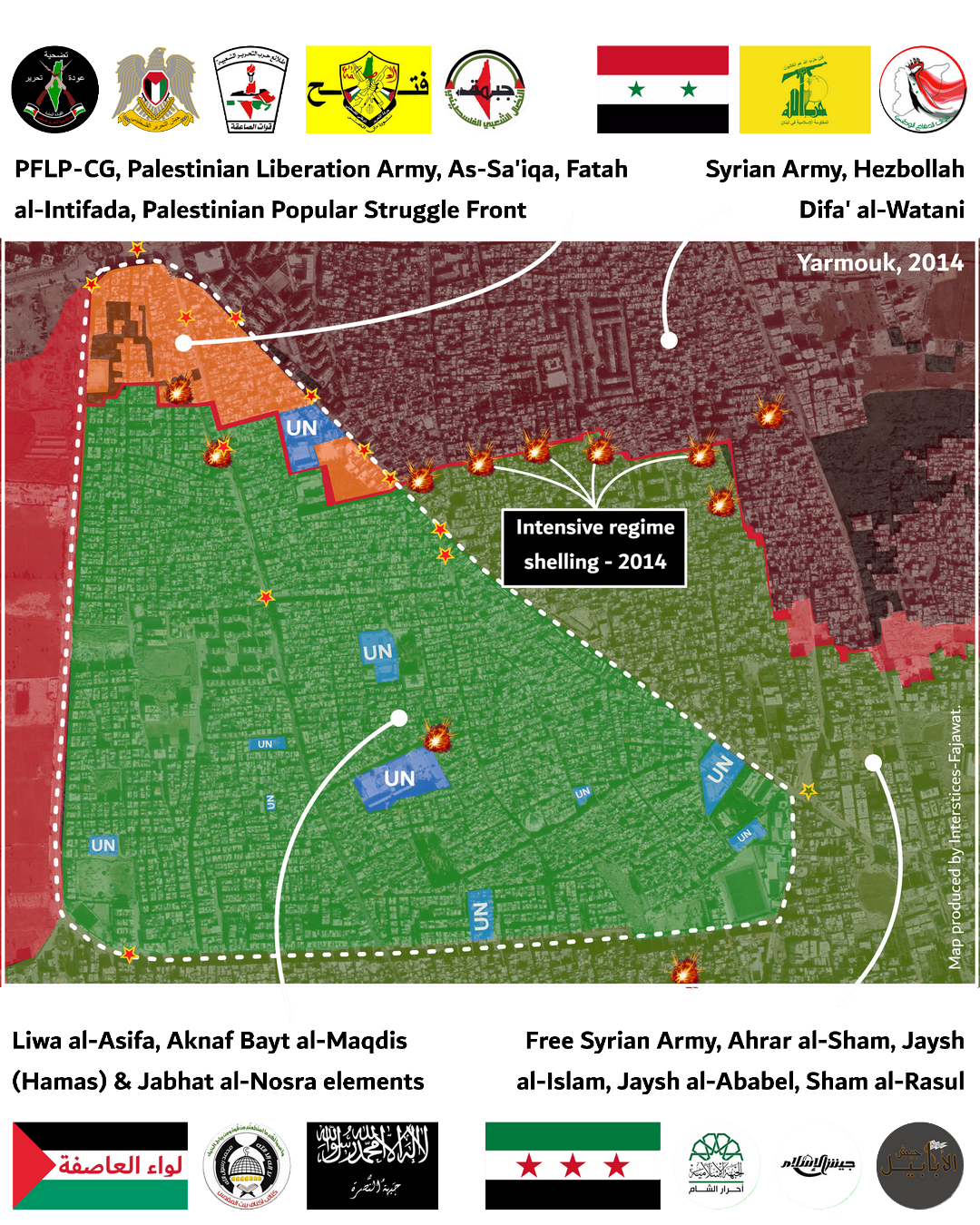
 

More than ten years after the uprising of 2011, the revolt has resumed in southern Syria. As in 2011, the mainstream media are not reporting much on it, as if popular uprisings in this region were only of interest if they coincided with the interests of the states that have been working to carve up the Middle East since the Sykes-Picot agreements in 1916. This time, the revolt started in Suwayda, the Druze governorate, in the middle of August and spread modestly to other towns, notably in the neighboring governorate of Dera’a. This text offers a contextualization on Syria in general and on Suwayda in particular. It has been written by people from the region who are concerned about the situation there, and who hope that a solution will finally be found for the people, which does not simply consist of choosing their oppressors. No foreign power can propose a viable and satisfactory solution for the Syrians, their land having served as a bloody playground for all the powers that have interfered in their affairs.

The Druze exception

The Druze are a religious community attached to a heterodox belief in Ismaili Shi’ite Islam, which originated in Egypt under the impetus of Imam Hamza ibn Ali ibn Ahmad and Vizir Nashtakin ad-Darazi in the early 11th century. The druze religion, like Sufism, takes a philosophical and syncretic approach to faith, recognizing neither the rigorist precepts nor the prophets of Islam. Note that the Druzes prefer to call themselves Al-Muwahhidun (Unitarians) or Bani Maaruf (People of Goodness). Despite the spread of this belief to Cairo during the Fatimid caliphate of Al-Hakim, who was venerated by the Druzes, they were swiftly subjected to persecution by the rest of the Muslim community following his demise in 1021. As a result, they were exiled to Bilad el-Cham (present-day Syria, Lebanon, Jordan, and Palestine), specifically to Mount Lebanon and Hawran. However, it was around the beginning of the 19th century that the Druze community of Hawran gained strength after a large part of the community had been expelled from Mount Lebanon by the Ottoman authorities. The Hawran then took the name of Jabel al-Druze.

Today, Suwayda governorate is home to the majority of the world’s Druze community, some 700,000 people. The Lebanese Druze are the second-largest community, numbering 250,000. In Syria, several Druze settlements also exist in Jebel al-Summaq (Idlib, 25,000 people), Jebel al-Sheikh (Quneitra, 30,000 people), and Jaramana (Damascus suburbs, 50,000 people). Finally, outside Syria and Lebanon, the largest Druze communities are to be found in occupied Palestine (al-Juwlan, Galilee and Mount Karmel, 130,000), Venezuela (100,000), Jordan (20,000), North America (30,000), Colombia (3,000) and Australia (3,000).

Following numerous revolts against the Ottoman Empire until 1918, then against the French colonizers between 1925 and 1945[1], the Druze have a reputation for insubordination that describes them to this day and which has enabled them to maintain a permanent balance of power with the Assad regime, based on compromises negotiated between Druze leaders and the regime’s local representatives[2]. After 2011, despite a few sheikhs expressing their support for the regime[3], many Druzes took part in the demonstrations against Bashar al-Assad, mostly supporting the position of the «Men for Dignity»[4], who refused to take part in the war and called on the community to arm itself for the sole purpose of self-defense. The sheikhs took the lead and the initiative by refusing to join the regime’s army with the aim of protecting the region and its youth, but also to prevent the community from being compromised in Assad’s war by taking part in the repression of other communities elsewhere. This defiance of the regime was embodied, among others, by the druze sheikhs Ahmed Salman al-Hajari and Abu Fahd Wahid al-Bal’ous, who both were killed, the first in a car «accident» in March 2012[5] and the second in a bombing that killed 23 other people in September 2015.

Other prominent druze figures got involved in the opposition: Khaldoun Zeineddine, his brother Fadlallah Zeineddine and Hafez Jad Al-Kareem Faraj, all three officers in the Syrian army, from which they defected to join the rebels. Khaldoun Zeineddine formed the Sultan Pasha al-Atrash Battalion within the Free Syrian Army (FSA)[6] [7]. Joined by a number of Druzes, the battalion, however, remained weak and isolated and faced several attacks and kidnappings by Al-Nusra rebels in Dera’a[8] before being finally wiped out and its commander killed in 2013[9]. Its remaining members fled to Jordan, from where they announced the cessation of their activities in January 2014, denouncing a lack of support for the revolution from the Suwayda Military Council and from the Druze community, as well as the hostility toward the Druze on the part of the rebel groups of Dera’a, called «Islamists» and accused of being accomplices of the Assad regime[10].

Generally speaking, the Druze have a very secularist vision of society, and their religious representatives refuse to take charge of the community’s political and administrative affairs. In the conflicts that have shaken Druze and Syrian society, the sheikhs have repeatedly expressed their support and encouragement for the community’s choices[11]. While the Druze community has refused to take sides in the civil war, it has nevertheless always expressed its rejection of the regime, not hesitating to confront the security forces present in the governorate to enforce their demands or free prisoners from the hands of the army[12].

Bashar and his Islamist puppets

Right from the start of the insurrection and repeatedly since, the regime has played the divide-and-rule card, urging the Shi’a and Ismaili religious minorities (to which the Druzes belong) to oppose the FSA because of the «Islamist threat» their Sunni majority component is supposed to represent. In the propagandist rhetoric of the regime and its allies, the FSA rebels are constantly equated with the Al-Nusra Front and branded as Salafists or takfiri, while the useful idiots of the Islamic State are used in a thousand ways to hinder the revolution and to go hand in hand with the regime’s forces for the indiscriminate slaughtering of the Syrian population. In fact, the most radical religious component of the Syrian opposition has been deliberately favored by the regime: between June and October 2011, three months after the first anti-regime demonstrations, Bashar al-Assad released nearly 1,500 Islamist militants from prison, most of whom went on to join jihadist groups affiliated with al-Qaeda and ISIS. Thus, the main leaders of the Jabhat al-Nusra, Ahrar al-Sham and Jaish al-Islam groups, as well as the ISIS section responsible for most of the beheading of foreigners, had previously been released from the notorious Saydnaya prison[13].

Bashar al-Assad’s strategy has paid off, as the outpouring of violence from ISIS jihadists has succeeded in permanently distracting the rest of the world’s gaze from the atrocities committed by the Syrian army, the Shabihas[14] [15] and Iran-backed militias[16], and then from the massive bombing of civilians in the north and east of the country by the Russian air force from September 2015 onwards[17], with this military intervention itself motivated by the «fight against Islamists». Moreover, it has enabled the Kurdish People’s Protection Units and Women’s Protection Units (YPG/YPJ) to distance themselves from the Syrian revolution and focus their forces on the fight against the Islamists, mainly with American help. Finally, because of the terror instigated by the jihadists and out of disinterest in the fate of the Syrian people and their revolution, the «international community» (EU, USA and UN) did not bring substantial support to the FSA, leaving Qatar, Saudi Arabia and Turkey to provide logistical and military support to the FSA components most compatible with their political agenda and confessional interests, so to speak «the Islamists»[18]. The democratic, secular and socialist components of the FSA, abandoned on most sides and threatened from within by the Islamists, then had no choice but to join the sectarian groups in order to survive and continue the fight against the main executioner of the Syrian people: the regime of Bashar al-Assad[19].

In May 2018, Bashar al-Assad’s regime made an agreement with ISIS for their surrender in the Damascus area[20]. Following this agreement, 800 of its fighters and their families (1,800 people) had been evacuated from the districts of Yarmouk and Tadamon (Damascus suburbs) to the desert near Palmyra and to abandoned villages northeast of Suwayda[21], with 40 trucks and cars under heavy guard by the Syrian army. Three months later, on July 25, 2018, ISIS predictably attempted to invade the Suwayda governorate from the east, guided by Bedouins who had a long-standing discord with the Druzes. At dawn, ISIS fighters thus began slaughtering the population of several druze villages on the edge of the desert[22] before taking 42 members of the community as hostages (including 16 children and 14 women[23]) and carrying out four suicide attacks in the heart of the main city of Suwayda[24]. Hundreds of Druzes from Jabal al-Druze (the region of Suwayda), joined by Druzes from Jabal al-Sheikh (located on the border with Lebanon), spontaneously took up arms and threw ISIS back into the desert, putting a stop to its campaign towards the south of the country[25] but also definitively confirming the anger and distrust of the Suwayda Druzes towards the Syrian regime, accused of using ISIS to weaken them[26].

Regime and gangs hand in hand

Although the region has escaped bombardment and military operations since 2011, the people of Suwayda, like all Syrians, have endured the consequences of the war and the regime’s murderous policies: sporadic armed confrontations with gangs and militias affiliated to the regime, assassinations, kidnappings, drug trafficking[27]

In the spring of 2022, the gang of Raji Falhout, a notorious trafficker, claimed responsibility for the kidnapping of some twenty residents of Suwayda and Dera’a[28] before his men stormed the swimming pool in Suwayda’s al-Maqous district to kidnap its users, provoking an armed confrontation with the residents[29].

Following this incident, an uprising broke out on July 26 in the town of Shahba following the kidnapping of a resident, Jad al-Taweel, by Falhout’s gang[30]. Residents led by the «Men for Dignity» Movement blocked the roads and arrested military intelligence agents affiliated with the local organized crime[31] before taking up arms against the Falhout gang, leaving 24 people dead on the residents’ side and 12 on the gang’s side. The gang’s headquarters in the towns of Salim and Atil were then stormed by residents of numerous villages in the region, leading to the capture of the premises, the release of hostages, and the discovery of Captagon production equipments[32], revealing the Assad clan’s complicity with organized crime, using the 4th Military Intelligence Division and Hezbollah as middlemen[33]. Over the past decade, these regime-affiliated gangs have been responsible for numerous kidnappings and assassinations, causing insecurity and violence to destabilize the region.

After the eradication of the Falhout gang and its affiliated gangs, kidnapping and car theft operations in the Suwayda region significantly decreased[34], and this victory over organized crime has proven the capacity of the Druze community to ensure its own security.

Falhout gang with the citizens they kidnapped, 2022.

Raji Falhout posing with his gang.

Raji Falhout’s card as a member of the Intelligence Service Division n°2017.

People from Suwayda gathering to raid the Falhout gang

Captagon production

Endemic crisis and seeds of dissent

Over and above the direct consequences of the civil war, and then of the imperialist wars waged in Syria by the major powers (Iran, Russia, Turkey, Israel, the United States, Qatar, Saudi Arabia…)[35], Syria has been in an unprecedented economic slump for ten years. The population was initially subjected to rationing of basic resources and foodstuffs, such as water, gas, petrol, fuel oil, bread, sugar, oil, rice, tea and onions, obtained with the help of a ration card (the smart card), before abolishing this support for essential goods, leaving the population obliged to buy these commodities at market prices. The value of a Syrian pound has risen from $1 = 47 SYR in 2011 to 500 SYR in 2017, and climbed from 2,500 to 14,000 SYR by the summer of 2023, with an above average salary of 200,000 SYR ($14). In summer 2023, the food prices reached unprecedented level: 1L oil = 30000 SYR, 1L milk = 6000 SYP, 1kg flour = 4500 SYR, 1kg tomato = 4000 SYR, 1kg potatoes = 6500 SYR, 1kg onions = 3500 SYR, 1kg cucumber = 4000 SYR, one egg = 2000 SYP. This means that the majority of Syrians have spent their entire salary in less than a week. As for electricity, two years ago it was delivered to the Suwayda region as part of a daily rationing program (three hours on, three hours off), before this short window was reduced to an hour and a half on, versus six or seven hours off, not to mention the numerous power cuts occurring during this time, causing the rapid degradation of electronic devices whose purchase or fixing prices are unaffordable.

In recent years, Russian military police have regularly attempted to act as peacekeepers to ease tensions generated by the economic crisis. Its presence was confirmed in 2021 in Suwayda governorate, when a delegation of Russian officers presented themselves to the population with the intention of recruiting deputies from the population of both governorates[36]. The Russian contingent based in Bosra, located between Suwayda and Dera’a, made several attempts to distribute food aid in 2021 to Shahba and in 2022 to Dhibin, but residents firmly rejected their humanitarian intervention[37].

Between 2020 and 2023, spontaneous and short-lived demonstrations regularly took place in Suwayda, but were either not renewed or were repressed. In February and April 2022, protesters blocked the roads, stormed the governorate building, and set fire to a military vehicle before security forces opened fire on demonstrators, killing one and injuring 18[38]. Nevertheless, in December 2022, protesters managed to storm the governorate building for the second time, while their slogans and protest signs were mainly demanding a «decent life», after the allocations of gas and electricity had been reduced. Throughout the winter and spring of 2023, rallies continued under pressure from Baath Party members actions, who attempted to organize pro-regime demonstrations in order to intimidate the protesters.

Meanwhile, the Assad regime returned to the fold of the Arab League following diplomatic meetings in Cairo on May 7, 2023, and the Arab League Summit in Riyadh on May 19[39], as well as a Chinese-brokered deal to reestablish ties between Iran and Saudi Arabia in order to defuse the proxy war these two countries are waging in Syria and Yemen[40]. In exchange for this return of favor, Bashar al-Assad committed himself to tackling drug trafficking on his borders with Jordan and Iraq[41]. The day after the Cairo agreement, Jordan sent a clear message to the Syrian authorities by carrying out an air strike on the personal home of drug trafficker Marai al-Ramthan in Al-Shaab, south of the Suwayda governorate, killing him, his wife and six children, as well as an Iran-linked (handled by Hezbollah) drug facility in Kharab al-Shahem in the nearby Dera’a governorate[42].

And the fuse caught fire…

On August 5, 2023, a collective emerged in the coastal governorates of Latakia and Tartus, issuing an ultimatum to the regime by August 10[43], demanding reforms and making public a list of demands in application of UN Security Council Resolution 2254 which was adopted in Geneva in 2015. A particular feature of the movement is that it has developed in regions with a strong Alawite community, to which Bashar al-Assad belongs, notably in the towns of Tartus, Latakia, Banias and Jableh, where thousands of leaflets have been distributed[44]. In response, Bashar al-Assad raised civil employees’ salaries by 100% but simultaneously announced the abolition of petrol subsidies and an increase in fuel prices, with the price of a liter of petrol rising sharply from 3,000 to 8,000 Syrian pounds, an increase of 167%, and the price of fuel from 700 to 2,000 Syrian pounds, an increase of 186%. Syrians’ exorbitant transport budgets are making daily life impossible and forcing thousands of Syrians to stop going to work. Faced with the rise in resignations in the public sector, the regime has responded by tightening the conditions of resignation. Meanwhile, the regime has announced its intention to abolish subsidies on all consumer goods by 2024[45].

In the wake of these announcements, a call for a general strike was issued in southern Syria[46]. Since August 16, more than 52 communes in southern Syria have witnessed demonstrations using various types of action: strikes, vigils, blocking roads, closing government institutions, etc.

Demonstrations of support took place in the governorates of Idlib, Dera’a and Aleppo, as well as in Jaramana, the predominantly Druze district of Rural Damascus, reviving the slogans of 2011 for the fall of Assad : «Syria is ours, not Assad’s», «one, one, one, the Syrian people are one» and «the people want the fall of the regime». The demonstrators also expressed their wish to see an end to the Iranian presence in Syria.

On August 25, demonstrations spreaded to Idleb, Aleppo, Azaz, Afrin and Al-Bab. In several places, demonstrators waved the Druze, Kurdish and Syrian Revolution flags together. While the regime’s forces did not overreact in Suwayda governorate, they did open fire in Aleppo and Dera’a, killing at least two people. The Syrian Human Rights Network also reports the arrest of 57 people in connection with the protests, mainly in the governorate of Lattakia et Tartus[47].

Protesters show Druze, Syriaque and Kurdish flag replacing the three stars of the Syrian Revolution flag in the city of Idleb

Protesters show Syrian Revolution, Kurdish, Shia, Druze, Sunni, Christian and Syrian national flags in the city of Suwayda.

Since then demonstrations in Suwayda’s central square, long since renamed «Dignity Square» (al-Karami) by the population, have been weekly, if not daily, and have grown from one Friday to the next, reaching several thousand people a month after the start of the revolt, on September 22. Baath Party offices and a number of government offices were closed by the demonstrators during the protests, while banners and portraits of Bashar al-Assad were destroyed and burned.

Meanwhile, on September 14, Bashar al-Assad’s cousin, Firas al-Assad[48], published a video in which he condemned the regime and expressed his support for the demonstrators[49]. This video follows that of Majd Jadaan, Maher al-Assad’s sister-in-law[50], fiercely denouncing the crimes of the Assad clan from Jordan and hailing the revolt of the people of Suwayda against the regime[51]. Interviews of actors of the revolt were also made public, such as that of the leader of the «Men of Dignity Movement» in Suwayda, Sheikh Abu Hassan Yahya Al-Hajjar[52], or the activist and lawyer Adel al-Hadi[53].

Protesters burn a military vehicle in front of the governorate building.

The governorate building with Hafez al-Assad’s picture set in flames.

In the chaos of the proxy war

Despite twelve years of revolt and civil war, the Syrian regime is still in power. If it has withstood the storms, it is undoubtedly thanks to the interventions of Iran, ISIS and Russia, each of which, in their own ways, helped to make the Revolution so desired by the Syrian people impossible. To this we can add Saudi Arabia, Qatar and Turkey, who for their part have succeeded in creating division within the democratic and secular forces of the Free Syrian Army by favoring, as mentioned earlier, the most reactionary and least democratic forces of the rebellion against the regime.

The United States, for its part, which is responsible for the birth and development of Al-Qaeda and the Islamic State, both born on the still-smoldering rubble of Afghan and Iraqi societies, chose in 2011 (the year of its official withdrawal from Iraq) to no longer participate directly with its armed forces in conflicts in the Middle East. For all that, after condemning the repression of the 2011 protests and imposing sanctions against the Assad regime, the United States launched its first air strikes in Syria in September 2014[54] and, from 2015, sponsored the new Syrian Democratic Forces (SDF), made up of 25,000 Kurdish fighters from the YPG/YPJ and 5,000 Arab fighters, with the stated aim of halting the advance of the Islamic State. Initially spared, the Syrian regime finally underwent US strikes in 2017 and 2018, in retaliation for the Syrian army’s use of chemical weapons against civilians in Douma (Damascus) and Khan Cheikhoun (Idlib)[55]. That same year, two-thirds of the American troops deployed on Syrian soil were brought back in agreement with Turkey, which then decided to launch an offensive in the Kurdish-controlled border zone in order to establish a «security zone» there[56]. Nevertheless, the United States maintained a strong presence in Syria; in 2021, it carried out a series of air strikes against Hezbollah and its Iraqi allies, including Hachd al-Chaabi, who were held responsible for attacks against «western interests» in Iraq[57].

Russia, which has been one of the Syrian regime’s main military backers since 2015, was diverted by its invasion of Ukraine, which didn’t go exactly as Putin would have liked. It had to withdraw a significant part of its contingent from Syrian territory[58] to redeploy it in eastern Ukraine, while the 250 to 450 Wagner mercenaries operating notably in the Syrian governorates of Homs and Deir ez-Zor, remaining without leadership since the Prigozhine mutiny, were reportedly ordered to report to their base in Hmeimim (Latakia governorate) and return to the authority of the Russian military command[59]. Some of those who refused were possibly sent back to Russia or redeployed to Mali. As a result of the withdrawal of Russian troops, some of the military bases under their control were transferred to the Iranian armed forces, notably the Islamic Revolutionary Guard Corps and Hezbollah. However, Russia retains its military forces in Syria and has no intention of relinquishing its share of influence in the region, particularly in the face of Iran, which remains its main competitor there.

Iran, which has been the primary supporter of the Assad regime since the reign of Bashar’s father, Hafez, remains the key player in the Syrian war. Without the military support of Iranian militias, the main one being the Lebanese Hezbollah, the Assad regime would probably not have been able to hold out, not least because of Hezbollah’s involvement in the trafficking of Captagon, one of the regime’s main resources. After denying their presence in Syria, the Iranian regime and Hezbollah ended up openly supporting the Assad regime, calling it both a «jihad against Sunni extremists» and a «necessary intervention to protect Palestine and resist Israel». In the propaganda of Iran and Lebanese Hezbollah, unconditional support for the liberation of the Palestinian people is a mirage that works well, particularly among the Western left[60]. Where one might have expected unanimous support for the Syrian revolution from the majority of revolutionary left-wing forces, a resounding silence responded to the chants of the Syrian demonstrators. In the naive imagination of the left, Iran, Syria and the Hezbollah (and Hamas) militias constitute an indisputable bulwark against American imperialism and Israeli colonialism. In reality, Hezbollah’s main concern is to maintain its quasi-hegemonic hold on Lebanese society while working frantically to keep Syria within Iran’s zone of influence, on which its entire survival depends. Between 2013 and 2018, the Syrian regime’s siege[61] and then violent eradication of the world’s largest Palestinian Yarmouk refugee camp (suburb of Damascus)[62], which can easily be considered an operation of ethnic cleansing carried out with the complicity of Hezbollah and Palestinian movements like PFLP and Hamas[63], is enough to disqualify the latter’s propaganda as to the reality of their struggle for the emancipation of the Palestinian people.

Israel, without intervening militarily on Syrian soil, has never stopped launching drone strikes on Iranian infrastructures in Syria. In fact, not a month goes by without rockets hitting Hezbollah buildings or executives, the militia being the main concern of the Israeli regime. Yet, Israel has never shown any willingness to support the democratic aspirations of the Syrian people. If we look at the situation rationally, we understand that Israel has no interest in the establishment of a democratic society in an Arab country on its borders, as any democratic progress in the region would naturally lead to Arab solidarity with the Palestinians and a threat to Israel’s apartheid regime. In fact, the Assad regime and Hezbollah have largely contributed to restricting the political organization and resistance of Palestinian refugees in Lebanon and Syria[64], which is not to Israel’s displeasure.

What could happen next?

Like the Syrian people as a whole in 2011, the Suwayda demonstrators can hardly win a revolution without external support or a large uprising of the Syrian population in the main other governorates.

As for the Free Syrian Army, it’s hard to expect enthusiastic support for the Druze uprising, given that the aspiration of the majority of the current fighting groups remains the establishment of an Islamic caliphate that is difficult to reconcile with the democratic and secular aspirations of the Suwayda protesters. Nevertheless, in all the governorates, whether under the control of the regime or the rebels, there are still remnants of democratic movements who see the Druze insurrection as an immense source of hope. This is why those who still believe in a non-confessional, democratic society have spontaneously taken to the streets of various towns to express their solidarity with Suwayda, whether they be Sunni Muslims, Alawites, Christians, Syriacs, Arabs or Kurds.

Here again, one would expect Kurdish organizations, which have managed to maintain their autonomous status in a good quarter of the country and proclaim loud and clear that they are driven by a revolutionary, universalist and democratic project, to express more strong and unconditional support for their brothers and sisters in Suwayda. But beyond a communiqué from the women of the Syrian Democratic Council calling for Syrian women to take the political issue into their own hands, we haven’t heard much from the Kurdish revolutionary movements. This suggests that, in accordance to their well-established autonomy, the Kurds don’t feel much concern for what’s happening south of the Euphrates, whether the fate of the rest of the Syrian people or that of the Palestinians. It’s sad to see the extent to which solidarity with other struggling communities is not perceived as a sine qua non for the survival of the project for Democracy in the Middle East. Moreover, recent events in Deir ez-Zor have done little to bolster Arab confidence in the Kurdish People’s Protection Units (YPG): between August 27 and September 7, the Syrian Democratic Forces, largely dominated by the YPG, clashed with local Arab factions affiliated to the Deir ez-Zor Military Council following the dismissal and arrest of an Arab senior commander of the SDF, Ahmed al-Khubail also know as Rashid Abu Khawla. Although the sanctions taken against him were justified in view of the accusations of corruption and drug trafficking made against him by the local population, the arrest fueled the anger of its supporters, who launched an assault on the SDF, resulting in the death of 90 people over the eleven days the fighting lasted[65]. The backdrop to this conflict is the reproach levelled at the Kurds by the local population, who legitimately blame them for their hegemonic control of the area, which is seen as disrespectful considering the Arab majority living there[66].

Among the Druze, there is intense debate about the procedure to be followed. A certain mistrust seems to persist with regard to the autonomist and confederalist proposal. Some people see in the autonomist claim a risk of separation from the rest of the Syrians, unable to grasp the difference between autonomy and independence, while others confuse the means with the end: when they are told about establishing democratic assemblies and struggle committees to organize the revolt in the medium term, they think they are being told about a long-term project for society, and find it hard to believe in the people’s capacity for self-organization without mediators and leaders. As a result, political organization in the context of the popular uprising in al-Karami Square is still struggling to take on the form of the Egyptian Tahrir of 2010 or the Ukrainian Maïdan of 2014, when it would perhaps be sufficient to take up the recipes and positive experiences of the 2011 uprising, and in particular that of the Local Committees described by the Syrian anarchist Omar Aziz[67] and set up in many cities at the time. Unfortunately, if no grassroots’ organizing initiative is put in place, we run the risk of seeing sheikhs and heads of traditional family clans propelled as leaders, to the detriment of lesser-known individuals or collectives driven by more progressive and genuinely emancipatory ideals.

Already, Russian ambassador Anatoly Viktorov has paid a visit to the sheikh of the Druze of Galilee (Israel) Muwafaq Tarif[68], while American representatives French Hill, Joe Wilson and Brendan Boyle have called on phone the sheikh of Suwayda Hikmat Al-Hijri[69], trying to initiate negotiations with the Druze community to ensure that the outcome of the revolt would be in line with their interests in the region. Nor should we doubt that Saudi butcher Mohammed Ben Salman, who is conducting diplomatic dealings on all sides with Iran, China, Israel, the United States and France, will also come to shake up the region’s future, so much does his interest in weaponry acquisition and uranium enrichment outweigh the fate of the people, whether Syrian or Palestinian. For the Saudi tyrant, it obviously doesn’t matter that these peoples remain caged, as long as they are martyred in silence and don’t disturb usual business. And that’s not counting Bashar al-Assad’s recent visit to Beijing at the invitation of Chinese despot Xi Jinping, to break out of his isolation and secure China’s support for a deal to «rebuild» Syria. The very act of all these vultures is enough to generate suspicion and speculation, which cannot be beneficial to the popular movement underway. In view of the chaos that the various states have generated in Iraq and Syria over the last twenty years, we can legitimately say that only solutions implemented by the people for the people can hope to lead to a semblance of peace and democracy. For now, the people of Suwayda have categorically refused to join under any banner that has political or economic interests in Syria.

Let’s hope it will last and succeed in this way!

NOTES

[1] The withdrawal of the French in 1945 was largely due to the fight for independence waged since the 1920s by Sultan Pacha al-Atrach, representing a family of Druze notables, whose feats of arms and resistance to the occupiers are still celebrated by many Syrians.

[2] The regime has no checkpoints inside Suwayda governorate, and the community refuses to send its young people to the army outside the region. Nevertheless, the governorate administration and security services remain present and informed of what is happening in the region.

[3] Among these sheikhs, the notorious ones are the sheikh Jerbo and Nayef al-Aqil from the Dir’ al-Watan faction.

[4] https://yalibnan.com/2012/03/25/anti-regime-druze-spiritual-leader-killed-in-syria/

[5] https://www.meforum.org/5554/the-assassination-of-sheikh-abu-fahad-al-balous

[6] https://foreignpolicy.com/2015/06/22/druze-syria-assad-israel-netanyahu/

[7] https://syrianobserver.com/news/34453/sedition_between_druze_and_sunni_fighters.html

[8] https://www.meforum.org/3463/syrian-druze-neutrality

[9] https://www.zamanalwsl.net/news/article/45392

[10] https://www.zamanalwsl.net/news/article/45392 (AR)

[11] https://www.youtube.com/watch?v=J8HeEzKTmbc (EN)

[12] https://suwayda24.com/?p=20610 (AR)

[13] https://s.telegraph.co.uk/graphics/projects/isis-jihad-syria-assad-islamic/ (EN)

[14] https://npasyria.com/en/53834/ (EN)

[15] https://cija-syria-paramilitaries.org/#investigating-assads-ghosts (EN)

[16] https://syriafreedomforever.wordpress.com/2017/02/26/the-rawr-report-interview-with-joseph-daher-on-hezbollah-and-the-syrian-revolution-02162017/ (EN)

[17] https://www.aljazeera.com/news/2015/9/30/russia-carries-out-first-air-strikes-in-syria

[18] The main are Ahrar al-Sham (Qatar, Turkey, Saudi Arabia), Syrian Islamic Liberation Front (Qatar, Turkey), Liwa al-Tawhid (Qatar, Turkey), Jaych al-Islam (Saudi Arabia, Qatar)

[19] https://thisishell.com/interviews/894-leila-al-shami-robin-yassin-kassab (EN)

[20] https://english.aawsat.com/home/article/1275206/isis-militants-evacuated-southern-damascus-desert (EN)

[21] Hamlets called Ashraffieh, al-Saqiya and al-Awara, less than 20 kilometers from the Khalkhalah military base and less than 10 kilometers from the first Druze settlements at the gateway to the desert, al-Qasr and Barek – https://suwayda24.com/?p=2423 (AR)

[22] Villages of Tema, Douma, Al-Kseib, Tarba, Ghaydah Hamayel, Rami, al-Shbeki, al-Sharahi, al-Mtouneh and al-Sweimreh – https://suwayda24.com/?p=4431

[23] On July 31, 2018, the regime negotiated the release of women held hostage by the jihadists, in exchange for an agreement to evacuate more than 200 of their fighters from western Deraa (Yarmouk Basin) to the Badiya region. Refusing the deal, the Islamic State demanded a ransom, before publishing the video of the execution of one of the hostages, Muhannad Touqan Abu Ammar, a 19-year-old Druze resident of al-Shbeki, on August 2, 2018 – https://www.youtube.com/watch?v=f_OhL8bJD2M (AR). Eventually, the remaining hostages were released following agreements reached with the regime in october and november 2018, while 700 to 1,000 jihadists were evacuated to Badiya under a new agreement reached with the regime on November 17 – https://suwayda24.com/?p=19606 (AR) ; https://stj-sy.org/en/946/ (EN)

[24] https://www.hrw.org/news/2018/08/25/syria-isis-holding-children-hostage (EN)

[25] The ISIS offensive affected 10 villages, 263 people were killed (30 by the suicide bombers in Suwayda) and 300 injured. In retaliation for the massacre, on August 7, 2018 local members of the pro-regime Syrian Social Nationalist Party (SSNP) hanged an elderly man they presented as a jihadist at the so-called “Arch of the Hanged” (al-Mashnaqah) in the town of Suwayda – https://suwayda24.com/?p=4711 (AR) ; https://syria.news/179bd6d3-07081812.html (AR) ; https://orient-news.net/ar/news_show/152458 (AR)

[26] The regime’s army intervened only belatedly (after the attack on the Khalkhalah military base located to the north of Suwayda governorate) to track down ISIS into the desert next to the volcanic field of as-Safa, as they were already pushed back by the Druzes’ counter-attack.

[27] Watch “Captagon: Inside Syria’s drug trafficking empire” by BBC World Service Documentaries – https://www.youtube.com/watch?v=N4DaOxf13O0 (EN)

[28] https://www.facebook.com/Suwayda24/photos/pb.100064794576009.-2207520000/2097785973734342/?type=3

[29] https://suwayda24.com/?p=19288 (AR)

[30] https://suwayda24.com/?p=19589 (AR) ; https://suwayda24.com/?p=19611 (AR)

[31] https://www.opensanctions.org/entities/NK-Do5hgZ5JS8hTfGJbyQvr6J/ (EN)

[32] https://www.facebook.com/photo/?fbid=2161930727319866&set=pb.100064794576009.-2207520000

[33] https://www.bbc.com/news/world-middle-east-66002450 (EN)

[34] https://suwayda24.com/?p=19955 (AR)

[35] Since 2011, over 600,000 people have been killed in the conflict, more than half of them civilians. Five million Syrians have left the country, while almost 8 million have been internally displaced. While Russia and Turkey intervene militarily on Syrian territory, most other powers intervene through militias or by providing financial and material aid to the various armed groups active in the conflict. Iran openly supports the Syrian regime, notably by guaranteeing the support of its militias, the main one being Hezbollah.

[36] https://npasyria.com/en/65789/ (EN)

[37] https://syrianobserver.com/news/75404/widely-condemned-russian-delegation-enters-town-in-suweida-under-pretext-of-aid.html (EN)

[38] https://suwayda24.com/?p=20325 (AR)

[39] https://www.aljazeera.com/news/2023/5/7/arab-league-agrees-to-bring-syria-back-into-its-fold (EN)

[40] https://www.usip.org/publications/2023/03/what-you-need-know-about-chinas-saudi-iran-deal (EN)

[41] https://www.aljazeera.com/news/2023/5/1/syria-agrees-to-curb-drug-trade-in-arab-ministers-meeting (EN)

[42] https://www.aljazeera.com/news/2023/5/8/sohr-attack-that-killed-drug-trafficker-in-syria-was-by-jordan (EN)

[43] https://www.newarab.com/news/who-are-syrias-new-opposition-group-10-august-movement (EN)

[44] https://en.majalla.com/node/297431/politics/alawite-protest-movement-emerging-syrias-coastal-areas (EN)

[45] https://alsifr.org/syria-protests (AR)

[46] https://suwayda24.com/?p=21730 (AR) ; https://www.aljazeera.com/news/2023/8/21/strike-protests-in-syrias-sweida-enter-second-day (EN)

[47] https://leilashami.wordpress.com/2023/08/26/revolution-reborn/ (EN)

[48] Firas’ father, Rifaat, commanded the armed forces responsible for the Hama massacre in 1982, before attempting a coup against his brother, Bashar al-Assad’s father, in 1984. Exiled to France, he finally returned to Syria in 2021 after being granted an amnesty by his nefew and found guilty by French courts of embezzling and laundering money for the Syrian regime. All his assets were seized, worth an estimated 90 million euros, including two Parisian townhouses, a stud farm, 40 apartments, 7300 square metres of office space in Lyon and a castle.

[49] https://www.youtube.com/watch?v=GmCRl-Hkn94 (AR)

[50] Maher is Bashar’s brother and General commander of the Republican Guard and the regime’s Military Intelligence. He is the regime’s second strongman, directly responsible for the Shabihas militia and the captagon traffic organized by the military intelligence services, in particular the Fourth Armored Division.

[51] https://youtu.be/IobX1vxHkDY (AR)

[52] https://suwayda24.com/?p=20610 (AR)

[53] https://hawarnews.com/en/haber/developments-in-as-suwayda-to-where-h37625.html (EN)

[54] https://obamawhitehouse.archives.gov/the-press-office/2014/09/23/statement-president-airstrikes-syria (EN)

[55] https://www.armscontrol.org/factsheets/Timeline-of-Syrian-Chemical-Weapons-Activity (EN) ; https://www.opcw.org/media-centre/news/2023/01/opcw-releases-third-report-investigation-and-identification-team (EN)

[56] https://www.kurdistan24.net/en/news/fff9400a-a0b3-4ff4-be05-e18d00a046cf (EN)

[57] https://www.reuters.com/world/middle-east/us-carries-out-air-strikes-against-iran-backed-militia-iraq-syria-2021-06-27/ (EN)

[58] By 2020, Russia had control over 75 sites in Syria, including 23 military bases, 42 points of presence and 10 observation points. While an estimated 63,000 Russian military personnel were deployed in Syria between 2015 and 2018, on the eve of the war in Ukraine this number appears to have fallen to 20,000 – https://daraj.media/108925/ (AR) ; https://www.arab-reform.net/publication/russian-forces-in-syria-and-the-building-of-a-sustainable-military-presence-i/ (EN)

[59] The main Russian military bases in Syria are located in Tartus, Hmeimim (Latakia) and since 2019 in Qamishli (Al-Hasakah).

[60] https://alsifr.org/syria-protests (AR)

[61] See the film “Little Palestine”, by Abdallah al-Khatib – https://youtu.be/GbpxMFNuYVY (AR / FR)

[62] Before 2013, the Yarmouk camp was home to over 160,000 Palestinian refugees.

[63] Hamas militants in Yarmouk initially fought the Assad regime until 2013, when Hamas timidly criticized the intervention against the Yarmouk camp, before maintaining a position of neutrality, due to its financial and military dependence on Hezbollah. Hamas also maintains its headquarters in Hezbollah’s stronghold in Dahiyeh, Lebanon.

[64] https://alsifr.org/syria-protests (AR)

[65] It was finally under US pressure that a withdrawal and ceasefire agreement was initiated by the FDS, motivated by the fear that ISIS cells, regime forces and pro-Iranian militias would take advantage of the situation to regain ground in the region.

[66] https://www.middleeasteye.net/news/syria-deir-ezzor-sdf-fights-arab-tribes-control (EN)

[67] https://www.fifthestate.org/archive/397-winter-2017/the-legacy-of-omar-aziz/ (EN) ; https://www.syria.tv/عمر-عزيز-يدخل-غيابه-العاشر

[68] https://www.aljazeera.net/politics/2023/9/21/انتفاضة-السويداء-مستمرة-اتصالات

[69] https://syrianobserver.com/news/85155/american-senator-reaches-out-to-sheikh-al-hijri-in-suweida.html (EN) ; https://www.thenationalnews.com/world/us-news/2023/09/21/us-politicians-speak-to-druze-leader-sheikh-al-hajari-as-anti-assad-protests-continue/ (EN)