
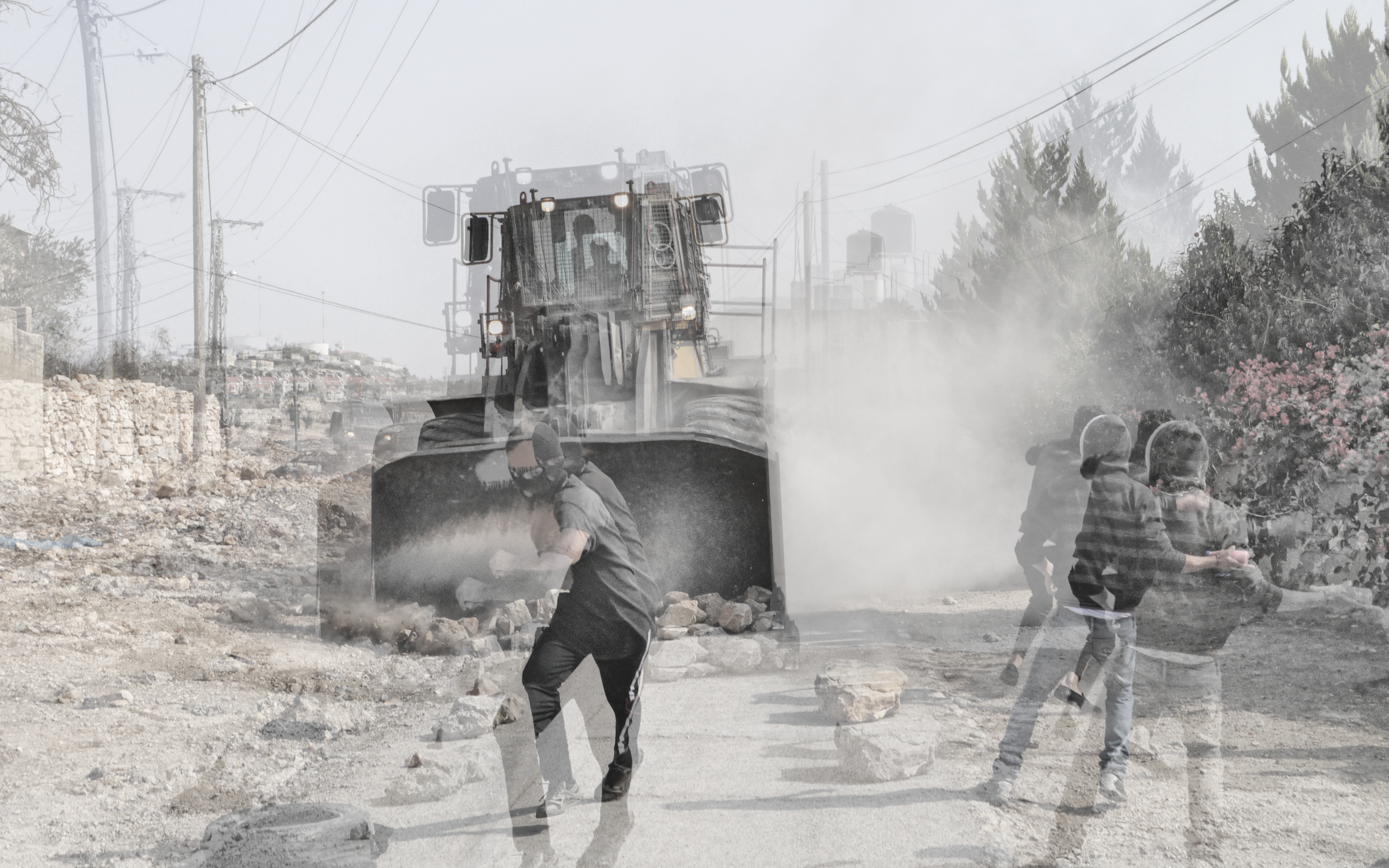
Palestine 2013: First encounter with colonial reality
About the author: Cédric Domenjoud is an independent researcher and activist based in Europe. His research areas focus on exile, political violence, colonialism, and community self-defense, particularly in Western Europe, the former USSR, and the Levant. He is investigating the survival and self-defense of Syrian communities and developing a documentary film about Suwayda, as part of the Fajawat Initiative.
In 2013 I traveled to Palestine for the first time. I didn’t know anyone there, but I had prepared the trip as an initiatory journey into a colonial reality I’d read extensively about in books and articles and watched in countless documentaries. Stepping beyond the wall reshapes one’s entire worldview.
October 24, 2013 – Jerusalem
A military ceremony takes place in front of the Western Wall. Men and women in austere uniforms mourn, devout youths dance in Israel’s honor, teenagers brandish weapons, and some men dress as scarecrows. Arab children hurl stones at me and threaten with sticks. A pious man grabs my hand, murmuring prayers in hopes of a donation; beggars wave their coin‑filled cups as frivolous teens pass by.
“I’m in Israel,” I think, confronting stark contrasts. Violence hangs in the air, ready to erupt. An UN officer crosses my path, shedding his sky‑blue bullet‑proof vest. An Arab vendor clutches at me, urging me to buy a bag priced three times its worth. A child—Jewish or perhaps Arab, I can’t tell—spits on me as I turn away. A caravan of Russian pilgrims, dressed like Mormons, storms past, their dark wooden crucifixes a reminder of a past that still haunts.
Tomorrow I head to the West Bank for a protest marking seven years of struggle at Al‑Ma’sara, southwest of Bethlehem. Tear‑gas looms. Two Frenchwomen have offered to travel together from Jerusalem, departing at 09:30 through the Damascus Gate.
I’ve just finished Maintien de l’Ordre by David Dufresne and will start Stephen Graham’s Villes sous contrôle. The militarisation of urban space feels especially pertinent.
October 25, 2013 – Bethlehem
The Al‑Ma’sara demonstration embodies paradox. Arriving early, we encounter Mahmud, a leader of the Popular Committees, deep in conversation with a German volunteer working three months for the AIC. He delivers a compelling talk on non‑violence—a tactical approach far removed from the “bobo” civil‑disobedience theories popular in Europe. Here, the goal isn’t to dodge physical confrontation but to stay perpetually on the defensive, reacting rather than initiating attacks. It’s a form of popular self‑defence.
Yet media narratives and symbolic speeches dominate the scene, eclipsing direct resistance. These participants are undeniably resistors, but not fighters; they exist only through the lens of “militant tourists,” NGO volunteers, left‑wing politicians, and a few lost anarchists like myself who wish to help yet end up as mere witnesses.
I won’t criticize further; I haven’t lost loved ones, I’m not crushed by occupation, nor do I live in constant fear of soldiers dragging me from my bed.
The protest—largely composed of foreigners with cameras—advanced toward the village entrance, aiming for the Efrat settlement, before being halted by an Israeli soldier cordon. Minor scuffles erupted: Arabic and English chants, a few kicks and elbows against shields, followed by performative speeches for the guests. Some determined Palestinians and foreign activists tried to slip through olive groves; soldiers redeployed below, chasing stone‑throwers in a jeep as if it were a folkloric ritual. Tear‑gas was deployed, though most foreigners had already fled. The ensuing gunfire angered nearby villagers, who turned on the demonstrators. Both sides exchanged stones and punches before calm returned.
Foreign participants eventually left; the show ended. That evening I arrived in Ramallah, opting not to spend Shabbat in Jerusalem.
October 28, 2013 – Ramallah
After a night in a youth hostel filled with tourists, Mohammad escorts me to the Al‑Amari refugee camp—a village within the city populated by people displaced from villages now erased inside modern Israel. Everyone knows each other; the atmosphere is warm. I quickly forge contacts, aware of their fleeting nature. Tomorrow I’ll be gone.
I spend a day walking along the separation barrier: Beit’ur at Tahta, Saffa, Bil’in. The arid landscape stretches toward settlements and their war‑like apparatus—fences, walls, watchtowers. An Israeli jeep roars down a road reserved for Israelis, then silence returns, punctuated only by sun‑baked olive trees. A young Palestinian warns me of stray dogs. A red sign on the barbed wire warns anyone attempting to cross that their life is at risk.
Palestine lives in a paradox: peace and war coexist daily. Local news constantly reports incidents—assaults, arrests, settler raids sometimes with army complicity. Settlers wage an annihilation campaign for a “lebensraum” of Jewish Israelis, expanding their vital space by eradicating anything that stands in their way. Their logic is ruthless; they level Palestinian olive groves—a potent symbol.
November 1, 2013 – Nablus
Green‑khaki IDF uniforms dominate every corner of the occupied territories, kicking up dust behind roaring jeeps. Checkpoints and patrols, stone‑thrower chases, perpetual enforcement of Arab population control—don’t forget the green card, the AWIYYA.
In the towns, bustling street vendors, young men leaning against walls, university girls in colorful hijabs create a lively rhythm that momentarily masks the fact that we’re in an occupied zone. It feels alive, breathing. “Welcome! What’s your name? How are you?” Children and elders alike greet the passing Westerner traveling through the land of Arafat, intifada, and the separation wall. Hospitality remains warm; lingering in the streets is a daily pleasure.
Still, one must stick to main routes, avoiding side roads near settlements and the wall. Not forbidden, but certainly discouraged. Even when Qalandia gate is open, we weren’t invited in.
Kufr Qaddum, Qaryut, Ras, Beit Ummar, Halhul, Susiya, Yabad—the list of villages scarred by recent Israeli‑Palestinian violence keeps growing.
Crossing into a settlement—Gilad Farm or Yitzhar—IDF presence is never far, reminding intruders they have no business there. Green uniforms seize the “intruder” and process him at the settlement’s police station in Ariel. That’s exactly what happened to me after entering Yitzhar. I learned that Palestinian towns are deemed dangerous, Arabs labeled killers, and the army is there to protect Israeli citizens. Against the very violence they generate, welcome to the land of paradoxes and contrast!
During five hours of “detention,” confined within the police station, I witnessed a juxtaposition of the mundane and the violent: stone‑throwing Palestinians, an Israeli parent of a recalcitrant teen, jovial officers, heavily armed soldiers, and two blindfolded Palestinians with hands bound behind their backs, forced to lower their heads and sentenced to long prison terms for allegedly attacking a soldier with a knife.
“Why did you come to Palestine? Which cities have you visited? Where will you go next? When are you leaving Israel? Where are you staying? Will you attend protests? Do you understand the Israeli‑Palestinian conflict? Are you in contact with NGOs?” The same security questions repeated—from the Yitzhar settlement guard, to an IDF captain, to a police officer, and finally to a military intelligence (AMAN) employee over the phone. A security mantra of a nation living in fear and paranoia. Absurd, if not dramatic. Adults behaving like children, playing Indians, cowboys, cops, thieves, good guys, and terrorists. One could laugh—if not for the dead and imprisoned Palestinians lurking behind the scenes.
November 2, 2013 – Jenin
Inside a quiet teachers’ lounge at Zabda school, I discover the familial rhythm of a small village school, reminiscent of Russian classrooms. Children from around the world share the same curiosity; teachers are young, smiling, eager to learn about the world beyond. It contrasts sharply with Western individualism. Sunlight filters through curtains. Tobacco grows near the school, a regional hallmark. Moving from class to class, kids bombard me with questions—delightful, revealing the nuances of a Palestinian childhood.
After school, on the road to Yabad, we stop between two hills at a charcoal‑making site. A late‑19th‑century tableau, Germinal reenacted in Jenin. Workers, faces blackened with soot, pile imported wood—dubbed “occupied Palestine”—into mounds, cover them with straw and ash, then set them alight from the top. The flames consume the piles for hours, releasing thick black smoke. Thus is born Yabad charcoal, a guaranteed recipe for lung cancer.
November 4, 2013 – Express departure
My father’s cancer resurfaces in my thoughts. I must leave Jenin, Ahmad, and his school to return to France before it’s too late. I bring back sacks of a Jenin herb that supposedly cured Mohammed, an elderly man from Tura. After his sheep recovered from illness, he boiled the plant into a decoction. Four months later, his cancer vanished. Journalists and scientists swarmed his doorstep, eager to unravel the mystery of this medicinal plant. I now play magician, hoping the trick works.
On the roof of the Citadel Hotel in Jerusalem I await the muezzin’s call before heading to Tel Aviv, praying the checks won’t drag on. Mosques chant as the first transports depart.
November 5, 2013 – The Border
Chaos reigns. It took two full hours of scanning, rescanning, and scanning again every nook of my backpack for a phantom explosive. Headaches mount; the wait drags. Every item is examined, then I’m examined. I open the bag, remove shoes, unzip trousers, strip my sweater, empty the pack. The inspecting officer looks younger than me, clinging to my sleeves, escorting me to check‑in, then passport control. Another officer asks why I’m in Israel; a second repeats the same trio of questions: where have you been? Do you have friends or contacts here? How long have you stayed? Where did you sleep?
They wield a small blue scoop‑shaped probe, sliding it between every fold of my luggage. Paranoia.
Back to the West, back to normal: folly, fear, xenophobia, low‑intensity warfare. I’m on familiar ground—that’s what worries me. Tomorrow I’ll see my father.
NOTES:
[1] Maher Alloush (1976, Homs), writer and researcher specializing in political, social and economic issues, as well as Transitional Justice, Hassan al-Daghim (1976, Idleb), graduate in Islamic studies and comparative jurisprudence, Mohammed Mustat (1985, Aleppo), graduate in electronic engineering, political science and Islamic studies, Youssef al-Hijar, Mustafa al-Moussa, pharmacist and member of HTS, Hind Kabawat (1974, India), Master’s degree in Law and International Relations and Houda Atassi, civil engineer with degrees in Architecture and Information Technology.
[2] Abdul Hamid al-Awak, PhD in Constitutional Law; Yasser al-Huwaish, recently appointed Dean of the Faculty of Law at Damascus University; Ismail al-Khalfan, PhD in International Law; Mohammad Reda Jalkhi, PhD in International Law; Bahia Mardini, the only female journalist with a PhD in Law.
[3] Anas Khattab (1987, Rif Dimashq), Minister of Interior; Murhaf Abu Qasra (1984, Hama), Minister of Defense; Asaad al-Shaibani (1987, Al-Hasakeh), Minister of Foreign Affairs and Expatriates; Mazhar al-Wais (1980, Deir Ez-Zor), Minister of Justice; Mohammed Abu al-Khair Shukri (1961, Damascus), Minister of Awqaf; Marwan al-Halabi (1964, Quneitra), Minister of Higher Education; Hind Kabawat (1974, India), the only woman, Minister of Social Affairs and Labor; Mohammed al-Bashir (1984, Idleb), Minister of Energy; Mohammed Yisr Barnieh, Minister of Finance; Mohammad Nidal al-Shaar (1956, Aleppo), Minister of Economy and Industry; Musaab Nazzal al-Ali (1985, Deir Ez-Zor), Minister of Health; Mohammed Anjrani (1992, Aleppo), Minister of Local Administration and Environment; Raed al-Saleh (1983, Idleb), Minister of Emergency and Disaster Management; Abdul Salam Haykal (1978, Damascus), Minister of Communications and Information Technology; Amjad Badr (1969, As-Suwayda), Minister of Agriculture and Land Reform; Mohammed Abdul Rahman Turko (1979, Afrin), Minister of Education; Mustafa Abdul Razzaq (1989), Minister of Public Works and Housing; Mohammed Yassin Saleh (1985), Minister of Culture; Mohammed Sameh Hamedh (1976, Idleb), Minister of Youth and Sports; Mazen al-Salhani (1979, Damascus), Minister of Tourism; Mohammad Skaf (1990), Minister of Administrative Development; Yaarub Bader (1959, Latakia), Minister of Transport; Hamza al-Mustafa, Minister of Information.
[4] Except by proxies.
[5] https://www.independent.co.uk/news/world/middle-east/deal-for-joint-military-action-with-us-in-syria-could-elevate-russia-as-well-as-defeat-isis-a7237256.html
[6] https://www.middleeasteye.net/fr/news/russia-and-turkey-agree-deal-coordinate-strikes-syria-1427197601
[7] https://arabcenterdc.org/resource/jordan-and-the-us-russia-deal-in-southern-syria/
[8] https://www.dohainstitute.org/en/PoliticalStudies/Pages/Israel-Reacts-to-US-Russian-De-Escalation-Agreement-in-Syria.aspx
[9] See the history of Ahmad Al-Awda’s 8th Brigade – https://middleeastdirections.eu/new-publication-med-the-eighth-brigade-striving-for-supremacy-in-southern-syria-al-jabassini/
[10] He is currently still in charge.
[11] Between 4356 and 6456 civilians killed according to airwars.org; 8763 civilians killed according to the Syrian Observatory for Human Rights.
[12] Zahran Alloush (founder of Liwa al-Islam in September 2011, which became Jaysh al-Islam in 2013); Ahmad Issa al-Sheikh (founder of Suqour al-Sham in September 2011); Abu Khalid al-Suri and Hassan Aboud (founders of Ahrar al-Sham December in 2011).
[13] Anas Hassan Khattab is also said to be a liaison officer for the Turkish intelligence service (MIT). He is believed to be operating under the control of MIT officer Kemal Eskintan, known to jihadists under the pseudonym Abu Furqan, himself under the orders of Hakan Fidan, then Ibrahim Kalin, heads of Turkish intelligence from 2010 to 2023 and since 2023. After 15 years of close collaboration, Ibrahim Kalin and Hakan Fidan were the first foreign officials to visit Damascus after the fall of the Assad regime. The former was seen praying with Al-Sharaa at the Umayyad Mosque on December 12, 2024, while the latter celebrated Turkey’s victory with Al-Sharaa on the heights of Qassiun on December 22, 2024.
[14] Opposition leaders present in Astana include Mohammed Alloush (Jaysh al-Islam – Army of Islam), Fares Al-Bayoush (Jaysh Idleb al-Harr – Free Army of Idleb), Nasser al-Hariri (Syrian National Coalition of Opposition Forces and the Syrian Revolution), Abu Osama Joulani (Southern Front, made up of 58 rebel factions). Eleven other groups are taking part in the negotiations.
[15] Abdul Rahman Hussein al-Khatib a.k.a. ” Abu Hussein al-Urduni ” (Jordanian, General de brigade) ; Omar Mohammed Jaftashi a.k.a. ” Mukhtar al-Turki ” (Turc, General de brigade) ; Abd al-Aziz Daud Khudaberdi a.k.a. ” Abu Mohammed al-Turkistani ” ou ” Zahid ” (Chinese ouïghur, General de brigade) ; Abdel Samriz Jashari a.k.a. ” Abu Qatada al-Albani ” (Albanais, colonel) ; Alaa Muhammad Abdul Baqi (Egyptian, colonel) ; Moulan Tarson Abdul Samad (Tadjik, colonel) ; Ibn Ahmad al-Hariri (Jordanian, colonel) ; Abdulsalam Yasin Ahmad (Chinois Ouïghur, colonel) …
[16] The leaders of these groups are, respectively, former Assad Republican Guard commander Moqdad Fteha, former head of the Syrian Arab Army’s 4th Armored Division Ghiath Dalla and Mundir W.
[17] Realizing the scale of voluntary participation in the offensive – and no doubt the genocidal chaos that ensued from the very first hours of clashes – the Authorities subsequently announced that this support was no longer necessary.
[18] Figures vary according to the two main sources: Syrian Observatory for Human Rights (SOHR) and Syrian Network for Human Rights (SNHR).
[19] Hussein al-Salama as head of intelligence, replacing Anas Khattab, Amer Names al-‘Ali as chairman of the Central Control and Inspection Authority (anti-corruption) and Sheikh Rami Shahir al-Saleh al-Dosh as head of the Supreme Council of Tribes and Clans. All three hail from the town of Al-Shuhayl in the governorate of Deir Ez Zor, which has a population of less than 15,000.
[20] Which are nothing other than an Arab-Muslim version of European fascism.
[21] The chabiha are the regime’s supporters, henchmen and mercenaries, most of whom have been integrated into the National Defense Forces and other paramilitary groups.
[22] In the words of Syria’s new Foreign Minister Asaad al-Shaibani during his speech at the 9th Donors for Syria Conference in Brussels on March 17, 2025.
[23] The Murshidis are a recent religion founded in 1923 in the Latakia region by Salman al-Murshid. This religion derives from Alawism, and its members exist only in Syria, where they are estimated to number between 300,000 and 500,000.
[24] See our mapping of incidents listed by the Syrian Observatory for Human Rights on the home page of our website: https://interstices-fajawat.org/fr/accueil/
[25] As is already the case for the Jaysh al-Islam faction, whose members Majdi Nema aka Islam Alloush and Essam Al-Buwaydani aka Abu Hammam were arrested and prosecuted in international legal proceedings before being granted diplomatic immunity.
[26] https://english.enabbaladi.net/archives/2025/02/transitional-justice-in-syria-steps-to-diffuse-tension/
[27] https://english.enabbaladi.net/archives/2025/02/former-syrian-interior-minister-mohammad-al-shaar-surrenders-to-authorities/
[28] In the wake of this controversial visit, General Security quietly arrested the commander of the local branch of the National Defense Forces, Ghadeer Salem, then – with more media noise – three of his subordinates, Mundhir Al-Jaza’iri, Somar Mohammed Al-Mahmoud and Imad Mohammed Al-Mahmoud.
[29] These include : Farhan al-Marsumi, chief of a Bedouin tribe in Deir Ez Zor, actively involved in drug trafficking to Iraq in collaboration with Maher al-Assad’s 4th Division and Iranian militias; Agnès Mariam de la Croix, Mother Superior of the Carmelite monastery of “Saint-Jacques le Mutilé” in Homs, an accomplice and active propagandist for the Assad regime; Dr. Tammam Al Yousef, cardiac surgeon and brother of Brigadier General Ali Mu’iz al-Din Youssef al-Khatib, head of the Idleb air force intelligence service, suspected of corruption and embezzlement in cooperation with the Assad regime; Safwan Khair Beyk aka “Safwan Shafiq Jaafar”, mafia boss from Jableh and leader of the National Defense Forces, linked to the Assad family through Bashar al-Assad’s cousins, Mundhir al-Assad and Ayman Jaber – Source: Zaman al-Wasl – https://www.zamanalwsl.net/
[30] The number of missing is estimated between 96,000 and 158,000, including enforced disappearances attributed to the Assad regime, the Islamic State, the Syrian Democratic Forces, armed opposition factions, the Syrian National Army and Hayat Tahrir al-Sham.
[31] It was only through public appearances and rallies in the three months following the fall of the regime that the families of the disappeared represented by The Syria Campaign obtained an appointment with Al-Sharaa in February 2025 – https://diary.thesyriacampaign.org/my-father-is-still-missing-join-wafas-struggle-to-uncover-the-truth-about-syrias-disappeared/
[32] As early as December 20, 2024, the Association of Detainees and Missing Persons in Sednaya Prison (ADMSP), Amnesty International, Human Rights Watch and the Independent International Commission of Inquiry set up by the UN Human Rights Council urged the transitional government to take steps to protect the archives and evidence of mass atrocities – https://reliefweb.int/report/syrian-arab-republic/syria-preserve-evidence-mass-atrocities-enar
[33] The hallali is the decisive moment in hunting when the impatient or excited herd of hounds rushes to the exhausted prey to put an end to the hunt.
[34] Withdrawals from ATMs have been frozen, while a large number of civil servants are no longer receiving their salaries.
[35] The exchange rate fluctuated between 10,000 and 12,000 pounds per dollar during the first four months of 2025, compared to a rate of 14,750 pounds before the fall of the regime, 15,000 the day after and an exceptional drop to 8,000 at the beginning of February – ttps://www.sp-today.com/en/currency/us_dollar/city/damascus
[36] https://english.enabbaladi.net/archives/2025/02/turkish-goods-undermine-local-products-in-syria
[37] The Turkish embassy in Damascus reopened on December 14 after a 12-year interruption in diplomatic relations, and its foreign minister, Hakan Fidan, officially visited Al-Sharaa on December 22, on the eve of Qatar’s visit.
[38] Syria’s relationship with Turkey must be distinguished from its relationship with Qatar and Saudi Arabia. While the former is characterized more by a form of military and strategic dependence, implying a form of colonial extension and Turkish security hold over Syria, the latter is primarily economic.
[39] The Deir Ali power plant is expected to generate 400 megawatts daily by burning natural gas supplied by Qatar via Jordan.
[40] Ahmad al-Sharaa remains on the international terrorism list with his war name of “Abu Mohammed al-Jawlani”, but the promise of a $10 million reward for his capture has been revoked by the USA.
[41] The main importers of Syrian crude oil in 2010 were Germany (32%), Italy (31%), France (11%), the Netherlands (9%), Austria (7%), Spain (5%) and Turkey (5%).
