
Palestine, 2014: War from the other side of the wall
At the end of June 2014, I traveled to Palestine for the second time, less than nine months after having to interrupt my previous trip to see my father before he died. Little did I know that just a few days after my arrival, a new war would break out. Here is my account.
I’ve barely arrived and the war begins.
A few days before my arrival in the Palestinian territories, three young settlers from Gush Ezion were abducted on June 12 while hitchhiking along Route 60 between Hebron and Bethlehem. Since then the Israeli army has launched a sweeping “Brother’s Keeper” operation across the occupied territories, pairing mass raids and targeted kidnappings with a heavy bombardment of the Gaza Strip—all officially aimed at crushing Hamas, which the organization denies any involvement in the abductions.
Around Hebron—and throughout the rest of the West Bank—the army has spent day and night searching homes of alleged Hamas members, tightening pressure on the population. In response, daily clashes have erupted, already resulting in the killing of roughly a dozen Palestinians, mostly youths shot during riots or on the margins of unrest:
- Ahmad Arafat Sabbareen, 21, killed June 16 in Ramallah.
- Mahmoud Jihad Muhammad Dudeen, 14, killed June 20 in Doura.
- Hajj Jamil Ali Jaber Souf, 60, killed June 20 in Salfit.
- Ahmad Sa’id Abu Shanno, 35, killed June 22 in Al Ein (Nablus).
- Mahmoud Ismael Atallah, 31, killed June 22 in Ramallah.
- Fatima Ismael Roshdi, 70, killed June 26 in Al Arroub (Hebron).
- Mustafa Hosni Taher Aslan, 24, died June 26 from Israeli fire in Qalandia.
- Ibrahim Abu Zagha, 21, killed July 1 in Jenin.
These figures do not include the civilian casualties from the ongoing bombardment of Gaza.
Parallel to these events, Israeli authorities estimate that nearly 600 people have been abducted and several hundred injured. Many observers claim that the level of tension has not been seen since the last Intifada.
The bodies of the three young settlers were finally discovered in a field near Halhul on June 30, just a few kilometres from the site of their kidnapping. Since then, the army’s violence has been compounded by settler vigilantism, with punitive actions carried out—often in the presence of soldiers—such as a child run over near Bethlehem, funeral processions attacked in Ramallah, olive trees felled near the Betar Illit settlement, violent confrontations on the Temple Mount in Jerusalem, and a spontaneous demonstration by extremist Israelis shouting “death to Arabs” in the Old City. Most recently, a 16‑year‑old Palestinian, Muhammad Hussein Abu Khdeir, was kidnapped and murdered in Shu’afat (East Jerusalem).
Israeli officials have added fuel to the fire by promising sweeping reprisals, which began today across the occupied West Bank with the arrest of about fifty suspects and the demolition in Hebron of houses belonging to the families of the presumed kidnappers (Marwan al‑Qawasmi, 26, and Ammar Abu Aisha, 33, who remain missing).
Soldiers now patrol roads and checkpoints throughout the territories, a routine sight in an occupied land where operations and abductions typically occur in the late afternoon.
The international community, in its usual role, condemns the violence while offering Israel excuses. It appears that the lives of three settlers are weighed against those of dozens of Palestinians. Israel has seized upon this incident to undo the recent rapprochement between Hamas and Fatah and to launch a broad offensive aimed at dismantling the Palestinian resistance fabric—whether peaceful or armed.
It should be noted that Israeli forces have been abducting Palestinians with regularity: 2,478 cases have been recorded since the start of 2014. For decades, Israel has imprisoned young Palestinians—often minors—for years, employing tactics in the West Bank reminiscent of the Algerian War and arguably no more respectable than the terrorism it claims to combat.
For the past two weeks the Palestinian territories have reverted to the volatile atmosphere of 2006. The vengeful, belligerent rhetoric of Prime Minister Benjamin Netanyahu and Defense Minister Yoav Gallant offers little hope for a peaceful Ramadan that is now beginning.
Traffic jams and clashes in Qalandiya
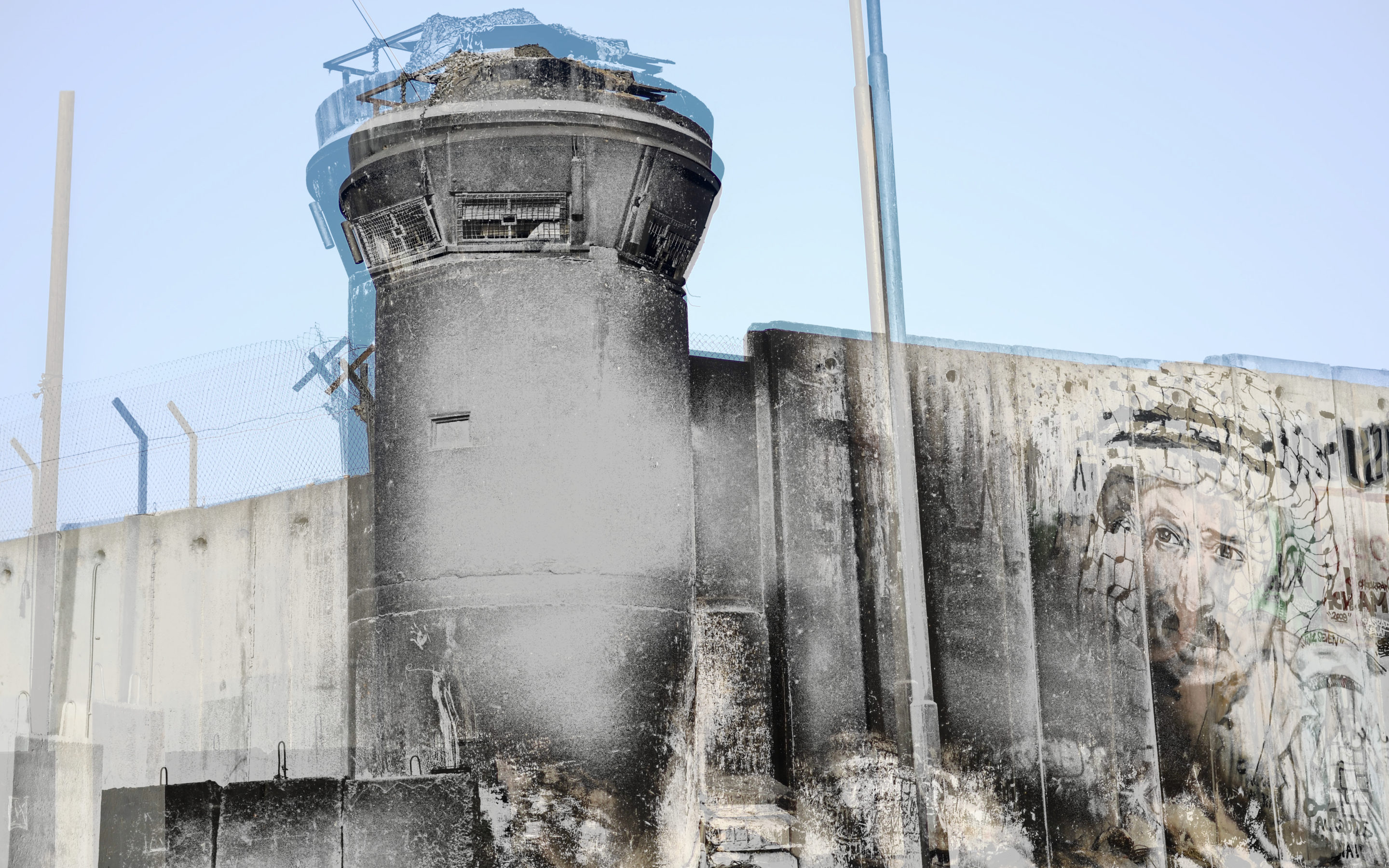
Qalandiya—known to everyone for its checkpoint, the wall plastered with Barghouti’s portrait, and the charred watchtower—is the main crossing point between Jerusalem and the West Bank and, above all, a symbolic site that embodies the humiliation of controls, apartheid‑like restrictions, and the inability of many Palestinians to leave their own territory. In Arabic it is called hajez. Israelis control everything that passes into Israel there.
Qalandiya is also something of a knot at the heart of Palestine. Directly below the checkpoint stretches the refugee camp, and between the two runs Route 60, which links Jalame (north of Jenin) and Meitar (south of Hebron), the two checkpoints that bookend the West Bank. It is a bottleneck that rarely clears: cars crawl forward, honk, turn around, and seem to overlap each other in an almost suffocating jam. White and green buses may cross into Israel, as can vehicles bearing yellow Israeli plates. All others—yellow “services” and cars with the green‑white Palestinian plates—must stay within the West Bank. Like all Palestinians without Israeli residency permits, they are barred from their own land.
Young men, armed and exuding a swaggering contempt, carry out the security formalities. Passports and visas, Palestinian ID cards, and residence permits are mandatory. Pedestrians pass through grids that resemble cattle‑holding corridors. Turnstiles constantly jam, opening only at the whim of the adolescent‑looking soldier conducting the checks, while queues can stretch indefinitely. Above each turnstile sit two lights—a red and a green—but a green light does not necessarily mean the gate is open. The endless cycle repeats: you pass, you pass again, you set your bag on the scanner and press your passport against the armored glass. Changing buses costs five shekels; a bus ride from Ramallah to Jerusalem (Damascus Gate) is eight shekels.
Over the checkpoint stand three of those familiar watchtowers that punctuate the Palestinian landscape. The one overlooking the entrance to the refugee camp is blackened with soot. Tires were set ablaze at its base during clashes that, in that spot, occur weekly—and, since the death of Mohammed Abu Khdeir, daily. During Ramadan they usually begin after Iftar, the evening meal that breaks the fast.
I found myself caught in one of those confrontations on my way to Shu’afat. At moments the soldiers moved close to the Palestinians to launch stun grenades, or hid behind barrels on the left sidewalk to fire live rounds. A sniper crouched behind a blue water tank, adjusted his aim, and fired repeatedly—whistling and a faint metallic crack. On the Palestinian side there were about forty people armed with stones and slingshots—the inverted myth of David versus Goliath, minus the victory. In the end, two Palestinians were wounded by gunfire.
Taking advantage of a lull, I slipped away to rejoin the road to Shu’afat…
East Jerusalem rises up following the death of Mohammed Abu Khdeir
After the kidnapping of three young Gush Ezion settlers, Israel’s government—ever quick to blame Hamas—still could not locate Eyal Yifrach, Naftali Frankel or Gilad Shaer alive. The Shin Bet (Israel’s internal security service) now has to admit its failure. The three were found dead in Halhul, north of Hebron, and buried in Modiin on July 1.
The discovery ignited a wave of fury. Within 24 hours, hundreds of extremists flooded the internet with calls for the murder and genocide of Arabs, despite the victims’ parents urging restraint and reminding skeptics that “the same blood runs in the veins of Arabs and Jews.”
On the dawn of Wednesday, 16‑year‑old Mohammed Abu Khdeir was seized by three men outside a shop in Shu’afat. His charred body was later recovered in a nearby forest; the autopsy showed he had been burned alive after being beaten. The next three days saw Shu’afat and several East‑Jerusalem neighborhoods—Beit Hanina, at‑Tour, Silwan, Ras al‑‘Amoud and al‑Eesawiyya—rise in protest.
July 4, the first Friday of Ramadan, was marked by massive funeral rites for Mohammed in Shu’afat, drawing more than 10 000 mourners. Israel barred the ceremony from Al‑Aqsa Mosque, which for weeks had endured violent incursions by Israeli fanatics accompanied by soldiers.
That night, roughly 200 demonstrators clashed with Israeli special forces at the Beit Hanina–Shu’afat junction. Molotov cocktails, stones, rubber‑bullet fire, tear‑gas grenades and water cannons were exchanged. Unlike the earlier episode at Qalandiya, where a sniper perched behind a water tank appeared ready to add another name to the growing list of Palestinian martyrs, the special forces reportedly refrained from using live ammunition.
The Veolia‑Alstom tram line was not spared. Protesters cut the tracks and toppled two poles on the line that connects Jerusalem to the illegal settlements of Giv’at‑Ha Mivtar, Pisgat Ze’ev and Neve Ya’akov, depriving more than 50 000 settlers of tram service. Simultaneously, incidents multiplied across the West Bank: army raids and skirmishes in the Old City of Hebron, the Al‑Arroub refugee camp (Hebron district), the villages of Barta’a ash‑Sharqiyya (Jenin district), Al‑Asakra, Jouret ash‑Sham’a and Um Salmouna (Bethlehem district), leading to further abductions.
From the settler side, new violent episodes were reported: in Osarin (Nablus district), 22‑year‑old Tareq Ziad Odeily was seized by two Israeli vehicles, beaten and left for dead near a field; in Keesan (Bethlehem district), 17‑year‑old Ala’ Mousa Obeyyat was deliberately run over by a settler’s car; and in Sha’aba (Hebron area), 30‑year‑old Bashir Sobhi al‑Mohtaseb was beaten by a group of Kiryat Arba settlers.
A conversation with a group of young Karmi Zur settlers camping outside Halhul revealed once again how misinformation and hatred shape their worldview, prompting them to see every Arab as a butcher and terrorist. Their interaction with me was surprisingly cordial—they even offered chocolate. During our talk I heard them claim that Palestinians have no reason to complain because Israel “generously gave them the Gaza Strip—now full of luxury hotels—and provides water and electricity for free.” They also asserted that Arabs are educated from childhood to kill Jews and that the proportion of fanatics in Israel is infinitesimal. The settlers believe they alone live in fear and view each new settlement as a way to further bind Jews in the occupied territories for protection against Arab aggression. They do not even recognize the label “settlers” applied to them.
When they invited me to wait for a gathering that would be guarded by soldiers for our safety, I declined. I preferred to leave before engaging in any deeper debate with the Israeli forces, opting instead to spend the early evening on a bus packed with “dangerous Palestinians” on my way back to Ramallah.
Mounir Ahmad Al Badareen: a dove has fallen
July 14, pre‑dawn – Between four and five a.m. in the village of As Samuʾ (Hebron district), Israeli army jeeps rolled into the town.
Violent clashes erupted when residents tried to drive the intruders away, pursuing them to the edge of Route 60 at the western tip of the village. The road slices the hill there like an open wound in the landscape, linking the settlements of Otni’el and Shim’a before continuing toward Beersheba beyond the “wall of shame.”
Mounir Ahmad Al‑Badareen, 19, was among those who attempted to resist with stones. Stones against rifles—the drama and tragedy of an unarmed youth risking his life daily to shake off oppression.
Palestinian projectiles ricocheted down the road; their impact marks were still visible two days later. The youngsters were exposed, standing too close to the road’s lip. A soldier fired two .22 calibre dum‑dum rounds—ammunition banned under the Hague Declaration of 1899 and prohibited in 2001 for crowd control by the Israeli army’s chief legal officer—into Mounir’s torso. His friends fled.
Witnesses later described the routine brutality of the adolescent soldiers, who mishandled Mounir’s wounded body and blocked a Red Crescent ambulance from reaching him while his blood drained away. It took forty minutes for him to become a shaheed, a martyr for a desperate cause.
The following day, Ahmad Hamdan Al‑Badareen, an English teacher and Mounir’s father, spoke with humility about his son’s fate. He shared his broader view of the Israeli occupation and his unconditional wish for a just peace—a vision far removed from the revenge narrative often ascribed to Palestinians. In his view, a fair peace can exist only when walls fall: “No peace without freedom; no freedom without struggle.” The father and the slain son’s memory seemed to converge on that sentiment.
That evening, Mounir’s family welcomed me into their home as if I were one of their own, despite our differences and their grief. Sitting among them in the communal hall, I witnessed a ceremony attended by hundreds of locals and outsiders who came to offer condolences.
Mounir kept a pigeon loft. By killing him, the Israeli soldiers struck at a symbol of freedom itself.
The Palestinian Authority at the service of the settler
Israel appears able to lean on the Palestinian Authority to suppress any spark of popular revolt. Historically, the Palestinian people have been split between those who see a necessary uprising as inevitable and those who cling to the hope of a peace brokered through diplomacy—even at the cost of unbearable compromises. It seems that the prospect of securing crumbs from endless negotiations with the White House motivates Mahmoud Abbas to polish the shoes of the Israeli colonial state.
Fatah’s strategy since Yasser Arafat’s death has shifted dramatically. The comfortable Palestinian elite now seems to have nothing to gain from armed struggle and prefers pacification and compromise. This collaboration between the Palestinian bourgeoisie and the occupier, once again, appears to be a prerequisite for the creation of a new state.
While the Israeli army multiplies operations aimed at decapitating Hamas in the West Bank—carrying out arbitrary nighttime arrests across cities and villages in the occupied territories—the Palestinian Authority assists the occupier in its effort to choke resistance.
Since the beginning of the week, wherever Palestinian youth traditionally take up arms against the occupation, the Palestinian police have intervened to prevent conflict, forcibly interposing themselves between protesting civilians and Israeli soldiers.
That is exactly what happened last night in Al Bireh, when Palestinian anti‑riot forces blocked the road leading to the settlement‑garrison of Beit El, and similarly in Qalandiya, where the Authority’s police took over from the Israeli army to violently suppress rioters.
Following the sniper‑kill of Mahmoud Ismael Atallah in central Ramallah on 22 June, the Palestinian police opted for repression, quashing any uprising in the city. That intervention culminated in an attack on the police station by residents. Palestinians are not fooled.
What does the Palestinian Authority hope to achieve? If Abbas pushes collaboration with Israel as far as he wishes, no peace will ever be acceptable without the dismantling of all West Bank settlements, the implementation of the right of return for refugees, unrestricted movement for all Palestinians, and the removal of the apartheid wall. Conversely, if the Authority stubbornly persists on a path of compromise, it will reap the opposite of what it claims to seek—and a third intifada could prove fatal to it.
Overview of the clashes around Ramallah
The bloody toll continues to climb in the Gaza Strip: 583 Palestinians killed and 3,640 wounded (including many amputations) since July 8. The United Nations even publishes morbid charts, assigning a tiny silhouette to each victim. Every day the local media are flooded with horrifying images—bodies torn apart, videos of snipers executing people live—followed by the unspeakable comments of genocide supporters. The war is waged online as well as on the ground.
Meanwhile, Israeli demonstrators shout loudly for murder in the streets, erecting anti‑Arab, anti‑left checkpoints in Haifa and Tel Aviv. The idea is to force motorists to chant “death to the Arabs,” under penalty of being beaten. The atmosphere is nauseating.
On the other side of the wall, clashes with the Israeli army are daily, and the number of injured is staggering. Israeli soldiers fire live rounds, hitting targets multiple times per hour. In the Ramallah suburbs I have watched stone‑throwers fall one after another, crouching or sprinting from cover to cover. Stones and Molotov cocktails rarely reach their targets, while bullets seem to pierce everything. Rifles sweep the darkness, a metallic snap follows, and a whizzing bullet flies—life and death reduced to a coin toss.
Around Ramallah, several hotspots heat up every night after the evening prayer (Isha), roughly from 10:30 p.m. until three or four in the morning:
OFER – The town is actually called Betunia, but the fighting takes place a few hundred metres from the Israeli Ofer prison and its checkpoint. Ofer, together with Megiddo and Ktzi’ot, is one of the three main Israeli detention facilities holding between 800 and 1,200 Palestinian prisoners. The prison looms in the background; in the foreground a narrow road leaves Betunia toward the checkpoint, where an expansive vacant lot offers no shelter. Atop a hill stands a factory owned by businessman Yasser Abbas—son of Mahmoud Abbas—who manufactures cigarettes. The enterprise, built on wealth accrued since the Oslo accords, underscores how little the Abbas family seems to care about the peace process. Yasser, a Canadian citizen, watches the clashes from a small balcony while his security detail observes. Palestinians use the steep slopes near the factory for cover, hurling stones at vehicles that shuttle back and forth across the vacant lot. They also try to approach the eastern flank of the hill, which looks directly onto the Wall, where soldiers keep a gate ready for counter‑attacks.
QALANDIYA – I have described this site previously. Its terrain is treacherous. The checkpoint is fortified with concrete blocks, behind which soldiers take up firing positions. On either side of the perpetually congested road lie cramped stalls with virtually no shelter. To the right, a massive embankment shelters a restaurant, a metal shed, and construction equipment that can be used as cover. In the centre, traffic streams continuously through the fighting as if nothing were happening. To the left, a covered sidewalk runs past shuttered shops. Clashes usually begin with piles of tires set ablaze on the road, then shift up the hill that skirts the Wall. The layout rarely allows anyone to get closer than 150 metres to the checkpoint—beyond that range only slingshots have a chance of hitting anything.
BEIT EL – What is commonly called Ramallah actually comprises two adjacent towns: Ramallah to the west and Al Bireh to the east, linked by Route 60. Leaving the city at a roundabout, a massive concrete flagpole rises, topped by a Palestinian flag—a defiant banner to settlers and soldiers across the street. To the east, two settlements—Psagot and Beit El—overlook the town; the latter shares half its territory with a military base. Most of the clashes occur near that base, north of the Ramallah‑Al Bireh corridor, behind a cluster of houses and an Al‑Huda gas station. The terrain is largely exposed; only the houses and their low walls provide any cover. On July 20 the fighting there reached a particularly violent peak.
AR‑RAM – This town sits directly above the Qalandia checkpoint to the south. Its main entrance is a wide roundabout on the winding Route 60 that leads to Bethlehem. It was here that 20‑year‑old Mahmoud Hatem Shawamra was killed on July 21. Accounts of his death diverge: some say a settler shot him, others claim Israeli soldiers fired at his back. He died in a military ambulance bound for nearby Hizma. Youth gathered at the spot where he was allegedly shot, surrounded by discarded Israeli medical gear. No evidence confirms a settler’s involvement; the location is precisely where clashes regularly erupt, at the entrance to Ar Ram.
From there a protest marched after news of his death, first toward the center of Ar Ram and then toward armored Israeli units that had been positioned for hours opposite the town’s roundabout. To reach the soldiers, protesters first had to exit the town and get onto the road, but the troops were entrenched behind a concrete barrier and quickly repelled attacks with well‑lit gunfire.
Beyond the Ramallah district, daily clashes are reported from Hebron, Halhul, Beit Umar and Al‑Arrub, where the population endures regular army incursions. Yet the conflict is not confined to a handful of towns or villages that bear the torch of Palestinian resistance; wherever Israeli soldiers set foot, locals respond with stone‑throwing. The intense events of the past month have reignited the anger of a population pressured far too long.
Some Western observers see the non‑violent Friday protests in Bil’in, Ni’lin, Nabi Saleh, Al Masara and Kufr Qaddum as the future of Palestinian insurrection. In reality, everyday resistance is far less visible and receives far less media coverage outside local outlets. Most of it unfolds after dark.
Occupying forces do not like witnesses
Friday, July 18, proved especially tense between Palestinians and the Israeli army. As on many Fridays across the occupied territories, Palestinians stormed Israeli forces and installations—not with weapons, but with the almost suicidal determination that has become their hallmark. Yesterday’s resolve was sharpened by a desire to show solidarity with Gaza’s residents, who have been massacred for weeks by Israeli troops.
In the afternoon I first made my way to Ofer.
The clashes there meet an often disproportionate Israeli response; soldiers do not hesitate to fire live rounds when tear gas and rubber bullets fail to achieve their aims. During these displays of force, the Israeli army frequently makes no distinction between rioter, medic, passerby or journalist. On that day I witnessed a deliberate hunt for journalists. Military jeeps repeatedly approached reporters in a threatening manner, forcing them back into their vehicles before deliberately tossing gas grenades at their feet. Later, a water cannon was used to “clean” the journalists present.
I experienced that targeted violence firsthand. While standing alone ahead of an armored army vehicle, a rubber‑bullet struck me squarely in the chest, even though I was holding my camera at eye level. It is indisputable that, as a witness, I was the direct target of that shot, and the soldier firing from the vehicle’s door clearly knew the projectile would hit me just centimeters from my face.
Late that evening the fighting broke out near the Qalandia checkpoint. Arriving with a photographer friend and trying to get as close as possible to the Israeli soldiers while gunfire raged, we found ourselves alongside Palestinian television journalists under heavy Israeli fire. One of the journalists, Fadi Al Jayoussi, was hit in the leg.
Israel once again displayed blind, indiscriminate violence, even as the Gaza operation—condemned worldwide—has already claimed 316 lives and injured more than 2,200 people, the majority of them children.
Enough is enough: Israel fires on crowd at Qalandiya
On July 24, a collective called for a demonstration to mark the Nakba—the destruction of roughly 400 Palestinian villages and the forced exile of 700,000 Palestinians during the founding of the State of Israel. The protest was slated to depart from the Al‑‘Amari refugee camp, force its way through the Qalandia checkpoint, and continue on to Jerusalem and the Al‑Aqsa Mosque, which had been closed to anyone under 50 for several days even as Muslims prepared to celebrate the end of Ramadan.
Posters posted throughout Ramallah announced a 21:30 start time. Yet thousands of Palestinians were already gathered on Route 60 well before the hour, forming a sea of Palestinian flags and keffiyehs. With a photographer friend I set out to join the head of the march, but it took an hour to catch up with the procession. By then the front of the march had already reached Qalandia, where the Israeli army had, for hours, sealed the checkpoint with concrete blocks and steel grates, waiting resolutely.
The Israeli forces were invisible to us, blinded by a massive floodlight mounted on one of the watchtowers that bathed the entire scene in blinding glare.
The clash had been underway for some time; hundreds of stones already littered the ground. As we arrived the crowd grew denser and dozens of ambulances were already making their frantic rounds. Black clouds billowed from burning tires, and in front of us dozens of Palestinians hurled projectiles at the Israeli convoy, taking cover behind scant obstacles—a central median wall, a tired warehouse, a garbage bin and a metal barbecue grill. Hundreds of people crouched in tight groups, trying to avoid Israeli fire.
From the front of the scene we were thrust straight into the horror: a stretcher carried in the body of the first martyr, his forehead pierced by a bullet. Every two minutes another group pulled a wounded person toward awaiting ambulances. Repeated pleas for medics, thick plumes of black smoke, the crack of gunfire, fireworks and ambulance sirens created an apocalyptic tableau. The Arabic word “SA’AF!” (paramedic) echoed over the chaos.
Having lost sight of my friend, I moved around the battlefield—right beside the separation wall, left onto rooftops, and in the middle of the road—spending about fifteen minutes lying flat against a wall with dozens of others while Israeli shooters fired just above our heads. The green laser sights of Israeli rifles and the high‑pitched whine of bullets were terrifying.
There were a few instances of live fire from the Palestinian side, met with whistles and applause, but overall the fight was waged with stones, Molotov cocktails and fireworks. Repeated Palestinian assaults, shouted with “Allāhu Akbar!”, were answered by bursts of gunfire, bullets whizzing through the crowd and striking moving bodies. The clash left roughly 287 injured and two dead, figures that should soon be confirmed by doctors at the Ramallah hospital. Many of the wounded—and likely one of the fatalities—came from the Al‑‘Amari refugee camp.
I would later find out the identity of the young man I saw on the stretcher: Muhammad al-A’raj, from Qalandiya, killed at the age of 17.
I left the battle around 3 a.m., when the crowd had thinned and staying any longer grew increasingly dangerous. I, like many here, had hoped the march would force the checkpoint open, but the struggle was starkly uneven. Despite the unwavering determination of hundreds of young Palestinians daring to face the bullets, the assault lacked organization: no shields, virtually no barricades, and almost nothing to protect the demonstrators.
Back in Paris, my mind is still on fire
I returned from Palestine this Monday and am trying to put my thoughts in order, to revisit what I saw, the conversations I had, and the sensations I experienced during the 45 days I spent in Israel and the West Bank.
Putting aside Orientalist or exoticising lenses, I found among the Palestinians an incredible hospitality and an openness of mind that is hard to comprehend. After so many years of deprivation and violence, it is astonishing that the Palestinian people can still summon the strength to love the Other and open their doors to strangers. One might expect that a people whose lives are strewn with tragedy would inevitably be driven by their darkest emotions, that a wounded nation’s destiny is to unleash itself in adversity and terrorism. But that is not the case.
Martyrdom is part of Palestinian life, and dying at the hands of the enemy is regarded by the families of shaheed both as a tragedy and an honor. Yet I did not encounter the fanaticism that some attribute to all Palestinians or the assumption that every Palestinian supports suicide attacks.
At the same time, I must admit that I feel neither contempt nor indifference toward those who have chosen to give their lives for freedom, whether out of anger, despair, or hatred. Putting one’s life on the line is never a simple choice; it is often the culmination of a long descent into hell, a slow awareness of life’s futility in contexts where everything obstructs happiness and joy. Israel has created the conditions for its own destruction by continually crushing an entire people under a steel heel, under the pretext of fighting terrorism, while the root of that terrorism lies in the very origins of Israel’s creation: without the demolition of hundreds of villages, without the assassination and expulsion of thousands of Palestinians from their lands, and without the occupation, there would be no terrorism.
In Palestine I was never afraid. The only moments I felt fear were when I was in contact with settlers and Israeli soldiers. They are as fearful as they inspire fear because they are made of fear. Confined to residential enclaves surrounded by walls and barbed wire, armed with automatic weapons and accompanied by armed men, they express distrust and contempt and have forgotten their humanity. Their aggression often extends even to non‑Palestinians. The excuses they might offer to justify their closed‑off stance are false: they are not in danger. A simple comparison of Israeli and Palestinian death tolls since 2000 shows that they are not the ones who need protection and security the most.
But when you speak with them, it quickly becomes clear that they are steeped in myths and prejudices, convinced from a young age that the Arab is a murderer and a liar who only wants the destruction of Jews. Among settlers, it is said that Arab children learn to kill at school, that the notion of peace does not exist for them, that Arab civilization lacks faith and law, and that the Qur’an teaches only violence. Talking with settlers made me hear things I never imagined could come from a people long persecuted and victimised by racism. These Jews have forgotten.
During my month in Palestine I discovered that Israeli societal racism is extreme, capable of taking the form of pogroms comparable to those that caused the deaths of thousands of Jews in Russia between 1880 and 1945. I saw large groups of young Israelis descend into the streets shouting “death to the Arabs,” beating their detractors, expressing murderous desires, and openly insisting on targeting children and pregnant women so that the Arab race would not reproduce. Israeli elites may claim these are marginal positions, but the statements of public figures, the state’s tacit approval of settler violence, and the propaganda surrounding the massacre of Gaza’s population all send encouraging signals to Israeli fascists.
Nevertheless, there are many Israeli voices opposed to the state’s policies: Jewish peace organizations, anti‑Zionist Orthodox Jews, left‑wing activists, anarchists against the wall. They, too, face unparalleled violence, accused of betraying their people and of playing into antisemitic narratives, even though they are merely denouncing Jewish nationalism.
Palestine is undeniably a land of contrasts and dissonances. When I trace the events of the past month, the inconsistencies pile up. Nothing today clarifies, for example, the circumstances of the deaths of the settlers Gilad Shaer, Naftali Fraenkel and Eyal Yifrah, whose bodies were found almost intact after two weeks under a pile of rocks in full sun. Israel rushed to accuse two young Palestinians from Halhul—never located—before demolishing their families’ homes and arresting their relatives. Military operations across numerous West Bank towns, settler violence, the assassination of the young Palestinian Mohammed Abu Khdeir in Shu’afat, and the bombing of Gaza have resulted in weeks of daily clashes in which hundreds of Palestinians have been injured and about twenty killed in the West Bank.
Who bears responsibility? What will become of the fanatics who burned Mohammed Abu Khdeir alive? They have already been released under judicial supervision. What will become of the soldiers who, deliberately, with their advanced weaponry, shot Palestinians armed only with stones? They are praised; they have done their job. Israel thanks its assassins.
Meanwhile in Gaza, the toll stands at 1,422 dead (23 % children) and 8,265 injured as of 31 July—surpassing the casualty counts of previous operations. Israel does not defend itself; it exterminates. Some speak of genocide, a term that should not be used without UN endorsement.
I left Palestine as the Al‑Aqsa Martyrs’ Brigades—the armed wing of Fatah—launched targeted attacks against Israeli forces and settlers in the West Bank, in solidarity with Gaza and in support of Hamas actions. Suffice it to say, the summer is far from cooling down.
