
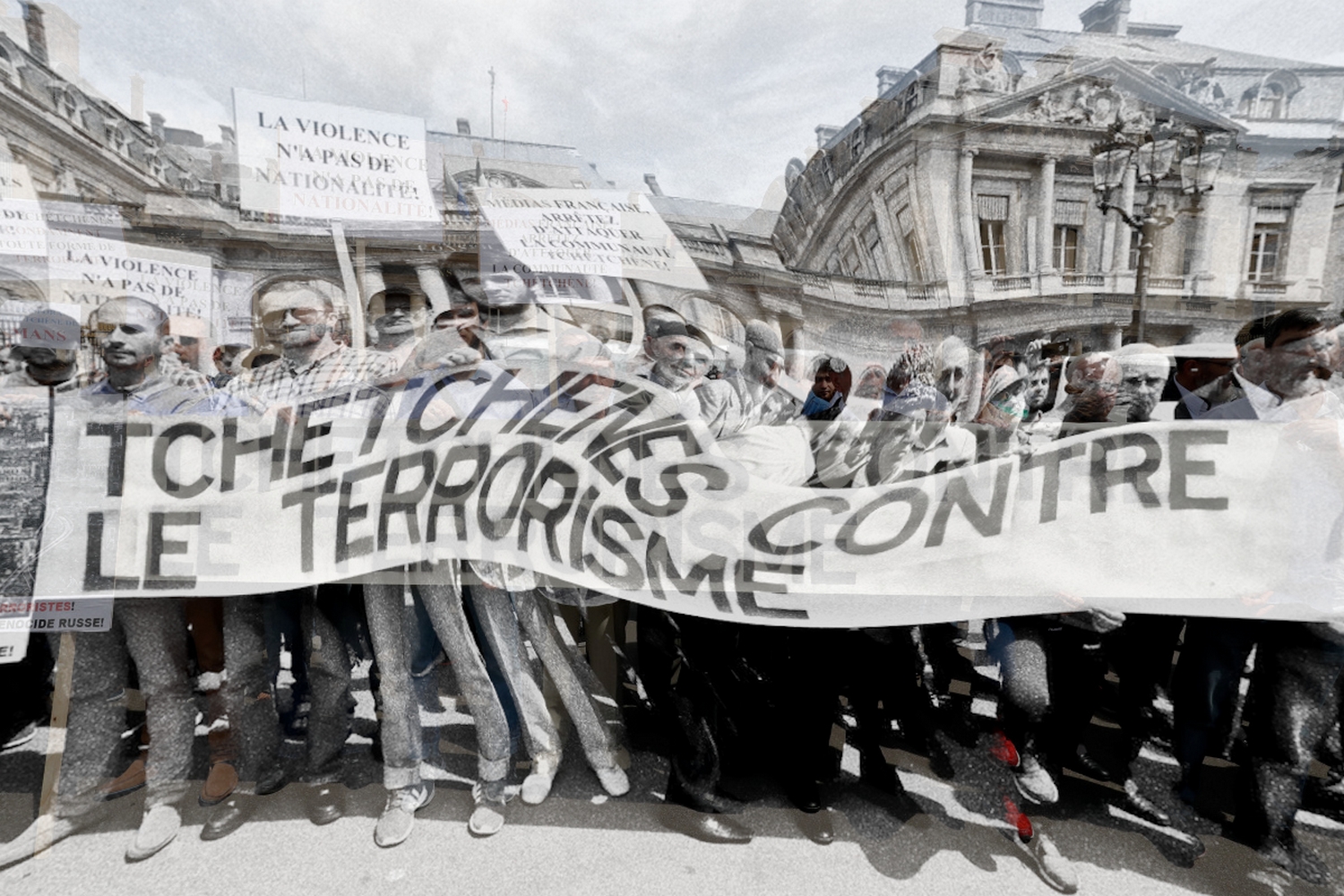
The Chechens, between extermination, exile, and counterterrorism
About the author: Cédric Domenjoud is an independent researcher and activist based in Europe. His research areas focus on exile, political violence, colonialism, and community self-defense, particularly in Western Europe, the former USSR, and the Levant. He is investigating the survival and self-defense of Syrian communities and developing a documentary film about Suwayda, as part of the Fajawat Initiative.
Since the beginning of April and the publication by the Russian opposition newspaper Novaya Gazeta of an article mentioning dozens of arrests of people for their actual or supposed homosexuality, we are (finally) hearing once again about what is happening in Chechnya.
Satellite images have proven that Chechen strongman Ramzan Kadyrov has imprisoned, tortured, and even disappeared numerous individuals in his secret prisons in Argun and Tsotsi-Yurt. The international press is quick to refer to these as “concentration camps” for homosexuals, adding horror to horror, while the original article in Russian merely reveals what has already existed for decades: secret bases where Kadyrov’s militias have always been active.
This massive attack on homosexuals accompanied attempts by LGBT activists to organize several gay pride events in four cities in the Caucasus. Requests to this effect were made on March 9, 2017 (see Novaya Gazeta article) to local authorities by Nikolai Alekseev and Vladimir Klimov, announcing the participation of several hundred people. A new wave of persecution immediately followed the announcement, which was merely a new pretext for attacks already initiated earlier by the government militias against homosexuals.
Some information from the mainstream media is available here and there in French.
This “cleansing” campaign is part of a long history of arbitrariness and violence.
The Chechen context
Since the official end of the second Chechen conflict, the inauguration of Ramzan Kadyrov, and the definitive withdrawal of Russian troops from the Chechen Republic in 2006, Kadyrov’s militias have been waging a systematic policy of terror that leaves little choice but to flee or suffer for those who survived Russia’s unspeakable 10-year war on the small republic. Kadyrov’s arbitrary power means random violence against anyone who does not publicly pledge allegiance to the tyrant.
After conscientiously eliminating all opposition, assassinating human rights defenders (Anna Politkovskaya, Natalya Estemirova, Stanislas Markelov, Anastasia Baburova, etc.) and closing their offices in Grozny (Memorial Association), Kadyrov launched a sinister vendetta against all the families of those who fled abroad or who, directly or indirectly, certainly or allegedly, helped or participated in the armed rebellion against the pro-Russian government. Torturing and murdering people in his secret prisons, burning down the houses (sources: 1, 2, and 3) of the parents of suspected combatants, he even went so far as to have the only person who dared to file a complaint against him directly with the European Court of Human Rights, Umar Israilov, assassinated in the heart of Europe, in Vienna, in January 2009. the only person who dared to file a complaint directly against him with the European Court of Human Rights, Umar Israilov. His assassin, Lechi Bogatyrev, is now police commander of the Pobedinskoe district of Grozny. For several months now, Kadyrov has also been staging weekly public humiliation sessions on local television, in which he and his lieutenants lecture people who bow down to them, accusing them of everything and anything (see 1, 2, 3, 4, 5, 6, 7…). Many of those lectured in this way subsequently disappear without trace. Finally, since 2014, Kadyrov has been sending his own men, willingly or by force, to fight in eastern Ukraine alongside Russian forces (see Euronews report).
Consequently, the murderous frenzies of Chechen “Ubu the King” benefit from the complicity of the Kremlin, preventing any Chechens from seeking refuge elsewhere in the Russian Federation. Kadyrov is the Kremlin’s ruthless puppet, whose iron fist guarantees Russia’s continued domination over the Chechen Republic.
An unbearable exile
Fleeing the country in their hundreds, Chechens first cross Belarus, which has still not reestablished its borders with Russia, before being screened at the Polish border in Terespol. For the past year, Poland has decided to drastically restrict access to its territory, turning back the vast majority of Chechens at the border crossing, causing hundreds of people to become stranded in Brest, in western Belarus. This is at the request of the European authorities and Frontex, who care little about the fate of asylum seekers who are turned away at the gates of the Schengen area.
Those who make it to Poland, despite the fact that there seems to be enough space in shelters for asylum seekers, quickly realize that it is a dead end and that they will never be granted any status that would allow them to live decently in the country. Not to mention that in Poland, as in Austria, Kadyrov’s men are everywhere and regularly resort to pressure, threats, and aggression. As a result, Poland is often only the beginning of the road that leads Chechens to Germany, Scandinavia, the Benelux countries, or France.
Once they arrive in Paris, most Chechen asylum seekers are placed under the Dublin Convention and forced to hide for 6 to 18 months while France tries to send them back to Poland (or another country considered responsible for their asylum application). During this interminable period of hiding, the Paris Prefecture sends them summonses to the 8th office (N.B.: other prefectures also have their own “deportation offices”), which are nothing more than ambushes designed to try to put them on a plane before they can file their asylum application in France.
And even when their asylum applications are registered, the Code on Entry, Stay and Asylum Application (CESEDA) has become increasingly strict over the past four years, leading to an exponential increase in rejections by the French Office for Refugees and Stateless Persons (OFPRA) or the National Court of Asylum (CNDA) . The further away the official end of the war in Chechnya becomes, the less likely Chechens are to have the threats they face if they return to their country recognized. This is despite the fact that the huge Chechen diaspora, the international community, NGOs, and journalists are (almost) unanimous in saying that Chechnya is an open-air death trap. This does not matter to asylum judges, who insist without blushing that applicants must provide them with “new evidence” and “be more persuasive during hearings.”
An increase in deportations means an increase in refusals of residence permits and orders to leave French territory. We know what happens next: the plane. But after that, we don’t know: Europe cares little about the fate of those who have been handed over, bound hand and foot, to the Russian police.
Counterterrorism and racist stereotypes
Disdainful of the plight of thousands of Chechen refugees who have been struggling for more than a decade in the Schengen Area, European authorities have decided to impose a double punishment on the Chechen diaspora since the start of the war in Syria.
In France, following the attacks in January and November 2015, the Central Territorial Intelligence Service (SCRT) and the General Directorate for Internal Security (DGSI), both newly established in 2014, have further tightened surveillance of Muslims, particularly Chechens.
The paranoid and fabricated notes of the intelligence services, fueled by a striking ignorance of the Muslim religion and its practices, but also by indifference to the history and experiences of the Chechen community since the 2000s, serve to justify administrative measures that allow for the harassment and arbitrary deprivation of liberty:
On November 20, 2015, Lioma, a 41-year-old refugee since 2007, was placed under house arrest at his home in Ingré. His house arrest was finally overturned by the Orleans Administrative Court more than 10 months later, in October 2016.
On November 21, 2015, at around 2:30 a.m., RAID police officers raided the home of Magomed, a 32-year-old refugee since 2006 and father of nine children, in the Cité des Chaumes neighborhood of Montauban. He was immediately placed under house arrest. The order was finally revoked two months later.
At the same time, two other Chechens were placed under house arrest in Montauban, in the Beausoleil and Montplaisir neighborhoods. Their house arrest orders were also lifted after two months.
On November 26, 2015, at 7 a.m., around 20 GIGN police officers raided the home of Saïd Ahmed Itaev, a 33-year-old father of five who had been naturalized as a French citizen in 2007, in Sarreguemines. He was immediately put under house arrest.
On November 30, 2015, at 6 a.m., around 20 police officers from the SWAT team raided the Madiev family home in Rouen and conducted a search as part of the state of emergency. The search proved fruitless.
On January 25, 2016, at around 11 p.m., several dozen police officers from the SWAT team conducted simultaneous searches of the homes of Aslan, Ibragim, and Issa, three Chechens aged 32, 24, and 29 living in the Croix-du-Sud neighborhood of Reims, who had been refugees in France since 2010.
On September 9, 2016, Mansour Koudousov, 25, was deported to Russia after being placed under house arrest in Die (Drôme) since 2012, following the Merah case.
There are dozens of stories like these. Among the more than 3,000 home searches and 400 house arrests carried out during the state of emergency, many Chechens were affected. In almost all of these cases, there has been no legal follow-up, no solid evidence, but rather baseless speculation, referring to “alleged links” and “signs of radicalization,” “trips” to Turkey and Ukraine, or even visiting “Islamist websites.” In this case, Chechen news sites such as Checheninfo, Kavkaz Center, Chechen Press, Nohchicho, Chechen News, Golos Ichkerii, Ichkeria Info, and Waynakh.com, which are visited by the diaspora, are not Islamist websites, but community news sites, even though they have religious sections and give a voice to the Chechen rebellion (= opposition).
Extraditions to Russia
Disdainful of the plight of thousands of Chechen refugees who have been struggling for more than a decade in the Schengen Area, European authorities have decided to impose a double punishment on the Chechen diaspora since the start of the war in Syria.
In France, following the attacks in January and November 2015, the Central Territorial Intelligence Service (SCRT) and the General Directorate for Internal Security (DGSI), both newly established in 2014, have further tightened surveillance of Muslims, particularly Chechens.
The paranoid and fabricated notes of the intelligence services, fueled by a striking ignorance of the Muslim religion and its practices, but also by indifference to the history and experiences of the Chechen community since the 2000s, serve to justify administrative measures that allow for the harassment and arbitrary deprivation of liberty:
On November 20, 2015, Lioma, a 41-year-old refugee since 2007, was placed under house arrest at his home in Ingré. His house arrest was finally overturned by the Orleans Administrative Court more than 10 months later, in October 2016.
On November 21, 2015, at around 2:30 a.m., RAID police officers raided the home of Magomed, a 32-year-old refugee since 2006 and father of nine children, in the Cité des Chaumes neighborhood of Montauban. He was immediately placed under house arrest. The order was finally revoked two months later.
At the same time, two other Chechens were placed under house arrest in Montauban, in the Beausoleil and Montplaisir neighborhoods. Their house arrest orders were also lifted after two months.
On November 26, 2015, at 7 a.m., around 20 GIGN police officers raided the home of Saïd Ahmed Itaev, a 33-year-old father of five who had been naturalized as a French citizen in 2007, in Sarreguemines. He was immediately put under house arrest.
On November 30, 2015, at 6 a.m., around 20 police officers from the SWAT team raided the Madiev family home in Rouen and conducted a search as part of the state of emergency. The search proved fruitless.
On January 25, 2016, at around 11 p.m., several dozen police officers from the SWAT team conducted simultaneous searches of the homes of Aslan, Ibragim, and Issa, three Chechens aged 32, 24, and 29 living in the Croix-du-Sud neighborhood of Reims, who had been refugees in France since 2010.
On September 9, 2016, Mansour Koudousov, 25, was deported to Russia after being placed under house arrest in Die (Drôme) since 2012, following the Merah case.
There are dozens of stories like these. Among the more than 3,000 home searches and 400 house arrests carried out during the state of emergency, many Chechens were affected. In almost all of these cases, there has been no legal follow-up, no solid evidence, but rather baseless speculation, referring to “alleged links” and “signs of radicalization,” “trips” to Turkey and Ukraine, or even visiting “Islamist websites.” In this case, Chechen news sites such as Checheninfo, Kavkaz Center, Chechen Press, Nohchicho, Chechen News, Golos Ichkerii, Ichkeria Info, and Waynakh.com, which are visited by the diaspora, are not Islamist websites, but community news sites, even though they have religious sections and give a voice to the Chechen rebellion (= opposition).
On a regular basis, the DGSI submits memos to the Department of Public Freedoms and Legal Affairs (DLPAJ), recommending action against individuals for whom there are “serious reasons to believe” that they “pose a serious threat to public order or state security.” This is where Pascale Léglise enters the picture—a senior civil servant and longtime veteran of the Ministry of the Interior, whose daily work is devoted to building cases against individuals for whom there is little or no substantive evidence, beyond the reactionary beliefs of overzealous ministry officials.
This same Pascale Léglise was, on the evening of November 13, 2015, while the Bataclan attack was still unfolding, drafting the decrees implementing the state of emergency by the light of her desk lamp at 11 rue des Saussaies.
She later appeared before the Melun Administrative Court on December 2, 2015, to argue against C., one of the individuals placed under house arrest during COP21. Described as a “leader of the radical ultra-left political scene,” C. was presented as a threat to public order. The house arrest was upheld, including by the Conseil d’Etat, thereby entrenching the draconian security measures of the state of emergency at the highest legal level.
Pascale Léglise appeared once again before the Paris Administrative Court on February 6, 2017, this time to argue against Kamel Daoudi—described as “Bin Laden’s lieutenant”—who had been under house arrest for nine years on the basis of 16-year-old suspicions (read his blog). Daoudi had already served five years in prison between 2005 and 2008. Since then, despite a residence ban, he has been shuttled from town to town while the authorities attempt to find a country willing to accept his deportation.
The most recent illustration of the DLPAJ’s harmful practices came on April 12, 2017, with the action taken against Vakha Djamalkhanov. Vakha, a 25-year-old Chechen granted refugee status in France in 2010, was arrested at his home in Limeil-Brévannes by dozens of heavily armed, hooded SWAT officers—after which he simply disappeared.
The following day, members of the Chechen community mobilized: around 20 people gathered at Place de la République on the evening of April 13, followed by some 70 people at the same location on April 14.
On Friday afternoon, we learned—not from his lawyer, who had been stonewalled by various government agencies, but from another source—that Vakha had been subjected to a provision of the 2014 law “strengthening the fight against terrorism.” This provision allows the DLPAJ to expel, without trial and without the possibility of appeal, any individual for whom there are “serious reasons to believe” they pose a threat to public order or state security. Further investigation revealed that this practice is far from exceptional.
Vakha was thus secretly deported to Russia on Wednesday and handed over to the FSB, after his refugee status had been revoked in 2014. The justification for this relentless pursuit was a trip to Turkey in January 2014, made using a valid Russian passport he had purchased. The suspicion: that he had joined ISIS. In reality, he was traveling to Turkey to meet his future wife.
Whether this claim is true or not, it is certainly not for the FSB to decide—particularly given that all of Vakha’s relatives were systematically executed by Russian forces between 1994 and 2007, often under especially horrific circumstances.
Even as Angela Merkel and François Hollande publicly feign tension in their relationship with Vladimir Putin—suggesting that sanctions further impoverishing the Russian population are an effective means of resistance—European police forces continue to cooperate with Russian authorities under the pretext of combating terrorism and illegal immigration. As early as April, it was reported that Khizir B., another young Chechen, was awaiting extradition to Russia in the German prison of Büren. A rally was held on April 3, 2017, outside the German embassy in Paris. About fifteen people attended, voicing the same message repeated two weeks later: “Don’t help Russia kill us.”
This apparent contradiction does not seem to trouble the French authorities.
As of Monday, April 17, no news had been heard from Vakha for five days. One can only imagine the anguish of his mother, who was present at his arrest alongside her two nieces, aged seven and nine. As with other raids targeting Chechen families, these hooded operations inevitably revive the traumatic memories of the “cleansing campaigns” carried out in Chechnya.
Update: Vakha has since been located in a prison in Chechnya, where he has been convicted of “participation in an armed organization.” France has finally responded to a request from European authorities, tersely confirming that he was deported on the day of his arrest. Swift and efficient.
