
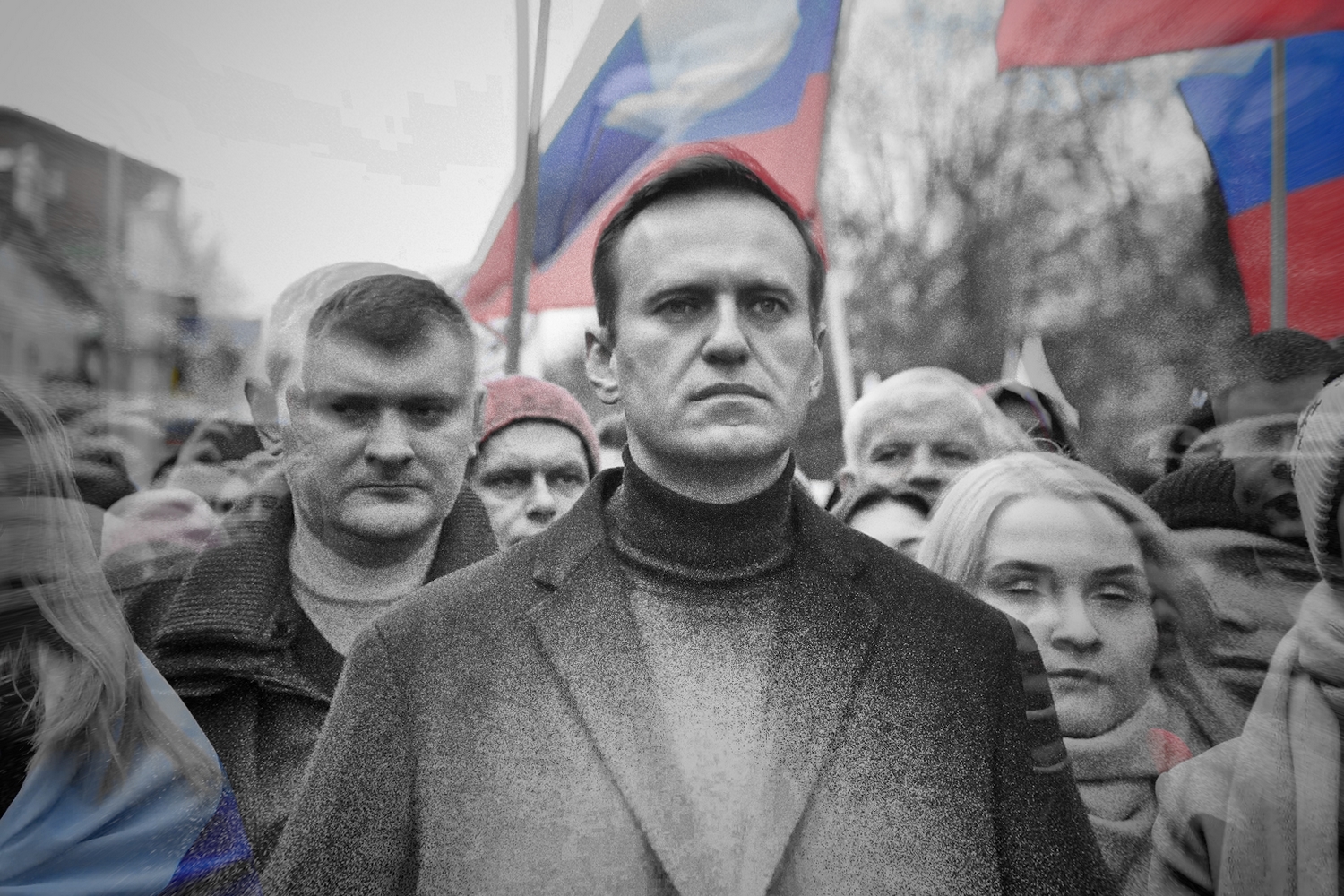
The highly opportunistic opposition of the liberal-nationalist Navalny
About the author: Cédric Domenjoud is an independent researcher and activist based in Europe. His research areas focus on exile, political violence, colonialism, and community self-defense, particularly in Western Europe, the former USSR, and the Levant. He is investigating the survival and self-defense of Syrian communities and developing a documentary film about Suwayda, as part of the Fajawat Initiative.
Please note: this article was written in 2021, before Alexey Navalny’s death in detention (2024).
Starting from 2009, a new opposition figure emerged in Russia, gaining attention for his staunch anti-corruption stance: Alexei Navalny. Here is a brief look at the career of an ambitious man whose reputation as a liberal does not quite match the substance of his ideology.
If there is one thing that unites Russians, it is their chronic aversion to corruption. Popular culture, comedians, cinema, and music openly mock and criticize corruption—whether by the police, oligarchs, or high-ranking officials (chinovniki)—as well as its presence at every level of Russian society. The most common manifestations include bribes (vzyatki) paid to traffic police for often fabricated offenses, or gifts in kind to teachers and instructors to secure a diploma. Even Kremlin-approved comedians do not hesitate to ridicule Vladimir Putin himself, often in front of audiences made up of the very people who are the biggest accomplices and beneficiaries of his corrupt system. They are the modern-day “court jesters.”
Russian social life is indeed riddled with corruption, and promises to eradicate it are the rallying cry of every opposition figure, including so-called “paper opponents” like Vladimir Zhirinovsky, the infamous ultra-conservative populist leader who regularly makes headlines by mocking the inconsistencies of those in power. Yet, he has never faced physical repercussions for his public statements, which help maintain the illusion of pluralism that Putin has carefully cultivated since he was crowned tsar of all the Russias.
Starting in 2009, a new opposition figure emerged in Russia, gaining attention for his staunch anti-corruption stance: Alexei Navalny, then an advisor to the governor of Kirov. Over the next decade, he became the only credible opposition to Putin, running in Moscow’s municipal elections and later in presidential elections, all while facing numerous judicial summonses designed to break his resolve.
If one were to compare Navalny to other political leaders fiercely opposed to corruption (at least while in opposition), one might look to Ukraine’s Petro Poroshenko, Yulia Tymoshenko, or Vitali Klitschko. All three campaigned for power on promises to end endemic corruption, basking in the aura of integrity that surrounds populist leaders opposing dictatorship—only to later lose their way in the labyrinth of ambition and cronyism.
A conservative political background
A brief look at Alexei Navalny’s platform is enough to see that his politics draw inspiration from the ultra-liberal doctrines that, since the 1970s, have championed individualism and competition while dismantling social protections and public services wherever they are imposed by force. Navalny thus follows directly in the footsteps of Thatcher, Reagan, and Sarkozy, and his political program is virtually identical to Macron’s: promises of growth, privatization, the expansion of self-employment, tax exemptions for small businesses, a technological gamble, deregulation of transport, increased military budgets and personnel, and the regionalization and decentralization of government…
There is nothing innovative or progressive in Navalny’s approach, which merely reproduces the precepts that have repeatedly brought populations to their knees under the harsh prescriptions of market economics—enforced by the World Trade Organization, the World Bank, and the International Monetary Fund—around the world. Beyond his neoliberal aspirations, Navalny is also a nationalist. Russian realists will argue that one must be a nationalist (or at least a patriot, if you prefer) to win the hearts of Russians. This is not entirely untrue. But it also condemns Russian society to be endlessly overtaken by its reactionary demons—where racism, homophobia, Islamophobia, and antisemitism are openly tolerated.
Navalny makes no secret of having co-founded the “Narod” movement (transl. “The People”) in 2007, whose principles and values are deeply rooted in the far right. His political platform includes opposition to immigration, and in his speeches, he does not hesitate to associate foreigners with crime. He regularly downplays the dangers of far-right extremism and nationalism in Russia, echoing Vladimir Putin’s positions on Crimea and the Caucasus, regions with Muslim majorities. Having forged multiple alliances with ultranationalists and proudly participating in the annual “Russian March,” he advocates for “national renewal,” speaks of “national betrayal,” “organic unity with the past,” and “Russian civilization,” and supports the expulsion of foreigners “who do not respect our laws and traditions” and the imposition of visa requirements for citizens of the former USSR—specifically those from Central Asia, whose communities are the primary targets of racism in Russia.
In a 2008 blog post, Navalny referred to immigrant workers as “metics” (tchutchmeki), suggesting that one could understand the violence of skinheads against them when hearing them “hammering metal with an infernal roar at dawn.” He has also published articles on his platform insulting Jews and people from Central Asia and the Caucasus. Furthermore, Navalny’s program calls for the decriminalization of Article 282 of the penal code, which punishes “incitement to hatred or discrimination, as well as offenses against human dignity,” advocates amnesty for Russian soldiers involved in the Chechen wars, and supports the widespread right to bear arms in the name of “self-defense.”
Popularity among the “White Russian” diaspora
Navalny left the social-liberal Yabloko party in 2007 due to his ties with the nationalist right. Yet, many of those now taking to the streets outside Russia to demand his release and protest Putin’s regime were predominantly Yabloko voters in elections over the past decade. Today, widespread frustration with the authoritarian status quo imposed by Putin—at the expense of both the Russian people and a small bourgeoisie with few opportunities—combined with Navalny’s effective communication, has led Russian liberals to rally behind this new “herald of democracy.”
For several years now, Navalny’s YouTube channel has been releasing incisive investigative reports exposing the “Putin system,” denouncing its corruption and violence with rigorous, hard-to-dispute evidence: the facts speak for themselves. Navalny does what no one else has dared to do, because in Russia, speaking the truth can cost you your life. Over the past two decades, numerous opposition figures have been assassinated: Anna Politkovskaya, Natalya Estemirova, Stanislav Markelov, Anastasia Baburova, Boris Nemtsov, Alexander Litvinenko, Paul Klebnikov, Sergei Magnitsky, Sergei Yushenko, Mikhail Beket, and others. Still more, such as Sergei Udaltsov or the anarchist activists convicted in the “Network” case and the dismantling of the “Narodnaya Samooborona” (People’s Self-Defense) social network, have been tortured and/or imprisoned in labor camps for allegedly threatening state security. Navalny himself was poisoned, as were Vladimir Kara-Murza, Viktor Yushchenko, Alexander Litvinenko, and Sergei Skripal before him…
In Europe, particularly in France, a significant portion of the Russian diaspora hails from the bourgeois or even aristocratic classes—the so-called “White Russians”—who fled to France after the 1917 Revolution and later Stalinism (an estimated 400,000 in France at the time, including 150,000 in the Paris region). On one of the diaspora’s Facebook pages, “Russkie v Parizhe” (Russians in Paris), which counts 40,000 members, one finds a mix of posts about the “good life” in Paris—luxury, fine dining, cultural outings, rental and job listings—as well as revealing exchanges and comments on how this diaspora views itself within French society, and by extension, the contemporary world. There, one often criticizes insecurity and dirt, rails against immigration and social movements, complains about public transport and bureaucracy (both French and Russian)—all fertile ground for the ideas espoused by someone like Navalny…
In the family and social circles of this exiled elite, revolution is hardly held in high regard, and left-wing revolutionary ideas even less so. Instead, there is a preference for liberal entrepreneurs with a youthful, charismatic image, such as Nemtsov or Navalny, or even for romantic rogues and libertarian gentleman thieves like Pyotr Pavlensky (though his reputation is more predatory than romantic) or Eduard Limonov, the former founder of the red-brown “National Bolshevik” movement, whose provocative, iconoclastic performances owe more to artistic shock value than to any coherent political project. The populist audacity of these “provocateurs” naturally earns the admiration and support of a diaspora that viscerally despises Putin’s austere, vulgar regime—a regime built on the ruins of the USSR by recycling Soviet-era bureaucrats.
The spirit that animates these “paper dissidents” is liberal, even libertarian, driven by the aesthetic mirage of free enterprise, which promises—sooner or later—to allow them to build and invest their European gains back in their home country, without having to contend with the mafia or Putin’s intractable police bureaucracy.
A binary understanding of the world
This mindset, shaped by the idea of change initiated through social media—naively reformist and deeply hostile to any form of revolutionary violence—has come to dream of a world where Good would naturally triumph over Evil. If one subscribes to this binary and candid worldview, which never questions capitalism as a system of oppression, it is hardly surprising to find oneself supporting a Navalny or a Poroshenko simply because they represent the only visible, demonstrative opposition to Putin, and to overlook the potential consequences of this “default” choice: the perpetuation of the very system that produced and promoted them. Navalny, of course, enjoys the backing of all the major Western democracies, with Emmanuel Macron’s France at the forefront. But is the choice really between Macron and Putin?
Meanwhile, a significant portion of the Russian people—many of whom believe Putin is not responsible for the social ills plaguing the country and who vote for him, beyond the very real election rigging designed to inflate the “consent rate”—nonetheless yearn for change. They blame an oligarchy of businessmen and high-ranking officials, whom no one dares to name, even though a closer look reveals most to be close associates of the president or their proxies. One doesn’t need Navalny’s self-promotional videos to see this.
Widespread frustration and endemic social chaos are driving more and more Russians into the streets whenever calls to protest spread on social media, only to be met with massive police repression (3,500 arrests on Saturday, January 23, 2021, mostly in Moscow and St. Petersburg) and extremely harsh judicial sentences. Yet, these movements remain far from achieving the hoped-for overthrow, and as long as this revolt stays superficial, Putin’s power will not waver. It is built on a repressive apparatus now a century old. Navalny in power would only change the roof and repaint the facades; the foundations and pillars would remain the same…
Some Russian dissidents in exile—political refugees, not the well-behaved students of the diaspora—attempted to expose this charade with humor during the Brussels rally for Navalny. The young liberals shouted “Shame on you!” at them: https://mobile.twitter.com/pepel_klaasa/status/1353004265489498112?s=09
As for political pluralism and criticism under a Navalny regime, the outlook is bleak…
