
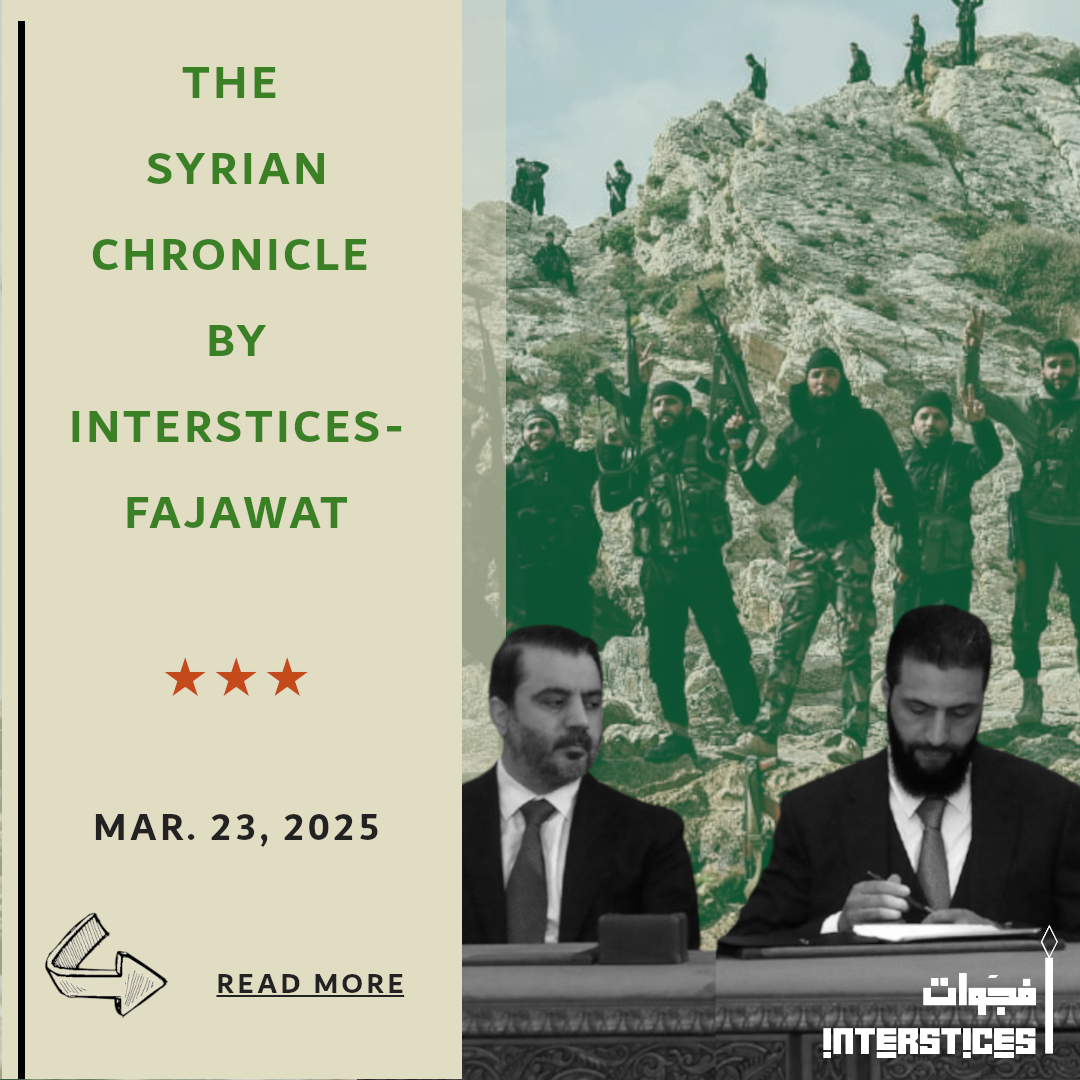
The Syrian Chronicle by Interstices-Fajawat, March, 23, 2025
In the aftermath of the massacres on the Syrian coast
When we published our last chronicle, the massacres on the Syrian coast were still taking place, and our analysis was necessarily still partial. We won’t go into detail here, as we’ve already published an analysis of what happened on our page. In any case, these massacres are both a shock and a turning point for post-Assad Syria. They are a shock due to their magnitude and brutality, and a turning point since they have ultimately convinced a large number of Syrians that nothing can be expected from Al-Sharaa and his supporters and allies. Beyond promises of justice and the formation of a commission of inquiry, Al-Sharaa is failing to do what is necessary to disarm and expel the jihadists from the army, particularly the foreign fighters, despite the explicit demands of the coastal population in early January.
The death toll varies from one source to another: the Syrian Human Rights Network gives a figure of 803 victims, including 420 civilians, of whom 211 were killed by Assad loyalists, while the Syrian Observatory for Human Rights gives a figure of 1454 victims, including 973 civilians, without specifying how many were killed by Assad loyalists. Between the war of statistics, denial and sectarian accusations, Syria is unlikely to get the whole truth any time soon, even though the massacre has been admitted by Al-Sharaa.
Kurdish autonomy called into question?
Immediately in the wake of the massacres, Al-Sharaa pulled off a smokescreen by announcing the signing of a historic agreement with the Syrian Democratic Forces, putting an end to three months of intense negotiations to integrate the SDF into the national army. The populations of Raqqa and Deir Ez-Zor welcomed the news with joy, while human rights defenders from “Raqqa is being slaughtered silently” – an initiative launched while the Islamic State occupied the region – denounce until today the harassment and arbitrary violence committed by an omnipresent Kurdish militia in the city, the Revolutionary Youth (Al-Shabiba Al-Thawriya). Beyond denial, it is essential to point out that the Kurdish presence is controversial among the local population, who do not necessarily perceive the SDF and the Kurdish socialist/federalist movement as an emancipatory force.
Full powers of the Rais
On March 13, Al-Sharaa stirred up a new wave of discontent in the country with the signing of a constitutional declaration which, in addition to engraving in stone the need for the president to be a Muslim, concentrates all executive powers in his hands, including that of declaring a State of Emergency. Al-Sharaa will also appoint one third of the members of the Legislative Assembly, while the other two thirds will be appointed by a Committee whose members will all be appointed by him (sic). Finally, the constitutional judges will also be appointed by the President, who for his part enjoys judicial immunity, which is quite cynical considering his past. As a result, Al-Sharaa will have total control over the executive, legislative and judicial powers for five years. Notably, he has never mentioned the word “democracy” since freeing Syria from Assad.
Insubordination of the Druze
As sectarian tensions escalate, reinforced by the blind enthusiasm or desire for revenge of some Sunni Muslims who see in Al-Sharaa their liberator after decades of persecution directed against their communities, voices of opposition – both civil and secular – are emerging. This is particularly true of the Druze leader Hikmat Al-Hajari, who has been the focus of the wrath of Al-Sharaa’s supporters ever since he opposed the disarmament of Druze factions (between 70,000 and 100,000 fighters) and declared his firm opposition to the new constitutional declaration. Following the massacres on the coast, Al-Hajari’s position of defiance received massive support from the Druze, but also from other Syrian communities. The (Kurdish) Autonomous Administration of North-East Syria also spoke out against the new constitution. Yet while there are among the Druze defenders of the federalist option “à la kurde”, such as the “Suwayda Military Council”, which was set up to continue the 2011 revolution beyond the fall of Assad, most are more in favor of a form of national but decentralized system. Many of these adhere to the position of Suwayda’s three main armed factions, who are prepared to compromise with the central government in exchange for decentralized security management.
Talks between these factions and the government have taken place, but attempts by government forces to enter or recruit in the region have been met with an outright refusal by Al-Hajari’s supporters. We are thus witnessing a division within the Druze community itself, which is also under pressure from outside actors who would like to instrumentalize the legitimate fears resulting from the massacres on the coast, as well as the hateful comments and sectarian rumors that have been circulating more and more on social networks since the beginning of the year.
After the party, back to reality
Despite the cheerful and enthusiastic celebrations of the anniversary of the Syrian Revolution and the Kurdish New Year (Newroz), the atmosphere of popular jubilation that followed the fall of Assad has diminished, and many people we encounter in the street express disappointment and pessimism.
Not to mention Israel’s ongoing invasion of southern Syria, always accompanied by targeted strikes on Syrian military infrastructure. On the very anniversary of the Revolution, March 17, Israel deliberately struck the center of Deraa for the first time, knowing perfectly well how symbolic the city is for all those who remember where the revolt began in March 2011. Two civilians died and 19 were wounded in the attack, but Al-Sharaa seems in no hurry to defend the cradle of the revolution. He even ignored to visit the site, which speaks volumes about his centralism and his concerns, which are clearly greater than the fate of Syrians.
It’s worth remembering that when the Revolution started in Deraa – before and after his stay in detention – Al-Sharaa was doing his jihad in Iraq in the ranks of Al-Qaeda. It was not the end of the dictatorship that motivated his choices at the time, but rather the holy war under the orders of Ayman al-Zawahiri. What we’ve slowly come to understand since December 8, 2024, is that liberation doesn’t necessarily mean revolution…
