
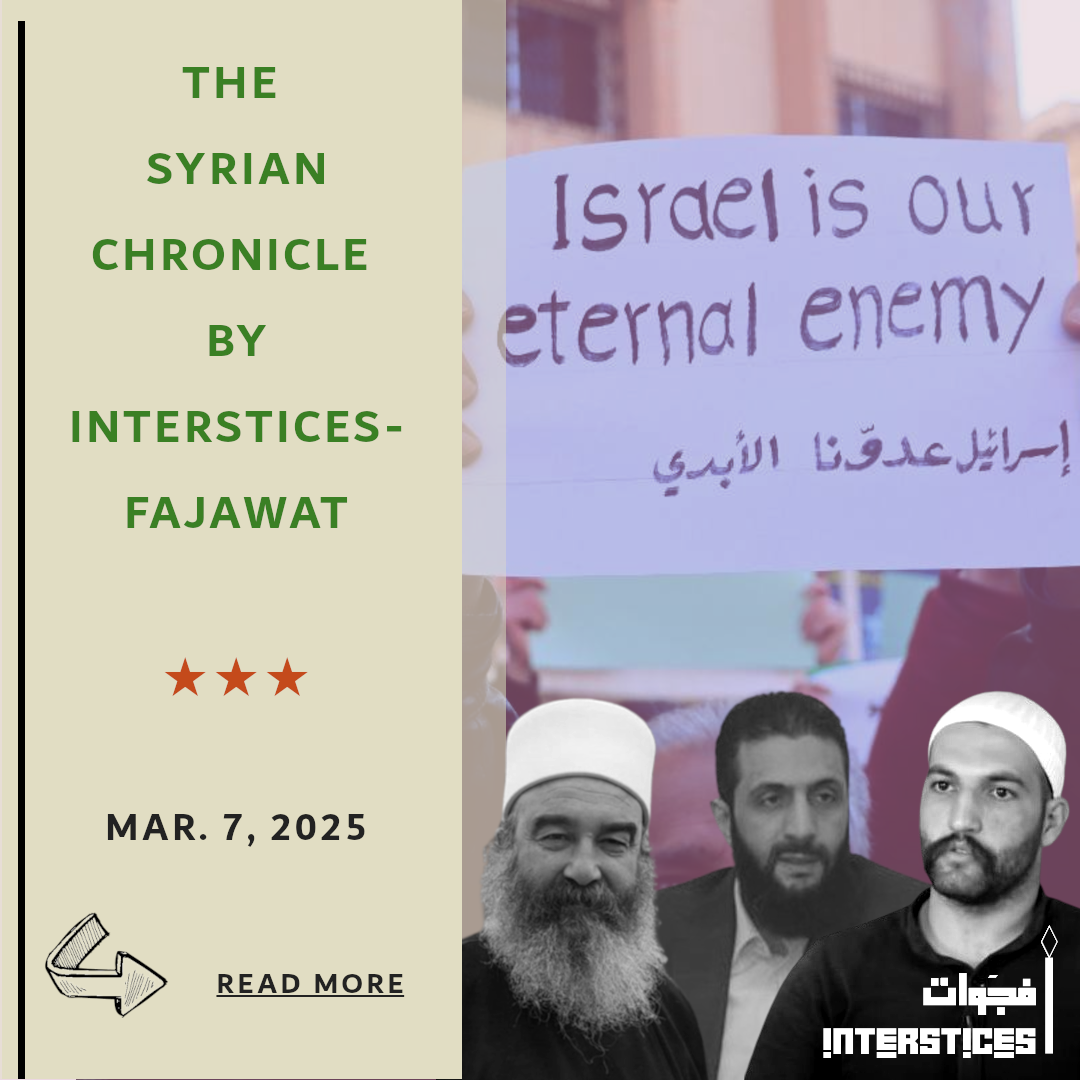
The Syrian Chronicle by Interstices-Fajawat, March, 7, 2025
To introduce this new chronicle, we’d like to announce that we’ve been back in Syria since February 27, and that we’ve started working on our documentary film, which is due to run for several months. Over the past few days, we’ve visited several of the former regime’s security and intelligence service branches, where we descended into the gloomy cells where so many people disappeared, and were able to confirm the extent of the surveillance and horror that this regime represented. We also began meeting the leaders of Druze factions, and spoke to the population about such pressing and vital issues such as the central power of Damascus, autonomy and federalism, and the potential threat posed by both Islamists and Israel…
Finally, we’ll be sharing our discoveries and reflections on our social networks and through our podcast “No Side but the People’s Side”. Support us, subscribe!
The impotence of the new central power
For two months, we were told about the transition to democracy and the preparations for the National Conference for Dialogue, which promised to be historic, inviting hundreds of representatives of Syrian society, respecting their diversity, to initiate the process of institutional reform. In the end, the invitations were received two days before the opening of the conference, which lasted no more than 48 hours. The Syrians don’t really know who took part, what was said or what the outcome was. We only learned from the press the day after this masquerade that seven jurists (including two women, one of them Kurdish) had been appointed to draft a new constitution, which already mentions the necessity of being Muslim to assume the office of president.
Since taking power, which seems destined to last well beyond the transition period, Sharaa has spent far more time settling Syria’s external relations than addressing the essential needs and expectations of Syrians. He has taken arbitrary decisions concerning the composition and forms of power, while rejecting federalism and decentralization epidermically, even though a substantial part of society considers them the only solution to guarantee equality between all Syrians and the representation of all components of Syrian society.
Faced with a stagnant situation, including the economic crisis and the perpetuation of crimes (murders, kidnappings, massive theft of materials, etc.) by unidentified armed groups throughout the country, discontent is rising here and there.
The desperate efforts of Assad’s henchmen
In the absence of any framework for transitional justice, acts of vengeance continue. The “remnants of the Assad regime” have gone back to work, like the police officers we met in Suwayda this week, who work in the same premises where they tortured and disappeared prisoners less than six months ago, and who are now demanding to be paid, accusing the new regime of “doing nothing”. They are not hiding in shame, as one might think.
On the contrary, in the last few hours, groups of former torturers and murderers of the regime, previously hidden away in their communities, have regained strength, led by former officers loyal to Assad who are communicating their determination to resist the new regime by force, possibly backed by Russia. Intense clashes resumed in the Latakia region more than 48 hours ago, leading to the adoption of a curfew, the massive deployment of the new regime’s forces and the deaths of at least 70 people.
The surrender of Kurdish autonomy
The breaking news for the internationalist left is Abdullah Öcalan’s call from Imrali prison to his PKK and PYD/YPG supporters to lay down their arms. For some time, the Kurdish socialist forces had been under pressure and attack from all sides, from Turkish proxies on the one hand and the Islamic State on the other, while facing an ultimatum from the new power in Damascus demanding their disarmament and integration into the new national army. It’s not impossible that the recent outbursts of Trump, determined to destabilize the global balance of power, have finished off the Syrian Kurds’ capacity for resistance and resilience.
We can assume that this surrender of the Kurdish armed forces will make it impossible to defend the autonomist and feminist Rojava project, despite the reassuring declarations of the Kurdish leadership. Indeed, faced with the reactionary ferocity of the Turkish state and its jihadist auxiliaries, but also with the conservatism of the new power in Damascus, it is doubtful whether the Kurdish left will be able to defend a socialist project without the support of armed forces.
The Druze, victims of Israel’s racist and colonial maneuvers
Finally, and this is what has been particularly agitating Syrian society for the past two weeks, the Israeli colony has decided to do everything in its power to destabilize Syria, by doing what it does best, namely putting the region’s religious communities back to back. Since the fall of Assad, Israel has been spreading the rumor that Syria’s Druze are calling for the annexation of southern Syria.
On March 1, a brawl between members of a Druze faction and agents of the new regime had a snowball effect, fuelling a series of rumours that led the Druze community on the outskirts of Damascus to barricade themselves in the Jaramana district and clash with security forces. Before the Druze leaders could intervene to negotiate a resolution to the conflict and a return to calm, Israel’s pyromaniac government declared that it wanted to “protect the Druze” and was ready to intervene militarily.
Since then, conspiracies of all kinds, reinforced by the proven links and sympathies of certain community leaders with the Druze of Palestine, and in particular with the controversial pro-Zionist Sheikh Muwafaq Tarif, have continued to fuel tensions within Syria’s Druze community, as well as between the Druze and supporters of a centralized state run by the Muslim majority. At the time of writing, the tension and fears are palpable, and it is very clear that several foreign states are trying to prevent any national unity in Syria. Federalism could be a solution, but Israel has unfortunately decided to promote it, in order to ensure that this option is rejected by the Syrians…
