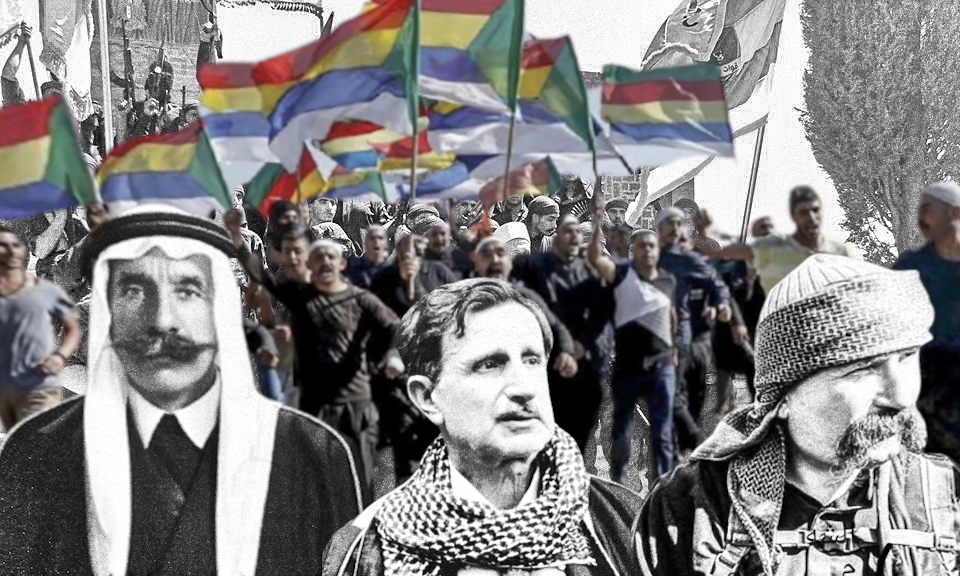
The Druze of Lebanon and Syria, a long history of insubordination

The Druze of Lebanon and Syria, a long history of insubordination
About the author: Cédric Domenjoud is an independent researcher and activist based in Europe. His research areas focus on exile, political violence, colonialism, and community self-defense, particularly in Western Europe, the former USSR, and the Levant. He is investigating the survival and self-defense of Syrian communities and developing a documentary film about Suwayda, as part of the Fajawat Initiative.


With the Assad regime having just fallen and the issue of disarming the Druze and Kurdish communities making headlines, it is worth recalling the highly political history of the Druze community in Syria and Lebanon. Here are a few key points.

The Druze are a religious community attached to a heterodox creed of Ismaili Shi’ite Islam, which originated in Egypt under the leadership of Imam Hamza ibn Ali ibn Ahmad in the early 11th century. The Druze faith takes its name from the preacher Muhammad ad-Darazi, although some of his followers do not recognize Ad-Darazi and he was disowned by Hamza ibn Ali before being executed on the orders of the caliph Al-Hakim bi-amr Allah. The Druze prefer to define themselves as “Muwahideen” (Unitarians) or “Banu Ma’ruf” (Children of Maarouf), although the origin of this term remains uncertain.

The Druze religion, like Sufism, takes a philosophical and syncretic approach to faith, recognizing neither the rigid precepts nor the prophets of Islam. Although this belief spread to Cairo under the Fatimid caliphate of al-Hakim, who was deified by the Druze, it was soon persecuted by the rest of the Muslim community after al-Hakim’s death in 1021, and so the Druze were exiled to Bilad el-Cham (present-day Syria, Lebanon, Jordan and Palestine), particularly to Mount Lebanon and the Hauran. But it was around the beginning of the 19th century that the Druze community in Hauran gained strength, after a large part of the community had been expelled from Mount Lebanon by the Ottoman authorities. The Hauran mountain was then named jebel al-Druze.
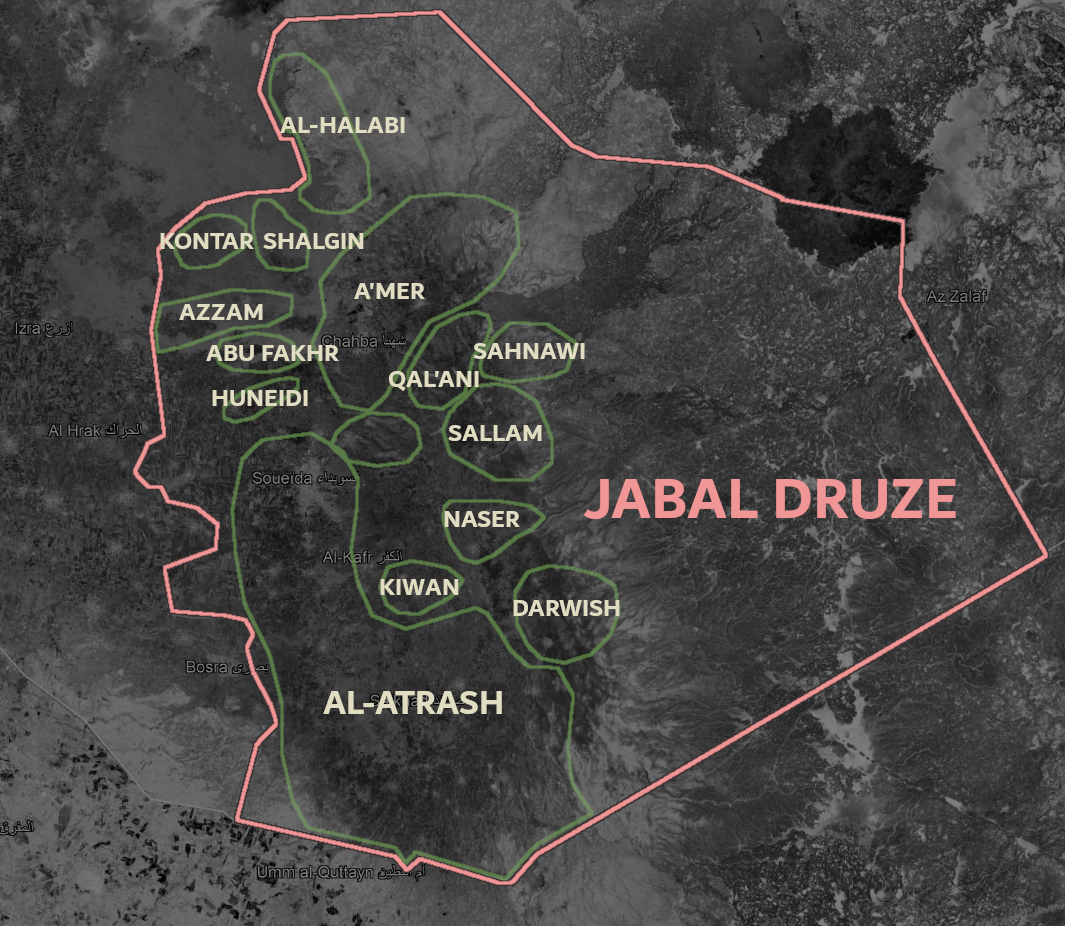
The main Druze families and clans in the 19th century

Today, Suwayda governorate is home to the majority of the world’s Druze community, some 700,000 people. The Lebanese Druze are the second largest community, numbering 250,000. In Syria, several Druze settlements also exist in Jebel al-Summaq (Idlib, 25,000 people), Jebel al-Sheikh and al-Juwlan (Quneitra, 30,000 people) and Jaramana (Damascus suburbs, 50,000 people). Finally, outside Syria and Lebanon, the largest Druze communities are to be found in occupied Palestine (Galilee and Mount Karmel, 130,000), Venezuela (100,000), Jordan (20,000), North America (30,000), Colombia (3,000) and Australia (3,000).

The Druze community is structured along traditional clan lines, with large families exerting a dominant influence. Until the mid-18th century, Hauran (or Jabal Druze) was dominated by the Hamdan family, whose hegemony was challenged in the 1850s by Al-Atrash family. The conflict between the two families and their respective allies between 1856 and 1870 was finally settled by the intervention of the Ottoman authorities, who divided the region into four sub-districts, the largest of which was that of Al-Atrash family, comprising 18 villages out of the 62 in Hauran at the time.
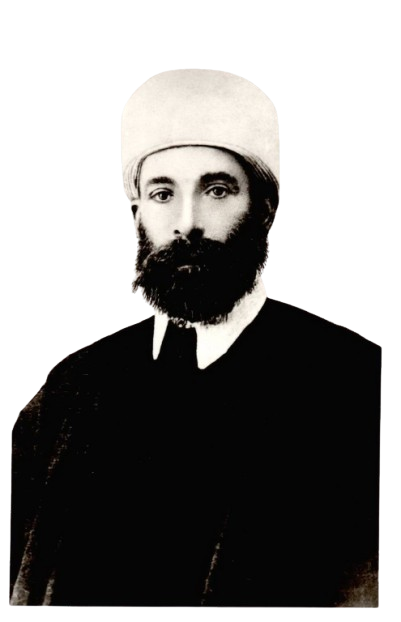
Zuqan al-Atrash

Rebellion against Turkish-Ottoman authority…


In 1878, the semi-autonomy acquired by the Hauran was called into question by Ottoman military intervention, which sought to put an end to the conflicts between the Druze and their neighbors in the plain (now Daraa). The Ottoman authorities imposed a new form of governance under the leadership of Ibrahim al-Atrash, and the payment of taxes to the Druze community, particularly to peasants. Between 1887 and 1910, a series of conflicts ensued, first between the region’s peasants and Al-Atrash family, then between Ibrahim’s brothers – Shibli and Yahia – and the Ottoman authorities. In 1909, the revolt against the Ottomans led by their nephew Zuqan al-Atrash failed at the battle of Al-Kefr, and he was executed the following year. His son Sultan took over at the time of the great Arab revolt of 1918…

During the 1914-1918 war, Ottoman rule left Jabal Druze relatively undisturbed. Sultan al-Atrash forged links with the pan-Arab movements involved in the great Arab revolt of the Hijaz (Saudi Arabia) and raised the Arab flag on the fortress of Salkhad, south of the Suwayda region, and on his house in Al-Qurayya. He sent a reinforcement of 1,000 fighters to Aqaba in 1917, then joined the revolt himself with 300 fighters at Bosra, before seizing Damascus on September 29, 1918. Sultan became a general in Emir Faisal’s army and Syria gained independence. This was short-lived, however, as Syria was occupied by the French in July 1920. Jabal Druze became one of the five states of the new French colony.
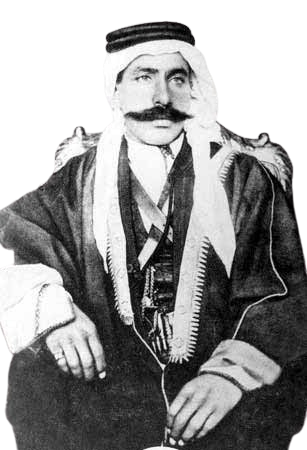
Sultan al-Atrash
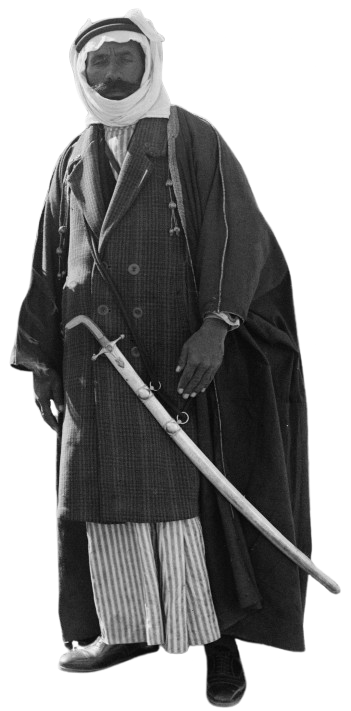
Sultan al-Atrash

…then against French colonialism


Sultan al-Atrash first clashed with the French in 1922, when his host, Lebanese Shi’ite rebel leader Adham Khanjar, was arrested at his home in his absence. Sultan demanded his release, then attacked a French convoy believed to be carrying the prisoner. In retaliation for the attack, the French demolished his house and ordered his arrest, but Sultan took refuge in Jordan, from where he led raids against the French forces. Temporarily pardoned and allowed to return home, he led the Syrian revolt of 1925-1927, declaring revolution against the French occupiers. Initially victorious, the Great Syrian Revolt was finally defeated by the French army and Sultan was sentenced to death. He took refuge in Transjordan, before being pardoned again and invited to sign the Syrian Independence Treaty in 1937. He received a hero’s welcome in Syria, a reputation he retains to this day. When the treaty failed to secure Syria’s independence in May 1945, the Syrians once again revolted against the French occupiers, who sent in the army and killed around a thousand Syrians. In Hauran, the French army was defeated by the Druze under the command of Sultan al-Atrash, before the British intervention that put a definitive end to the French mandate on April 17, 1946.

Editor’s note: the commitment of the Al-Atrash family must be seen in the context of Arab conservatism and nationalism, which did not challenge traditional clan, patriarchal and authoritarian structures. However, their constant opposition since the 19th century to foreign imperialism and the abusive authority of central powers made them precursors in the anti-colonial struggles of the second third of the 20th century. Their struggle can also be seen as carrying within it the seeds of community struggles for autonomy and self-defence, which will be discussed in Suwayda in the recent period (years 2010-2020). Sultan al-Atrash is also known for his stance in favor of multiculturalism and secularism.

الدين لله، والوطن للجميع

Religion is for God, Homeland is for everyone

Resistance to Israeli colonialism


When the British transferred their domination of Palestine to Zionist settlers in Europe and America, and the latter began ethnically cleansing the Palestinians from December 18, 1947, Sultan al-Atrash called for the formation of the Arab Liberation Army of Palestine. Under the command of future Syrian president Adib Shishakli, this army entered Palestine from Syria on January 8, 1948, as part of the First Arab-Israeli War.
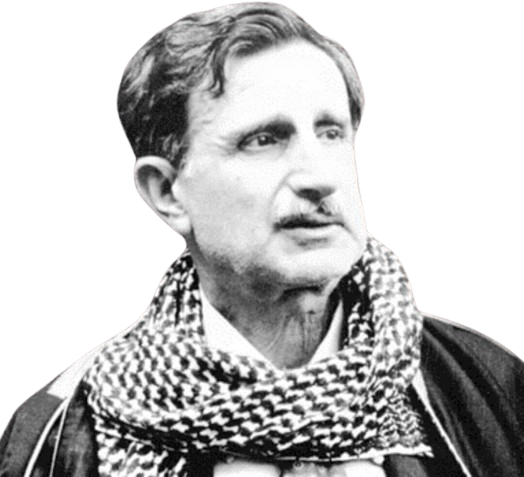
Kamal Jumblatt

Only a year apart, on May 1, 1949, Druze intellectual and political leader Kamal Jumblatt founded the Progressive Socialist Party, then he called for the first convention of Arab Socialist Parties in May 1951 and began to establish links with the Palestinian Left Resistance, embodied by the Fedayeen movement. Jumblatt then turned the PSP into an armed movement integrated into the Lebanese National Movement, a coalition of 12 left-wing parties and movements founded in 1969 to support the Palestine Liberation Organization, itself created five years earlier and then led by Yasser Arafat. Jumblatt is the leader of the Lebanese National Movement (LNM).

The entire period between 1952 and 1975 was characterized by growing sectarian tensions between secular left-wing movements – anti-imperialist and pro-Palestinian – and the pro-Western Christian Maronite elites, who dominated the Lebanese political landscape at the time. From 1970 onwards, these tensions were heightened by the significant increase in the number of Palestinian fighters in Lebanon, following their expulsion from Jordan, and leading to a considerable increase in the influence of Palestinian movements in the country. These tensions culminated in the massacres of Palestinian civilians by Christian Phalangists (Kataeb) at Ain el-Rummaneh on April 13, 1975 (30 dead) and at Karantina (between 1,000 and 1,500 dead), followed by the massacre of Christian civilians at Damour (150 to 580 dead) in January 1976.

Syrian President Hafez al-Assad – whose Ba’ath party had until then supported the Palestinian left and its allies – took up the cause of the Christian Falangists and proposed an agreement involving the reduction of Palestinian influence in Lebanon. The PLO refused, and in March 1976, Kamal Jumblatt went to Damascus to express his disagreement to Hafez al-Assad. The following month, the LNM and the PLO took control of 80% of Lebanon, but in June the Syrian army intervened in Lebanon. During the summer, the Christian militias who had been besieging the Palestinian camp of Tell al-Zaatar since the beginning of the year, massacred between 2,000 and 3,000 civilians with Syrian military support. At the end of a six-month confrontation with the PLO and the LNM, a temporary ceasefire was signed, establishing the long-term occupation of Lebanon by the Syrian army and leading to the gradual – then definitive ten years later (1987) – annihilation of the Palestinian Resistance in Lebanon.

On March 16, 1977, Kamal Jumblatt was assassinated by gunmen hired by Hafez al-Assad’s brother, Rifaat. Many left-wing personalities attended his funeral, and Yasser Arafat delivered a powerful eulogy for his ally and friend.

Excerpt from the film “Greetings to Kamal Jumblatt”, Maroun Bagdadi, 1977, 57 mm

Editor’s note: We are not here to idealize Kamal Jumblatt’s character, and we believe that leaders should never be heroes. However, we do not believe that Kamal Jumblatt is guilty of any crimes, nor that he has propagated feelings of hatred based on the ethnic or religious affiliation of his opponents, contrary to what has been conveyed by certain media affiliated to the Lebanese right. Nevertheless, it must be recognized that any armed movement has at one time or another been associated with or directly involved in the commission of crimes or acts of vengeance. This was notably the case with the Palestinian armed factions, and therefore their allies, as in Damour in January 1976. It’s also important to admit when a leader betrays the interests of his community, as in the case of Kamal Jumblatt’s son, Walid Jumblatt. His political choices following his father’s death and up to the present day are relatively dubious, and he does not seem to us to be worthy of his father’s political legacy.

Armed resistance to authoritarian centralism in Damascus


When the 2011 revolt against Bashar al-Assad broke out, Syria’s Druze joined the rest of the Syrian population in demonstrating in the streets of Suwayda and Jaramana, the Druze community district of Damascus.

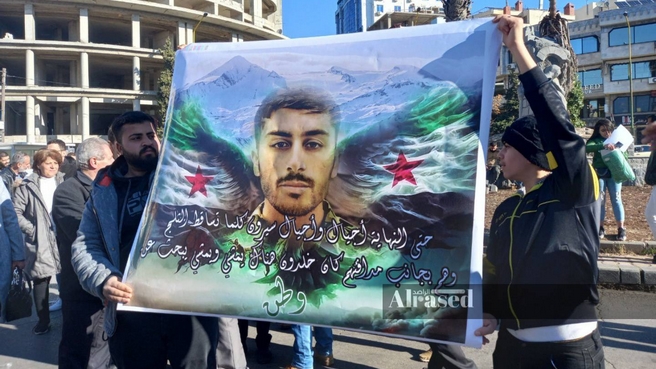
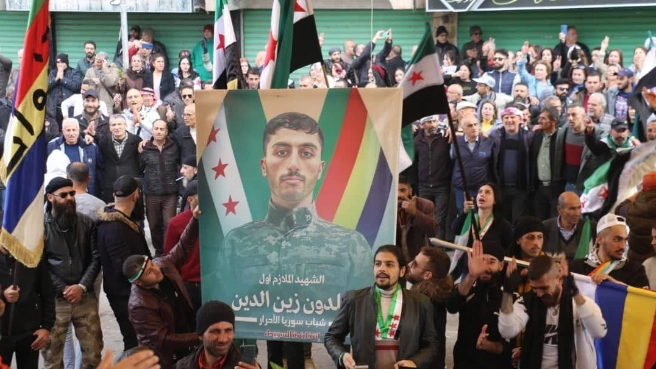
And when the armed struggle took over from the peaceful demonstrations, Druze officer Khaldun Zein Ad-Din defected from the regime’s army on October 31, 2011. He publically declared his allegiance to the Free Syrian Army and created the “Sultan Basha al-Atrash” batallion, made up of 120 Druze fighters.
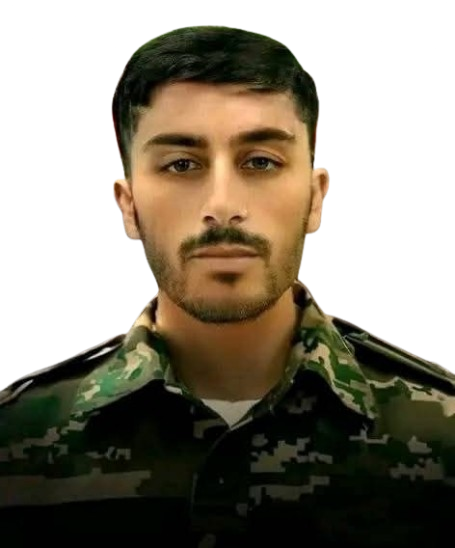
Khaldun Zein Ad-Din

Fadlallah Zein Ad-Din
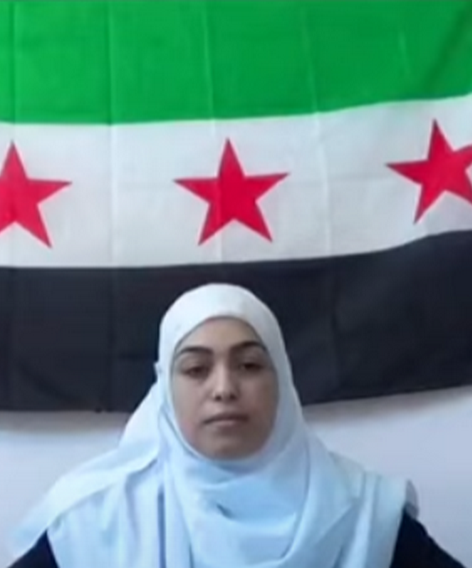
Amira Abu Bahsas

He was joined by his brother Fadlallah Zein Ad-Din in July 2012. Denounced by informers, they are besieged and Khaldun is killed with 16 other of their companions in Tall al-Maseeh on January 13, 2013. His brother announced his death in a statement ten days later. The Progressive Socialist Party of Lebanon organized a ceremony in their honor, and he became the symbol of the revolutionary and opposition movement in Suwayda. On March 21, 2013, his wife Amira Abu Bahsas publicly declared that she too would join her late husband’s battalion, becoming the first woman from Suwayda to join the Free Syrian Army.

During anti-regime demonstrations in Suwayda between 2023 and 2025, Khaldun Zein Ad-Din’s portrait is displayed in Dignity Square, where his parents Sami and Siham actively participated in the protests.
Another form of resistance to Assad’s dictatorship emerged in 2013 in Suwayda, following the forced recruitment of several dozen young men from the region. An influential sheikh in the community, Waheed al-Balous, refused to accept the community’s participation in the war against other Syrians and opposed forced recruitment. He founded the Men of Dignity Movement (“Rijal al-Karami”), which gained in popularity over the years and prevented the conscription of between 30,000 and 50,000 young men from Suwayda.

دم السوري على السوري حرام

A Syrian must not shed the blood of another Syrian

In 2015, Balous openly denounced the dictatorship, leading to his assassination in a double bomb attack on September 4, 2015. On the evening of his death, riots broke out in the region and the statue of Hafez al-Assad that had stood in Dignity Square was removed. It was never replaced. His brother Raafat, wounded in the attack, temporarily replaced him before giving up his position. Waheed al-Balous’s sons, Laith and Fahd, created a splinter group from Rijal al-Karami, the Sheikhs of Dignity (Sheikh al-Karami), which they intended to be politically more radical than their father’s movement. Despite frequent disagreements, the two movements continued to carry out joint actions, even as Rijal al-Karami drew closer to another major faction, the Forces of the Mountain (Quwwat al-Jabal). In December 2024, they joined the Southern Room for Military Operations, which also included other Druze factions and took part in the liberation of Damascus.

Waheed al-Balous

Raafat al-Balous

Laith al-Balous

Fahd al-Balous

Editor’s note: While here too we must refrain from idealizing one faction or another, we nevertheless consider that Rijal al-Karami and associated groups have, in recent years, embodied the Druze community’s imperative for self-defense and self-determination. Whether in the face of attempts by the regime’s army to impose itself by force or coercion, in the face of Islamist aggression or in the face of the predation of the gangs that have proliferated in the region, these factions have succeeded in protecting the civilian population and the general interest without committing exactions or abuses of power. Their leaders have generally answered the call of threatened communities and taken a clear stand against any outside force threatening community security. They also acted as protectors of popular demonstrations and revolts, before spontaneously joining the offensive against the regime in December 2024.

Suwayda at the heart of the revolutionary path from 2011 to 2025


Beyond the few emblematic examples of armed resistance to the authoritarian centralism of Damascus, civil society in Suwayda has never ceased to take a critical or hostile stance towards central power and the Assad dictatorship. Contrary to unfounded rumors that regularly portray the Druze as loyal to the regime, numerous examples demonstrate that the community has always succeeded in reconciling its tradition of resistance with a refusal to take sides in a conflict that very early on became confessionalized – with a very large Islamic religious component within the Free Syrian Army as early as 2012 – and which would have resulted in its annihilation.

Few remember that the people of Suwayda were involved in the 2011 uprising right from the start. As mentioned in our first article, the Suwayda Lawyers’ Guild organized one of the first public demonstrations in March 2011, and as elsewhere in Syria, the Jabal Druze took to the streets in the weeks that followed. To give just a few strong and symbolic examples, let’s recall that one of the main songs of the revolution is “Ya Heif!” (يا حيف – “What a Shame!”), composed and sung by Druze singer Samih Choukheir (Listen by clicking here).

At the beginning of this text, we also mentioned the influence of the Al-Atrash family in the region. Sultan al-Astrash’s daughter, Muntaha al-Atrash, took an early stand against Ba’athist tyranny. In 1991, she publicly tore up a photo of Hafez al-Assad to denounce his involvement with the Coalition in the Iraq war. Saved from prison by her father’s reputation, she joined the Sawaseya Human Rights Organization, becoming its spokeswoman in 2010. At the start of the revolution, she visited rebel areas and publicly called on the Syrian people to join the revolution, before receiving death threats serious enough to convince her to stop appearing in public.
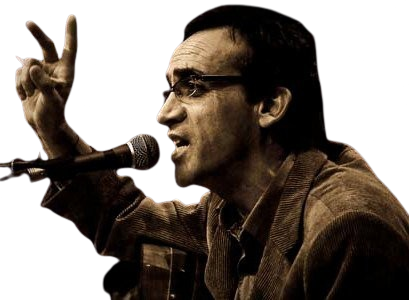
Samih Choukheir

Her daughter Naila al-Atrash, a university drama teacher with close ties to the Syrian Communist Party, was regularly threatened by the regime for her activities, which were deemed subversive. Dismissed in 2001, placed under house arrest in 2008, she took part in the beginning of the 2011 revolt by organizing support groups for people displaced and affected by the conflict, before leaving Syria in 2012. To this day, Naila remains an active supporter of the liberation of Syrians.

Finally, since the assassination of Waheed al-Balous in September 2015, the resistance and revolt against the Assad regime has continued to take shape. It has taken the form of an armed resistance embodied by several popular militias, as mentioned above, but has also largely developed in civil society, with the multiplication of demonstrations and actions that have increased in intensity and regularity since 2020, also as a consequence of the explosion in prices and the cost of living.

To reread in detail the unfolding of these revolts, read our first article published in October 2023:In Southern Syria, the uprising of Dignity has begun”.

Muntaha al-Atrash
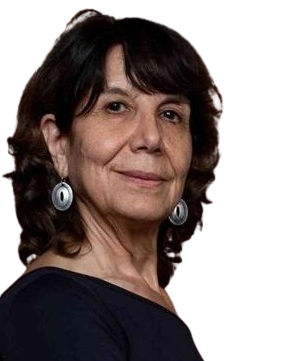
Naila al-Atrash

Hikmat al-Hajari
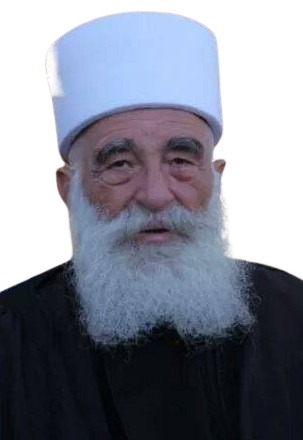
Hamoud al-Henawi
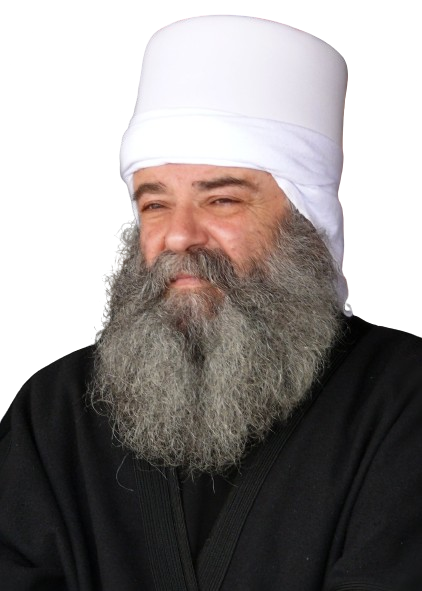
Youssef Jarboua

It is also necessary to know more about the structure of Druze society to understand that the population is not necessarily subservient to the decisions of a political or spiritual leadership. In Suwayda, religious leadership is embodied by three sheikhs, the “Aql Sheikhs”: Hamoud Al-Henawi, Hikmat Al-Hajari and Youssef Jarboua. The political positions of these three sheikhs are neither identical nor immutable, and their relationship with the Assad regime has varied according to periods and events.

Following the assassination of Waheed al-Balous and the attack on Suwayda by the Islamic State in 2018, the dissensions between the three sheikhs became even more aggravated. Initially neutral or relatively loyal to the Assad regime, they began to become more critical, particularly sheikh Hikmat al-Hajari, who took a clearer stance against the regime and gradually established himself as the charismatic leader of the community.

Editor’s note: The positions taken by the spiritual leadership are not binding on the Druze community, which is predominantly secular and does not follow its commandments as may be the case for other religious communities that accept that religion dictates social and political life. Regularly, Druze sheikhs have publicly declared that they support and follow the community’s choices. More recently, Hikmat al-Hajjari’s cautious yet firm stance on Ahmed al-Sharaa’s transitional government, and in particular on the disarmament of factions, has been much criticized by many people, often ignorant of or hostile to the ways of the Druze community, or even hostile to the Druze in general, out of nationalism or religious zeal. Within the community, his positions are also criticized by supporters of factional disarmament, who see it as the main cause of violence within society and seem to trust (a little too much) in the new Islamist central power not to (re)become a threat to the Druze minority…

The Druze, Israel and the Islamists


This last chapter is essential in view of recent events concerning the Druze communities in Syria and Palestine, and the controversies and rumors that have accompanied them. The two most persistent misconceptions concern the Druze’s supposed loyalty to the Assad regime on the one hand, and their supposed sympathy for Israel on the other. If we have invalidated the first theory in the preceding chapters, it seems to us that we need to add some more recent information than that concerning Kamal Jumblatt’s time to invalidate the second as well.

It should first be pointed out that the Druze communities of Palestine (Mount Carmel and Galilee) were integrated by the Israeli colony in 1948, in the wake of the ethnic cleansing of the Palestinians (Nakba). As such, the Palestinian Druze have Israeli citizenship and are subject to compulsory military conscription. Many of them have now accepted this assimilation to the point of supporting the Zionist project and its genocidal policy towards other Palestinians. Their spiritual leader Muafak Tarif is a perfect example of integrationism, cultivating a friendly relationship with the colonial administration and its representatives. He is also quite close to Benyamin Netanyahu.

Muafak Tarif et Benyamin Netanyahu
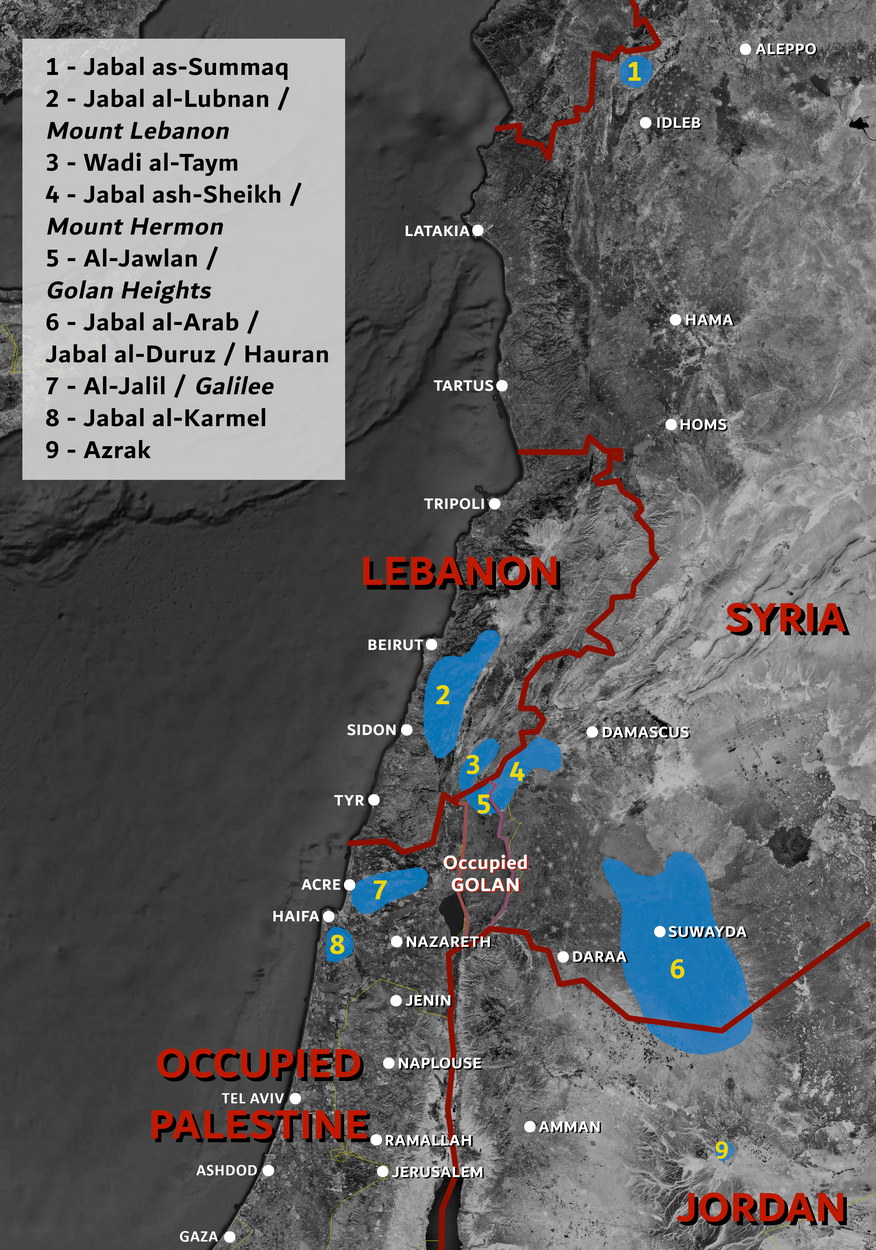
Location of Druze communities in the Levant

The other Druze community colonized by Israel is that of the Golan Heights, occupied during the Six-Day War in 1967 and officially annexed in 1981. Of the 130,000 Syrians living in the Golan before the invasion, only 25,000 Druze now live on the plateau, in five communes: Majdal Shams, Buq’ata, Mas’ade, Ein Kenya and al-Gager. However, the Druze of the Golan have never accepted assimilation, and almost 80% of them still refuse to take Israeli citizenship.

Israeli leaders persist in trying to win the sympathy of the Golan Druze and never miss an opportunity to claim that they support Zionism, but reality contradicts the propaganda. When, on July 27, 2024, Hezbollah fired a rocket at a soccer field in Majdal Shams, killing 12 children from the community, the opportunistic visits of Benyamin Netanyahu and Bezamel Smotrich to the site and to the funeral were refused by the residents, who booed and branded them murderers.

Finally, when in December 2024 the Israeli army crossed the 1967 border and invaded the Druze villages of Mount Hermon (Jabal al-Sheikh), Zionist as well as anti-Zionist (and campist) propaganda shared the same false information claiming that the residents of Hadar village were in favor of their annexation by Israel. This rumor was initiated by Nidal Hamade, a pro-Hezbollah Lebanese propagandist exiled in France, who posted on his X account a decontextualized video showing a Druze man declaring that he wanted Hadar annexed.

Yet on the same day, representatives of Hadar’s Druze community published a video containing a statement affirming their refusal to be occupied by Israel and denying the false accusations against the Druze.

Unfortunately, rumors often spread more widely than their denials…

For both sides, perpetuating this lie is useful: where Israel has an interest in legitimizing the occupation of Syria’s Arab lands by claiming that its inhabitants want it, the pro-Iranian camp has a clear advantage in keeping alive the myth that Syria’s minorities needed Assad and Hezbollah to protect them from Islamists, otherwise they would turn to Israel. This binarity of analysis feeds on the same campist and feudal logic of thought: “If you don’t place yourself under my protection, then you deserve to be oppressed by my enemy”. And for both sides, the Islamist scarecrow is used to justify the subjugation of civilian populations, insecurity and fear of barbarism (terror) being the colonial powers’ main resources for legitimizing their violations of the conventions and laws of war.

Assad, for his part, has never ceased to present himself as the protector of minorities, using Islamists as pawns to, on the one hand, disrupt the popular revolt against his regime, and, on the other, inflict terror among minorities when and where he needed to in support of his prophecy: “It’s either me, or chaos”.

Hadar residents’ statement, December 13, 2024, Al-Araby TV

In the weeks leading up to the Islamic State’s bloody attack on Suwayda in July 2018 (258 dead and 36 hostages), Assad ostentatiously withdrew all his troops from the region. Then, after the attack, when the population criticized him for not having intervened immediately to block the road to the Islamic State, he responded that it was the fault of the Druze who refused to send their young men into the army. But worst of all, the Islamic State fighters had been transported by bus from Yarmouk (a Palestinian camp on the outskirts of Damascus) to the Suwayda desert a month before the attack as part of a surrender agreement. And, as if that weren’t enough, in November of the same year, a new agreement was signed with the Islamic State resistance pocket in the Yarmouk basin (on the border with Jordan and the Israeli-occupied Golan Heights) for a new humanitarian evacuation to the desert in exchange for the release of the Druze hostages taken by the Islamic State after their attack on Suwayda. It should be noted that these two agreements between the regime and the EI were organized under the patronage of the Russians, who had at the same time made a commitment to Israel to keep any threat from Islamists, including Hezbollah, away from its border.

We discuss the attack on Suwayda by the Islamic State in more detail in our first article published in October 2023: “In Southern Syria, the uprising of Dignity has begun

And to conclude: As Islamists have often been the useful idiots of imperialism on all sides, it should come as no surprise that the Druze of Suwayda are in no hurry to hand over their weapons to the new power in Damascus, since Ahmad al-Sharaa has been the representative of the two Islamist movements, DAESH and Jabhat Al-Nosra, which have violently attacked the Druze over the past decade. And that certainly doesn’t make them Israel’s allies, whatever supporters of Iran and Israel may think.

It’s not complicated: A note to help you understand Syria

It’s not complicated: A note to help you understand Syria

In the age of social media and information for all and by all, it’s more than ever necessary to build up a reliable list of resources on the subjects you want to analyze and understand. Particularly when it comes to international geopolitics.

This note was prepared by “Interstices-Fajawat“. As an initiative connected to Syrian society, we have put together this note to share our sources of information on Syria. We do not claim that these sources are all impartial or neutral, as we believe that neutrality is often synonymous with blindness or complicity. We ourselves have our own bias regarding our beliefs in revolution and internationalism from below.

Wherever possible, we have indicated the biases and partialities we have identified. We have chosen to retain in the list resources whose analysis we do not share, because they are nonetheless well-informed and transmit first-hand information, which just needs to be taken with great care.

TO READ AND FOLLOW US :

📌 𝕏 (ex-Twitter) – https://x.com/IntersticesFaj

WEBSITES

At the top of the list, the first two categories contain most of the sources whose opinions we share, and which we recommend.

News and Analysis Websites :


Personnal Blogs (opinions & academic research) :


Syrian-led Advocacy & Media NGO Websites :


Local or specialized information websites :


General news websites :


ESSENTIAL FACT CHECKING WEBSITE 

Verify Syria (AR & EN) – based in Turkey, Syrian-led NGO 

https://verify-sy.com/

SOCIAL MEDIA ACCOUNTS (ex-Twitter/X & Instagram)

⚠️ Some of these accounts can share sometimes BIASED or ACRITICAL (sectarian, pro-Sharaa/HTS, pro-SDF/PYD, western…) content ⚠️

Local JOURNALISTS  / ANALYSTS / ACTIVISTS :

Matar Ismaeel – @RevoreporterSy
Joseph Daher – @JosephDaher19
Robin Yassin-Kassab – @qunfuz2
Hassan Ridha – @sayed_ridha
Leila Al-Shami – @LeilaShami
Rim Turkmani – @Rim_Turkmani
Mohammad Hassan – @mohammed_nomad
Firas Kontar – @fkontar78
Rami Jarrah – @RamiJarrah
Mazen Hassoun – @HassounMazen
Nedal Al-Amari – @nedalalamari
Ibrahim al-Assil – @IbrahimAlAssil
Qalaat Al Mudiq – @QalaatAlMudiq
Aymenn J Al-Tamimi – @ajaltamimi
Hassan I. Hassan – @hxhassan
Jenan Moussa – @jenanmoussa
Hussam Hammoud – @HussamHamoud
Abd alhade alani – @abdalhadealani
Rami Safadi – @RamiSafadi93
Vlogging Syria – @timtams83
Suhaib Zaino – @suhaib_zaino
Qusay Noor – @QUSAY_NOOR_
“Osama” – @OsamaSHL
“Karim” – @Idlibie
Tawfiq Ghailani – @SyriaNewsMan
Ivan Hassib – @Ivan_Hassib
Karim Franceschi – @karimfranceschi
Evin Cudi – @FreedomKurds
ScharoMaroof – @ScharoMaroof

FOREIGN JOURNALISTS/ANALYSTS :

Cédric Labrousse – @CdricLabrousse
Thomas Van Linge – @ThomasVLinge
Charles Lister – @Charles_Lister
Wladimir van Wilgenburg – @vvanwilgenburg
CJ Werleman – @cjwerleman
C4H10FO2P – @markito0171

MEDIA & SYRIAN NGOs :

ACT for the Disappeared – @actforthedisappearedlb
Action For Sama – @actionforsama
Al Swaida Al Thawra – @alswaidaalthawrah
Aljumhuriya – @aljumhuriya_net
Association Of Detainees & The Missing in Sednaya Prison – @sednayamissing
Based Syria – @based_syria
Caesar Families Association – @caesarfamilies
Daraj Media English – @darajmediaenglish
Dawlaty – @dawlatysy
Don’t Suffocate the Truth – @donotsuffocatetruth
Eye On Syria – @eyeonsyriaeng
Families For Freedom – @families4freedomsyria
Free Syria’s Disapeared – @freesyriasdisappeared
From the Periphery Media – @fromtheperipherymedia
Half of Syria – @halfofsyria
Horan Free League – @horanfreemedia1
Jadaliya – @jadaliyya
Jusoor for Studies – @jusooren
La Cantine Syrienne de Montreuil – @lacantinesyriennedemontreuil
Live Updates Syria – @liveupdatesfromsyria
Madaniya Network – @madaniyanetwork
Megaphone News – @megaphonenews
Middle East Eye – @middleeasteye
Middle East Institute – @middleeastinst
Middle East Matters – @middleeastmatters
Raseef 22 – @raseef22en
Release Me – @release_me0
Revoleft Syria – @revoleftsyria
Rojava Information Center – @rojavaic
Scholars for Syria – @scholars4syria
SOAS Syria Society – @soassyriasoc
Street Archives Syria – @streetarchivessyria


Syria Civil Defense – @syriacivildefence
Syria Mobilization Hub – @thesyriahub
Syria Pixel – @syria_pixel
Syria TV – @syr_television
Syrian Center for Media and Freedom of Expression – @scmsyriancenter
Syrian Emergency Task Force – @syrianetf / @ualr_setf
Syrian Eyes – @syrianeyesteam
Syrian Feminist Lobby – @syrianfeministlobby
Syrian Hub Official – @syrianhubofficial
Syrian Network for Human Rights – @snhr
Syrian Print Archive – @syrianprintarchive_
Syrian Revolution Archive – @syrian_revolution_archive
Syrian Revolution Story – @syrian.revolution.story
Syrian Road to Justice – @road2justicesy
Syrian Solidarity Campaign – @syria_solidarity_campaign
Syrian Spot – @syrianspot
Syrian Women For Democracy – @cswdsyr
Syrians for Palestine – @syrians4palestine
Syrians For Truth & Justice – @syrians_for_truth_and_justice
Ta’afi Syria – @taafi.syria
Tastakel Organization – @tastakel
The Fire These Times – @firethesetimes
The New Arab – @thenewarab
The Syria Campaign – @thesyriacampaign
The White Helmets – @the_whitehelmets
Verify Syria – @verify.sy
Vive Levantine – @vivelevantine
Wanabqa – @wanabqa
Yarmouk Camp – @yarmouk.camp

BOOKS

👷🏽‍♀️🔧 🚧 – work in progress, please help us by sharing with us books about Syria written by progressive Syrians –

DOCUMENTARIES (with our rating ⭐️⭐️⭐️)

We find it unfortunate that most of these testimonies are inaccessible to the general public and restricted to discretionary festivals where only the intellectual elites and concerned people can see them, while the Humans in question suffer and die most often in the shadows. We respect copyright, but would nevertheless like to acquire all these films, so if you know how to download or buy them, please don’t hesitate to contact us:

collective@interstices-fajawat.org

1974 – EVERYDAY LIFE IN A SYRIAN VILLAGE by Omar Amiralay ⭐️⭐️⭐️


The first documentary to present an unabashed critique of the impact of the Syrian government’s agricultural and land reforms, Everyday Life in a Syrian Village delivers a powerful jab at the state’s conceit of redressing social and economic inequities.

2003 – A FLOOD IN BAATH COUNTRY by Omar Amiralay ⭐️⭐️⭐️

The movie examines the flood’s devastating impact on a Syrian village. With its powerful and daring critique of Syria’s political regime and the tribal politics that hold it together, the film foreshadows the wave of democracy currently sweeping the Arab world, with citizens finally rising up to demand a fundamental change in their countries’ leadership.

2013 – RETURN TO HOMS by Talal Derki ⭐️⭐️⭐️

A look behind the barricades of the besieged city of Homs, where for nineteen-year-old Basset and his ragtag group of comrades, the audacious hope of revolution is crumbling like the buildings around them.

2014 – SYRIA : CHILDREN ON THE FRONTLINES by Marcel Mettelsiefen & Anthony Wonke ⭐️⭐️

The story of five young children whose lives have been changed forever by the civil war in Syria.

2014 – THE LAST ASSIGNMENT by Rashed Radwan ⭐️⭐️⭐️⭐️

On November 20, 2013, Iraqi freelance cameraman Yasser Faisal al-Jumaili crossed the Turkish border into Syria with his trusted Syrian fixer Jomah Alqasem. The Syrian war had been raging for two-and-a-half years and now saw the various rebel groups splitting one from another, mostly around ideological differences. The assignment was to access the groups and build a picture of who these men were, away from rhetoric, both on and off duty on the frontlines. For 13 days in Syria, the two reporters filmed the men behind the frontlines: fighters with the Free Syrian Army, Al-Tawhid Brigade, Al-Nusra Front, Ahrar Al-Sham, and even ISIL.

2014 – HAUNTED by Liwaa Yazji 

When the bomb comes the first thing we do is to run away, later we remember and think of everything we left behind. We did not bid farewell to our homes, memories, photos, identities and life that passed. It is about how homes haunt the life of the souls that were living in them, as much as they themselves haunt the houses.

2014 – OUR TERRIBLE COUNTRY by Mohammad Ali Atassi & Ziad Homsi ⭐️⭐️⭐️⭐️

How to make a film on violence without directly showing or reproducing it? The film Our terrible country attempts to respond to this approach by taking us on the perilous journey of Yassin Haj Saleh, a well-known Syrian intellectual and dissident, and young photographer Ziad Homsi who travel together in an arduous, dangerous route from the liberated area of Douma, Damascus to Raqqa in northern Syria, only to find themselves eventually forced to leave their home country for a temporary exile.

2014 – SILVERED WATER, SYRIA SELF PORTRAIT by Wiam Bedirxan & Ossama Mohammed ⭐️⭐️⭐️⭐️

A look at first-hand video accounts of violence in modern-day Syria as filmed by activists in the besieged city of Homs.

2014 – THE CAVE by Feras Fayyad

Deep beneath the surface in the Syrian province of Ghouta, a group of female doctors have established an underground field hospital. Under the supervision of paediatrician Dr. Amani and her staff of doctors and nurses, hope is restored for some of the thousands of children and civilian victims of the ruthless Syrian civil war.

2014 – LETTERS FROM YARMOUK by Rashid Masharawi ⭐️⭐️⭐️

Messages captured at the Yarmouk refugee camp in moments of extreme complexity; messages siding with life in the face of death; moments of love in a time of war and questions of homeland and exile.

2015 – SALAM NEIGHBOUR by Zach Ingrasci & Chris Temple

Two filmmakers fully embed themselves in a Syrian refugee camp, providing an intimate look at the world’s most dire humanitarian crisis.

2015 – 7 DAYS IN SYRIA by Janine Di Giovanni & Robert Rippberger ⭐️⭐️⭐️

In the most dangerous country in the world for journalists, Newsweek Middle East editor, Janine di Giovanni, risks it all to bear witness, ensuring that the world knows about the suffering of the Syrian people.

2015 – A SYRIAN LOVE STORY by Sean McAllister ⭐️⭐️

Filmed over 5 years, A Syrian Love Story charts an incredible odyssey to political freedom. For Raghda and Amer, it is a journey of hope, dreams and despair: for the revolution, their homeland and each other.

2016 – THE WAR SHOW by Andreas Dalsgaard & Obaidah Zytoon ⭐️⭐️⭐️⭐️

A Syrian radio DJ shares her experiences in the aftermath of the 2011 Arab Spring.

2016 – HOUSES WITHOUT DOORS by Avo Kaprealian

Aleppo-Armenian filmmaker Avo Kaprealian shows the life of an Armenian family that has fled to Beirut during clashes in the New Village district of Aleppo, Syria, in 2015. Kaprealian documented the destruction in the district and the civilians who faced hardships. He managed to shoot footage from the balcony of his house […]

2016 – BORN IN SYRIA by Hernán Zin

Since civil war started in Syria in 2011, an estimated 9 million Syrians have fled their homes, half of them children. These children have fled unimaginable horror: the indiscriminate bombings of Bachar Al Assad’s government, and ISIS’ raping and beheading, only to find themselves trapped in makeshift camps or closed borders. We witness the journey of these refugees to the promised land of Europe.

2016 – THE WHITE HELMETS by Orlando von Einsiedel ⭐️⭐️

As daily airstrikes pound civilian targets in Syria, a group of indomitable first responders risk their lives to rescue victims from the rubble.

2016 – TADMOR / PALMYRA by Monika Borgmann & Lokman Slim ⭐️⭐️

Amidst the popular uprising in Syria that began in 2011, a group of former Lebanese detainees of the Assad regime decides to break their long-held silence about the horrific years they spent imprisoned in Tadmor, Palmyra, one of the Syrian government’s most dreaded prisons.

2017 – LAST MEN IN ALEPPO by Feras Fayyad ⭐️⭐️⭐️

Volunteers Khaled, Mahmoud, and Subhi rush toward bomb sites while others run away. They search through collapsed buildings for the living and dead. Contending with fatigue, dwindling ranks, and concerns for their families’ safety, they must decide whether to stay or to flee a city in ruins.

2017 – CRIES FROM SYRIA by Evgeny Afineevsky ⭐️⭐️⭐️

An attempt to re-contextualize the European migrant crisis and ongoing hostilities in Syria, through eyewitness and participant testimony. Children and parents recount the revolution, civil war, air strikes, atrocities and ongoing humanitarian aid crises, in a portrait of recent history and the consequences of violence.

2017 – CITY OF GHOSTS by Matthew Heineman ⭐️⭐️⭐️

The anonymous activists who exposed ISIS atrocities in Raqqa. Follows their undercover operations, exile, and risks taken to reveal the ruthless realities under ISIS rule. The story of “Raqqa is Being Slaughtered Silently”:

https://www.raqqa-sl.com/en/

2017 – OF FATHERS AND SONS by Talal Derki ⭐️⭐️⭐️

Talal Derki returns to his homeland where he gains the trust of a radical Islamist family, sharing their daily life for over two years. His camera focuses on Osama and his younger brother Ayman, providing an extremely rare insight into what it means to grow up in an Islamic Caliphate.

2017 – HELL ON EARTH: THE FALL OF SYRIA AND THE RISE OF ISIS by Sebastian Junger & Nick Quested

A look at the current state of Syria amidst war and chaos in 2017, featuring stories of survival and observations by political experts from around the world.

2018 – THIS IS HOME by Alexandra Shiva

The lives of four Syrian families, resettled in Baltimore and under a deadline to become self-sufficient in eight months.

2019 – FOR SAMA by Waad al-Kateab and Edward Watts ⭐️⭐️⭐️⭐️

In a time of conflict and darkness in her home in Aleppo, Syria, one young woman kept her camera rolling — while falling in love, getting married, having a baby and saying goodbye as her city crumbled. The story before “Action For Sama”:

https://www.actionforsama.com/

2020 – AYOUNI by Yasmin Fedda

Noura and Machi search for answers about their loved ones – Bassel Safadi and Paolo Dall’Oglio, who are among the over 100,000 forcibly disappeared in Syria.

2021 – OUR MEMORY BELONGS TO US by Rami Farah ⭐️⭐️

Three Syrian activists are reunited on a theatre stage in Paris. 10 years after the revolution, they revisit traumas and memories of a ferocious war.

2021 – LITTLE PALESTINE: MEMORY OF A SIEGE by Abdallah Al-Khatib ⭐️⭐️⭐️⭐️

After the Syrian Revolution, Al-Assad’s regime besieges the district of Yarmouk, largest Palestinian refugee camp in the world. Yarmouk is cut off. The director records the daily deprivations while celebrating the people’s courage.

2022 – THE LOST SOULS OF SYRIA by Garance Le Caisne & Stéphane Malterre ⭐️⭐️

In 2013, a Syrian official flees with 27,000 photos of corpses tortured to death in the country’s prisons since 2011. One year later, the photos of the Caesar Report reveal to the world the horror of the crimes of Bashar Al-Assad’s regime.

2023 – UNDER THE SKY OF DAMASCUS by Talal Derki

In Damascus, a collective of young female actors comes together to research the topic. They plan to use the moving anonymous statements of countless women to create a stage play that will break taboos.

2024 – MY MEMORY IS FULL OF GHOSTS by Anas Zawahri

Like a visual elegy, My Memory Is Full of Ghosts explores a reality caught between past, present and future in Homs, Syria. Behind the self-portrait of an exsanguinated population in search of normality, emerge memories of the city, haunted by destruction, disfigurement and loss. A deeply moving film, a painful echo of the absurdity of war and the strength of human beings.

Podcast : We Will Need Time – The Final Straw Radio (USA)

This podcast was made by THE FINAL STRAW RADIO, Asheville, NC, USA

https://thefinalstrawradio.libsyn.com/we-will-need-time-two-libertarian-communist-perspectives-on-events-and-possibility-in-syria 

In this episode, you’ll hear Cedric and Khuzama, two libertarian communists with connections to Syria and editor contributors to the blog interstices-fajawat.org , speaking about their observations of what’s been going on leading up to and through the ouster of Bashar Al-Assad, as well as complications among various factions on the ground and the view from the Syrian diaspora. The situation on the ground is changing fast, so check the show notes for this episode on our website for links to news sources that can be helpful in keeping up.

And if you care to hear a perspective from an anarchist combatant affiliated with Tekosina Anarsist, which works with the Autonomous Administration of North and East Syria affiliated with the SDF and Rojava Revolution, you can find our episode from December 22nd and the transcribed zine.

We Will Need Time: two libertarian communist perspectives on events and possibility in Syria

by The Final Straw Radio

Call to all Syrian progressive forces !

Call to all Syrian progressive forces !

Apart from the accomplices of the Assad regime and the civilian populations still being targeted in the North and East of Syria, all Syrians are happy with the liberation of Syria thanks to the offensive of the Syrian rebels and the support of many Syrian communities who were only waiting for a signal to participate in the liberation.

After 58 years of one of the most ferocious dictatorships, and not 13 or 24 years as suggested by the Western media, Syrians needed at least 48 hours to breathe and share their infinite happiness, their cries, their joy, but also their tears of relief and sorrow too long contained.

Many abroad have not respected this need, continuing to infantilize Syrians and scorn their democratic and secular aspirations, constantly brandishing the Islamist threat in front of our faces since the start of the rebel offensive (which we refuse to reduce to Hayat Tahrir al-Sham, because hundreds of other factions have joined the operation).

We didn’t need to be told. We were among the first to suffer this threat, which has been with us for years, but we also know that jihadist criminal groups didn’t just spring up. They were born out of the chaos produced by decades of colonization, armed invasion and indiscriminate bombing.

Having celebrated, Syria’s progressive forces must now act fast and not relax too early. The threats of a reactionary and fundamentalist backlash are real.

That’s why we want to share a few essential demands with you, to be widely disseminated within ALL Syrian communities and passed on to those who will ensure the political transition in Syria.

We must:

END THE VIOLENCE

  • Put an immediate end to all military intervention in the areas of Idleb, Aleppo, Raqqa, Deir Ez-Zor and Hasakeh and implement ceasefire agreements between rebel forces and YPG/SDF armed forces;
  • Condemn and put a definitive end to foreign bombing raids on Syrian soil;
  • Demand the liberation of Syrian territories and civilian communities held hostage by neighboring states and armed groups serving their interests, in particular Israel and Turkey in the Golan, Quneitra, West Damascus, Idleb, Aleppo, Raqqa and Hasakeh regions;
  • Disarm non-Syrian armed fighters and ask them to leave the country, return home or apply for asylum in Syria, to be considered in the light of serious investigations into the crimes committed by the armed groups to which they belonged;
  • Guarantee access to Syrian territory for humanitarian NGOs and journalists;

IMPLEMENT A RESTORATIVE JUSTICE PROCESS:

  • Protect and analyze the archives of the Assad regime’s security services, then make them available for consultation by those concerned, to enable grieving and reparation for the crimes, as well as prosecution of the perpetrators;
  • Protect and allow full access to the lists of detainees and victims of the Assad regime for the families of victims searching for missing persons;
  • List those complicit in slanderous denunciations and protect their identity to prevent personal vengeance and ensure fair judicial procedures, which may involve transformative and restorative, rather than punitive, modes of justice;
  • Arrest and detain in humanitarian conditions all army, security service or armed militia personnel suspected of direct involvement in the commission of crimes against civilians and war crimes;
  • Prevent any public humiliation or execution, and initiate justice processes that respect international conventions against the death penalty;
  • Enable the establishment of alternative systems of conflict resolution and justice, allowing defendants to choose under which justice system they wish to be tried, while prohibiting the use of penalties involving corporal punishment or the death penalty;

GUARANTEE POLITICAL TRANSITION:

  • Prevent the establishment of a political regime based on religious or ethnic affiliations, to prevent a sectarian division of Syria;
  • Prevent the use of symbols of armed groups, as well as flags associated with Al-Qaeda and the Islamic State, and other Islamist groups, in the public institutions of the new political regime;
  • Organize a political transition to a confederal regime allowing egalitarian and non-segregative representation of the different ethno-religious communities of Syrian society that represent at least 1% of Syrian society: Sunni Arabs, Shiite Arabs, Christian Arabs, Druze, Alawites, Kurds and Assyrians. Ethnic communities representing less than 1% of the Syrian population must be given proportional representation in order to ensure respect for their specific identities and related rights: Turkmen, Circassians, Bedouins, Armenians, Mizrahim Jews, Yezids, Palestinians, Romanis, Aramaic/Syriacs;
  • Freeze all cooperation with a neighboring state that does not guarantee full freedom for populations belonging to at least one of the above-mentioned Syrian communities;
  • Restore full and unrestricted political and religious freedoms, as well as freedom of association, freedom of assembly, freedom of expression and freedom of the press;
  • Guarantee the freedom and protection of the rights of women and sexual minorities;

Without the implementation of all these demands, the self-determination of Syrians is not guaranteed, and the resurgence of authoritarian powers is to be feared. We must mobilize en masse to prevent history repeating itself and autocratic or reactionary ambitions compromising the democratic and secular Syrian revolution.

We must therefore loudly proclaim our solidarity with the Palestinian, Lebanese and Kurdish peoples in the face of oppression and unjustified violence. It’s not a question of supporting armed groups who carry their voice, but of sending a clear message to our brother peoples and to civilians who don’t deserve to suffer the repercussions of colonial wars.

We only want peace and democracy in Syria and the surrounding region.

Fajawat Initiative

Western leftist comrades, you failed your Levantine fellows.

Western leftist comrades, you failed your Levantine fellows.

We knew that the Syrian crisis would be the ultimate test.

However, the Palestinian and Ukrainian issues had already given us the chance to recognize the Orientalism that permeates Western leftist circles. The genocide of our Palestinian brothers and sisters had created a false sense of unity, leading us to briefly believe that the Western left had finally understood the gravity of the colonial struggle. Except for the German radical left, which, trapped in its Christian guilt, could not perceive the presence of Ashkenazi Jews in Palestine as part of the white supremacist colonial project. Yes, German leftists, Zionism was inspired from the very beginning by German supremacist theories, particularly the concept of Lebensraum. Herzl himself wrote in his memoirs that he sought to “civilize” Eastern Jews, whom he viewed as akin to Arabs. Kibbutzim are not exempt from this legacy, even if they label themselves as “socialist.”

But never mind. We thought we were united, yet the heated debates about the “Palestinian resistance” embodied by Hamas soon led us back to discussions about the “Lebanese resistance” represented by Hezbollah. As progressive forces, we had to accept that authoritarian and ultra-conservative factions had become our allies because the settler colonialists imposed apartheid and genocide upon us. As always, just like in Ukraine, the imperialist war forced us into unbearable compromises with obscurantist and corrupt forces, eager to seize power and turn our already colonized societies into fundamentalist nightmares. Our oppressors had, as always, become the axis of resistance to American capitalist evil. Thanks to U.S. imperialism and its wars, we were forced to abandon our fight for liberation in favor of total focus on war. And war is never left-wing.

A side note: let’s not forget the visionary writings of Frantz Fanon.

But Hamas is not Hezbollah. While we do not support Hamas in its exercise of power, we have, in some respects, supported its armed struggle against the settler colonialists. It represents a national liberation struggle waged by Palestinians, for Palestinians, against their enemy. On the other hand, Hezbollah is the product of a nationalist, inter-religious civil war (1976-1990), compounded by double foreign invasions by Israel and Syria, and foreign interference by Iran, which saw Lebanon—and especially its Shiite community—as a key strategic asset. Hezbollah was conceived as Iran and Syria’s mercenary, initially tasked with eliminating progressive and secular Palestinian resistance movements in Lebanon, along with their Lebanese allies.

Recall the massacre of Palestinian refugees at Tal al-Zaatar, with the complicity of the Syrian army.

Recall Yasser Arafat’s anger at Hafez al-Assad and the breakdown of alliances between the PLO and Syria.

Remember the assassination of Druze leader Kamal Jumblatt, a friend and ally of Arafat, by the Syrian Social-Nationalist Party’s henchmen in 1976.

Remember the denial of political freedoms to Palestinians in Lebanon and Syria, enforced by Hezbollah and the Assad regime, from 1980 to today.

And if you don’t remember, please educate yourselves!

We cannot list all the betrayals of the Palestinian cause and the crimes committed against Palestinians and Syrians by Hezbollah, nor their compromises with Western capitalism. However, we encourage you to read Joseph Daher’s enlightening book, “Hezbollah, Religious Fundamentalism and Liberalism”.

Joseph Daher is a fellow Arab leftist.

Recall the kidnapping and murder of Michel Seurat in 1985 by Islamic Jihad, affiliated with Hezbollah, on orders from Hafez al-Assad. Seurat, a man of the left and author of “L’État de Barbarie”, was married to Syrian writer Marie Seurat. Their daughter, Leila, now an expert on the Palestinian issue, has written “Le Hamas et le Monde”, which you should read.

But let’s return to the main issue. The fate of the Syrians and Palestinians, two brotherly peoples, was determined by Iranian and Syrian interventions in Lebanon. Or rather, “separated” by these interventions.

Hafez al-Assad imprisoned progressive left-wing activists for years, followed by his son Bashar in continuing this counter-revolutionary effort.

When thousands of Syrians, including left-wing progressives, rose up against Assad’s fascism, Iran, Hezbollah, and eventually Russia actively joined the counter-revolution, massacring the Syrian people, making thousands disappear in regime-run concentration camps, and proliferating gangs affiliated with Hezbollah and the Syrian Social-Nationalist Party. They turned Syria into a Captagon factory and a narco-state.

When Assad released thousands of Islamists to destroy the people’s revolution, then manipulated them to destabilize local resistance, did you see any of this?

When Assad, the West, and Russia agreed to focus on the Islamist threat, did you not see that the rhetoric against terrorism is always used as a pretext to crush revolutions? Did you not realize that many of the recruits for Al-Qaeda and ISIS were non-Syrians, many of them from the West, recruited within your backyards ?

The Islamic State organized massacres in Paris, then beheaded people on camera in the Syrian desert, yet you ignored the much more widespread atrocities committed by Bashar’s army and Shabiha forces.

There’s an old saying: “When you point at the moon, the fool looks at the finger.” That’s what the West did, and that’s what the Left did: condemning the Syrian revolution, condemning hundreds of thousands of Syrians to death.

Had you supported our revolution, ISIS would have been stopped in its tracks, and the genocide of the Kurds would not have happened.

YOU killed our revolution through your complicity.

Have you read the writings of Yassin al-Haj Saleh?

What about his partner Samira Khalil?

Did you know they were both imprisoned for opposing the regime and their affiliation with the Syrian Communist Party?

Have you heard of Syrian anarchist Omar Aziz, whose model for local coordination committees influenced the Syrian revolution, before he was arrested and tortured to death by regime agents?

Have you heard of Raed Fares and his pacifist efforts organizing Free Citizens demonstrations in Kafranbel?

No, fellow leftists, you haven’t heard of us. You chose not to see, blinded by your campism and ignorance of the specific political realities in the Levant. Like good Westerners, you applied your ideological frameworks to our situation, including your binary analysis: “all the enemies of my enemies are my friends.”

Congratulations, Western leftists, you’ve become the best allies of Eastern fascism and its imperialist backers.

Now, let’s briefly discuss the Palestinian issue.

Have you heard of the Yarmouk refugee camp? Did you know that Palestinian militias, dissident from traditional left-wing Palestinian resistance groups like the PLO, supported Assad in suppressing Palestinian revolutionary movements in Yarmouk? Were you aware that they were complicit in bombing the world’s largest Palestinian refugee camp (with 160,000 residents) starting in 2012, and its subsequent siege from 2013?

Read also about what Assad and Russia offered the Islamists in Yarmouk (Damascus) and the Yarmouk Basin (Deraa) in May and November 2018. Just look at the consequences for the Druze communities in Suwayda.

Educate yourselves, comrades.

If you read further and remove your blinders, you’ll learn that the Syrian regime is one of the few in the world to have consistently banned all pro-Palestinian demonstrations. Even during the genocide, Assad didn’t even attempt to organize a fake demonstration to bolster his pro-Palestinian propaganda. Nothing.

Except in Idlib and Suwayda, the only two regions not under regime control. In both cities, Syrians have consistently supported their Palestinian brothers and sisters.

But you didn’t see it. You preferred to believe that Iran and Hezbollah were the Palestinians’ only hope, even when not a single one of their rockets breached the security of the Zionist regime. Empty rhetoric.

Syrians were never fooled by Nasrallah and Khomeini’s bombastic speeches, grotesque threats, and pitiful fireworks.

But you, the Western left, thought they were the true axis of resistance, the cutting edge of anti-colonial struggles.

And now that Syrians have liberated themselves (and who cares if Turkey played a role, since it has no control over the millions of Syrians liberated from Assad), you’ve joined forces with reactionaries in the West to lecture us on anti-terrorism.

“Be careful, you Arabs, your rebels are jihadists who don’t take responsibility for themselves. They will betray you and destroy you.”

Thank you, white supremacists, for your concern. But on the Syrian issue, you’re no better than the anti-Deutsche Germans were on the Palestinian issue.

We, more than anyone else, know what the Islamist danger is. You discovered it on September 11th and at the Bataclan, and suddenly, the world wept for you. But did you know that over 80% of Islamist victims since the 1980s have been Muslims and Arabs? Did you also know that it was Syrians alone who confronted ISIS on their own soil?

Where were you to protect us, you who now lecture us condescendingly, when Hayat Tahrir al-Sham achieved in a week what we’d given up on dreaming of a decade ago?

Did you read the messages of solidarity and affection from Wael al-Dahdouh, the Palestinian journalist whose entire family was decimated by Israel?

No, once again, you saw nothing. You only saw the potential for Islamism in us. We Arabs are too backward to understand how democracy, socialism, and secularism work…

While Israel has waited for its dear ally Bashar to fall before attacking Syrians in Quneitra, your campism is out in the open, along with

Anti-Arab hatred and white supremacy, the seeds of Zionism

Anti-Arab hatred and white supremacy, the seeds of Zionism

About the author: Cédric Domenjoud is an independent researcher and activist based in Europe. His research areas focus on exile, political violence, colonialism, and community self-defense, particularly in Western Europe, the former USSR, and the Levant. He is investigating the survival and self-defense of Syrian communities and developing a documentary film about Suwayda, as part of the Fajawat Initiative.


This article, authored by an individual whose personal trajectory has been deeply influenced by his family history, employs a rigorously anti-fascist and anti-authoritarian analytical framework to argue that Zionism is historically rooted in traditions of white and Germanic supremacist thought.

Context

The military operation in response to the bloody attack by the Palestinian resistance on the Israeli settlements adjacent to the Gaza ghetto on 7th October 2023 quickly became the scene of war crimes against the Palestinian civilian population. Let’s start by recalling the true toll of the Hamas attack on several military bases and settlements in southern Israel[1] on October 7, 2023, as well as a music festival: in the course of the armed action, 1,139 people were killed, including 695 civilians (among them 71 foreigners and 36 children) and 373 members of the security forces (305 soldiers, 58 policemen and 10 members of the Shin Bet intelligence service)[2]. Hamas also captured 251 hostages (including numerous military personnel) in order to exert pressure on the State of Israel, in particular to obtain the release of hundreds of Palestinian prisoners, over 1,300 of whom were being held without charge or trial before October 7th[3].

In retaliation, the Israeli army claims to have killed over a thousand Hamas fighters who took part in the attack, while independent investigations, as well as the testimonies of a number of surviving Israeli civilians, also blame the IDF for the death of a significant number of Israeli civilians, among those officially attributed to Hamas. Experts refer to the application of the “Hannibal Protocol”, a 1986 Israeli directive which advocates avoiding as far as possible the need to negotiate the release of hostages, even if it entails killing one’s own nationals held hostage during the planned assault to free them. One thing is certain: this bloody adventure by Hamas has legitimized an unprecedented outpouring of violence by Israel, which has been condemned by the International Court of Justice for acts of genocide against the Palestinians of Gaza.

The rules of conventional warfare were in fact widely violated, first by the proscribed practice of siege, blocking the population’s water, electricity and food supplies, then by the combined use of weapons banned by international conventions (chemical weapons such as white phosphorus), snipers and killer drones targeting unarmed civilians, as well as the carpet bombing of residential areas, refugee camps, humanitarian NGO vehicles and premises, places of worship, schools and hospitals. On the top of that and from the very first weeks of the operation, dozens of humanitarian workers, working doctors and journalists were killed or arrested and transferred to detention centers without trial.

Social media tell the truth

The images produced by the Israeli regime’s and army’s communication services have not sought to conceal the use of inhuman and degrading treatment against the prisoners, who do not benefit from the status of prisoners of war, nor of hostages, either status implying the adoption of specific procedures and negotiations for their continued detention or their release within the framework of negotiations between the parties to the conflict. The IDF soldiers themselves did not stop communicating from the first day of the operation on social media, and in particular on Tiktok and Telegram, boasting almost daily of committing crimes and broadcasting damning videos testifying to their dehumanization of the Palestinians. More on this aspect further on.

War crimes have therefore been fully documented by the international community, NGOs and the media, including the Israeli media. In addition to conventional institutions and structures, social media have also widely reported on these crimes, and must be considered legitimate sources of information insofar as they transmit raw testimonies from an area directly affected. As such, these resources have as much evidential value as the testimonies of victims and civil parties, as well as the confessions of perpetrators in criminal trials, regardless of the subsequent use made of the images thus made public. What’s more, user accounts, as well as the locations and dates of video recordings, can easily be verified and fact-checked by experts and investigators, making it impossible to consider them fabricated or manipulated: the vast majority of the thousands of megabytes of data from Gaza CANNOT be the result of fake news and computer-generated images, as some claim. Societies have evolved, and taking modernity into account means recognizing new information and communication modalities as legitimate, not least because they guarantee a greater diversity of sources than the mainstream and national media.

However, we know how embarrassing it is for governments to have to deal with media that avoid their control, hence their constant efforts to obtain total censorship of critical content shared on social networks.

Self-defense or retaliation?

Once we have ruled out the negationist or revisionist hypothesis, which implies denial of the reality of the crimes committed by the Israeli army against the Palestinians, what remains to be examined is the motivations behind these crimes and their intentional nature.

The notion of intentionality is crucial for several reasons. Firstly, because it makes it possible to distinguish self-defence from revenge or retaliation, and secondly, because it makes it possible to identify the real purpose of the act of violence or crime. Self-defence, a basic rule at the crossroads of natural and positive law, defines the circumstances in which a person can be killed or harmed without fear of punishment. To define precisely the circumstances in which self-defence can be invoked, the law has identified a number of criteria which must be met for self-defence to be deemed legitimate: the threat must be real (not imagined or supposed) and imminent (not prior to the moment of response), the response must be immediate (confined to the source of the threat and without delay, otherwise it would be retaliation), necessary (there must be no other way to avert the threat) and proportionate to the threat (just enough to neutralize the threat). At its origins, this rule was thought to enable the individuals lacking legal authority to protect themselves in the event of aggression, but also to be protected from any sanctions or legal proceedings if they have used violence to defend themselves from others violence. Over the past decade, however, the legal authorities (whom we would like to believe to be legitimate), i.e. the State and its representatives, have progressively changed the discourse and laws to appropriate rules of law reserved exclusively for those subject to the law.

If we take a step back and refer to the overall theoretical context in which these developments took place, we can only draw parallels with the argument mobilized by the State of Israel and its allies to legitimize the relentless massacre of Gaza’s Arabs, based exclusively on its “right to defend itself” following the Hamas attack of October 7th 2023. The highly pragmatic questions the world should have been asking were: Was the threat posed by the population of Gaza to Israeli society a real one? Was the response – the total annihilation of an enclave inhabited by over two million people – necessary and proportionate? If the criteria of imminence and immediacy are indeed met on the surface, it would have been necessary to ask a final question to invalidate Israel’s argument regarding the legitimacy of its response: Was the Hamas attack part of an ongoing context of oppression and colonial violence on the part of Israel, or was it a gratuitous act of aggression responding to no threat to the people of Palestine?

Before answering this question, it is absolutely necessary to recall historical events such as the Warsaw ghetto uprising of 1943 (against Nazi siege) or the Soweto township riots of 1976 (against South African apartheid regime), and to draw the necessary parallels: The state of Israel is neither colonized nor oppressed; it is the colonizer and the oppressor. As such, it can under no circumstances claim self-defense, for if we follow this logic, France would have been legitimated in erasing the entirety of Iraq and Syria from the map following the Islamic State’s attacks on Paris in 2015. And in response, any Arab country would be justified in bombing Western cities whenever NATO armies forcefully interfere in its national affairs. Clearly, the logic legitimizing mass arabicide doesn’t hold water. And yet, this is exactly the logic that led the United States to permanently destroy Iraq between 2003 and 2011, on the pretext of a nuclear threat which the best analysts knew to be totally implausible. The West always has a fallacious motive for destroying Arab societies.

Beyond the violence and horror of the Hamas attack, no one can decently deny the absence of any compelling necessity justifying the annihilation of the Gaza Strip from October 8th onwards, nor the total disproportionality of the means employed to this end, given that the attackers on October 7th were largely decimated or taken prisoner during their attack (1809 fighters according to Israel) and that the 5000 rockets fired by Hamas were largely intercepted, killing no more than five people in all: the main and imminent threat was therefore neutralized by the evening of October 7, and strict self-defence only applied to the Israeli response on the same day. Revenge, on the other hand, is characterized by premeditation and/or moral inflection, i.e. the anticipation or preparation (including mental preparation) of the crime, with the intention of not acting ethically. Lastly, while the real motivation or purpose of armed action is often unofficial, even secret, and therefore open to interpretation, in law there are what is known as “array of presumption”, which makes it possible to establish whether there are criminal motivations, particularly racist ones. In the context of Palestine, these grounds for presumption include acts and public declarations that demonstrate a desire to essentialize the entire population of Gaza and to assimilate it as a whole to a specific group, in this case Hamas. This essentialization involves the use of reductive and simplifying terminology that erases the complexity and diversity that characterizes any civilian population, especially if it includes several thousand people. In the case of Gaza, we’re talking about 2.23 million inhabitants, including a multitude of ethnic, religious and political minorities, as well as thousands of dual nationals and 1.046 million children under the age of 18 (48%).

Hamas is in power in Gaza, but the Gazans are not Hamas

If we go back to the origins of the Hamas movement, we note that it was born late in 1987, almost 40 years after the creation of Israel. Before it, Palestinian resistance had been embodied by nationalist, socialist and secular political movements, including Fatah, founded in 1959. These movements globally renounced armed struggle at the end of the first intifada (1987-1993) to invest in peace negotiations, while remaining in solidarity with popular resistance to the Israeli apartheid regime. The perpetuation of violent oppression of the Palestinians despite the peace talks was the primary reason for the emergence of Islamist forces in Palestine, which coincided with the confessionalization of territorial conflicts in the region during the Lebanese civil war (1975-1990). Israel played an active part in this confessionalization, notably by supporting the Lebanese Christian militias, while encouraging the emergence of Hamas to weaken the socialist and non-confessional Palestinian organizations (PLO: Fatah, PFLP, DFLP, PPP, PLF…).

The imprisonment and death of political leaders involved in negotiating the peace agreements[4], followed by the second intifada (2000-2004) and the Lebanese war in 2006, accelerated the rise of Hamas in Palestine and Hezbollah in Lebanon. Finally, in 2006, Hamas won the elections in Gaza with 44.45% of the votes cast, while the secular nationalist and socialist political forces remained in the majority but divided (Fatah + PFLP + The Alternative + Independent Palestine = 51.32% of the vote). If we look back at these elections in detail, and take into account the abstention rate of 22.82%, then just 32.61% of registered voters chose Hamas. If we consider that 34.17% of the Palestinian population was either not registered to vote or not of voting age, only 11.14% of the 3.95 million Palestinians at the time actually chose Hamas.

Over the following decade, Hamas established itself as a conservative force that is intolerant of criticism and represses all forms of opposition, making itself relatively unpopular, as evidenced by a poll carried out in June 2023 by the Palestinian Center for Policy and Survey Research : 73% of Gazans consider that there is corruption within Hamas, 59% believe that Hamas cannot be criticized without fear, 57% would vote for Marwan Barghouti (Fatah) if he were free rather than for the Hamas candidate, while 43% believe that neither Hamas nor Fatah deserve to represent the Palestinians. Furthermore, 47% of Gazans favor peaceful resistance over armed struggle[5]. Finally, since the last elections were held 18 years ago, almost 78% of the current population was not born (48%) or of voting age in 2006 (30%), not to mention the fact that part of the population, and therefore of Hamas voters, has died in the last 18 years. As a result, we can say that the population of Gaza in 2023 has little or nothing to do with the election of Hamas in 2006, nor much to do with the fact that it has held on to power by force ever since.

Hamas: a reactionary movement

What’s more – and this is often overlooked when talking about Palestinian resistance – the process of essentialization also affects Hamas militants themselves. Notably, Hamas’s historical affiliation with the Muslim Brotherhood (and therefore with political Islam) is denied, and it is compared with jihadist currents, or even regularly equated with Al Qaeda or the Islamic State. Numerous intellectuals and specialists, most of whom cannot be accused of being Islamist sympathizers, have written a multitude of university theses and books on the history of Islam, as well as on religious and political currents within Islam. All these studies make it possible to understand why the Muslim Brotherhood is not jihadist, and why the institutionalization of political Islam almost systematically leads these currents to moderate their exercise of power[6]. The orientalism that characterizes the analysis of Muslim and Islamist currents today also clashes with the reality experienced by Arab and Muslim populations confronted with these movements.

What this reality says is that the Muslim Brotherhood is a moderate threat, both to the population under its control and to its neighbors, or in other words just as pervasive as any authoritarian political party or movement in power. Indeed, Hamas’ despotism against the civilian population stems not specifically from its religious radicalism, but more from its desire to maintain a hegemonic hold over the Palestinian society. In the same way as any far-right current in the world, Hamas is an authoritarian party bearing conservative and retrograde values in many respects, but it is not a Salafist or Jihadist movement: Hamas, however violent, does not behead or burn anyone alive. Finally, the motivations behind the commitment of Hamas fighters must also be assessed in the light of the situation of strangulation and continual oppression of the Palestinian population for 75 years, as well as the blockade imposed on Gaza by Israel for 16 years, entailing an unemployment rate exceeding 45% and an overall lack of prospects for young people. Hamas militants aren’t waging jihad, they’re joining the only decolonial armed movement that claims to oppose normalization and build a balance of power with the Israeli apartheid regime. The number of fighters affiliated to Hamas is not known, the only figure given by Israel is 30,000. Given the reality of the region, and in particular the numbers of other Islamist militias (notably Hezbollah), it is unlikely that the real number of Hamas fighters exceeds 20,000 men, which does not indicate massive support for the movement among Gazans.

The anti-terrorist smokescreen

It’s easy to see why Israel, in its efforts to dehumanize the Palestinians and discredit Palestinian resistance, finds it comfortable to use anti-terrorist rhetoric: like all authoritarian and colonial regimes, Israel refers to those who resist its oppression as terrorists. This newly universally accepted semantics reveals not only the ignorance and narrow-mindedness of those who employ it, but also their intention to reduce any armed resistance or radical or revolutionary opposition to a mere threat. Under the guise of protecting the civilian population from a threat to their security – which is not its actual motivation – counter-terrorism is first and foremost a tool of counter-insurgency to protect the security and interests of the state. Henceforth, simply designating a group as terrorist is enough to instantly deprive its members of every right and protection normally guaranteed by the laws of war, humanitarian laws and international conventions for the respect of human rights and dignity.

Moreover, the term “terrorist” has no precise legal definition, making it a vague notion entirely open to interpretation. Thus, in addition to the term “barbarian”, it is used to deprive individuals of their status as human beings, making public humiliation, summary executions, torture, mutilation and bodily harm lawful and acceptable. France in Algeria, the USA in Vietnam, Afghanistan and Iraq, Russia in Chechnya and even China in Xinjiang have all contributed to the normalization of cruel practices that are illegal under UN conventions. When Israel crosses the red line even further, it does so by assimilating the entire civilian population of Gaza to terrorism, claiming complicity with Hamas, including under-age children who, as already mentioned, make up almost half the population of Gaza. By encouraging the dissemination of blatant lies about Hamas’s acts of cruelty during the bloody attack of October 7th 2023, and in particular the alleged beheadings of some forty children and serial rapes[7], Israel knew perfectly well that barbarity and terrorism would be the appropriate lexical register to legitimize all the war crimes that were to be committed in retaliation against Gazans. This is part of Israel’s propaganda strategy, the Hasbara, which is part of Zionist lobbying aimed at countering negative discourse delegitimizing Israel.

The demonization of the Palestinians in order to convince the world that their annihilation is justified is thus combined with historical revisionism regarding the way in which the State of Israel was built and imposed by violence, and denial of the crimes committed by Zionist militias before 1948 and by the Israeli army since. For instance, we’re supposed to forget that the Zionist Irgun militia carried out bomb attacks against civilians as well as the British police in the years before the creation of Israel[8], before its leader Menachem Begin became Prime Minister and then Minister of Defense of Israel thirty years later, conveniently cleared of his crimes. The State of Israel is therefore the best showcase of victorious, unpunished terrorism. Thus, the question is: who decides who is a terrorist, and for how long?

Nevertheless, the concept of terrorism is an extremely useful tool for designating popular resistance, whatever its ideological basis. Beyond that, it is the Arab communities as a whole that are targeted. The Arab has become the practical enemy number one, the scapegoat who bears responsibility for any popular resistance to the hegemonic and civilizing will of the West. A single armed attack by a marginal individual or group from Arab-Muslim communities is enough to legitimize the elimination of tens of thousands of Arab lives. Collective punishment has thus become normalized. And we can talk about the slow death of the Palestinians because it’s in the news, but we mustn’t forget that Western interventions in the East since the late Middle Ages have all been guided by the same messianic desire to reclaim the “Holy Land” from the heretic or godless barbarians who inhabit it, that is to say the Arabs[9]. What changed in the second half of the 20th century was the rhetoric, but not the motivations. Ever since the Western nations set themselves up as the enlightened vanguard and promulgated their laws of war and all kind of humanitarian conventions, before granting independence to a number of countries after decades of racial supremacy, colonial plunder and slavery, they have indeed been forced to renew their rhetoric in order to continue justifying imperialist wars waged in the name of the Global Market, particularly where oil and gas abound. And what better theme than the familiar theme of the barbarian from the East? And yet not just any ordinary barbarian, fighting a battle that respects the laws of war, and whose cause is seen as legitimate by a section of the people and the Western left. No, rather it is the paroxysm of the barbarian, monstrous and cruel, who terrifies anyone who imagines him close to them. The West will call this barbarian a “terrorist” for simplicity’s sake. And if it doesn’t exist, we’ll have to help create it, or help it create itself, the crucial thing being that it frightens any ordinary people sufficiently for them to accept its death without further ado. This monster is the Muslim terrorist, who in the Western imagination resembles the vile and brutal Arab embodied by Mohammed Hassan aka Frank Lackteen in American movies of the 1930s-40s, as well as 78% of characters from the Near and Middle East appearing in American TV series[10].

Therefore, as soon as an Arab or Muslim launches a surprise attack or detonates a bomb here or there, it must be clearly understood that this is a specifically odious act, which has of course nothing to do with the attacks carried out by the Resistance to Nazism during the Second World War, the annihilation of Nagasaki and Hiroshima in 1945, the counter-insurgency actions applied by the French army and police against Algerian civilians between 1945 and 1962, the bombing of the American black group Move in the middle of the city by Philadelphia police in 1985, or the targeted assassinations regularly carried out using drones or remote-controlled missiles by the armies of the major democracies[11]. What sets them apart, though, is precisely the racist prism through which the perpetrators of these acts of violence are identified. Some, who can be described as villains, are by nature the aggressors, while the others, who are obviously good guys, necessarily act in self-defense. The former kill indiscriminately to terrorize and generate chaos, while the latter “neutralize targets” to restore peace and security. Beyond the ironic nature of these last sentences, we must realize just how close these caricatures are to the discourse commonly served up by the world’s political and media elites, and adopted by the majority without any real critical suspicion. There are no good terrorists, only bad Arabs and bad Muslims. But when a white man massacres dozens of children in an American school or stabs Arabs in a French town[12], nobody uses the term terrorist. It’s an “appellation d’origine contrôlée”.

Eretz Yisrael, a white Lebensraum in the Wild-East

In Gaza, Israël commits crimes, that has been established. The only thing that does not meet with consensus is the justification/legitimization of those crimes. We therefore need to look at what is known in law as the “motive for the crime”, which brings us back to the “array of presumptions” mentioned above. This requires an analysis of the organic relationship between Israel, Europe and North America. We won’t be going around the bush here: we want to address the ideological proximity of Zionism and German nationalism, both of which combine a colonial project with racial/national supremacism. In addition to considering the defended race or nation as superior or chosen by divine will (messianism/millennialism), both nationalisms agree on the possible – and therefore morally acceptable – subjugation or annihilation of other nations or races deemed backward or inferior. The more moderate versions of these nationalisms[13] are confined to evoking the need to bring progress and development to populations frozen in the past, usually under the guise of modernism. Such is the case with Zionism.

This ideological movement was initiated by the Austro-Hungarian journalist and writer Theodor Herzl (1860-1904) in 1897. Since then, numerous international Zionist congresses have been held, setting up structures to encourage the diaspora to perform its “aliyah” (ascent), i.e. to settle in Palestine, which had been under Ottoman (Seljuk Turkish) rule since 1517, and then under British occupation from 1920. Herzl’s personal views were deeply influenced by German supremacist theories, and he saw his move to Palestine as a hygienic project aimed at civilizing Eastern peoples, including the indigenous Jews. His anti-Zionist detractors, such as Abraham Shalom Yehuda (1877-1951), a Jew from Palestine, and Reuven Snir (b. 1953), a Jew from Iraq, mentioned some eloquent passages in Herzl’s memoirs, published in 1960: “It is God’s will that we return to the land of our fathers, we shall in so doing represent Western civilization, and bring the hygiene, order and pure customs of the West to this pestiferous and corrupt piece of the East […] It is with the Jews, an element of German culture that will approach the eastern shores of the Mediterranean […]. The return of the semi-Asiatic Jews under the rule of authentically modern people must undoubtedly mean the restoration of health in this neglected part of the East”. In this respect, we can draw a clear parallel with the thoughts and writings of Herzl’s contemporaries, the geographer Friedrich Ratzel (1844-1904) and the philosopher Karl Haushofer (1869-1946), and in particular with their theory of “Lebensraum” (living space). This theory largely inspired the supremacist theories developed by Hitler in Mein Kampf, even though Ratzel imagined a colonial settlement of the German people in the heart of Africa (Mittelafrika), rather than in Eastern Europe as advocated by the ideologues of Nazism. In any case, both Ratzel and Herzl placed their colonial and civilizing ambitions beyond the Mediterranean, which makes them similar to many Western imperialists of the 19th and 20th centuries.

What the end of the twentieth century brought was a renunciation of the overtly racialist approach of Western imperialism, and with it, a certain (albeit relative) moralization or weighting of essentialist discourses relating to the populations of the South from the late 1970s onwards. However, the turn of the 1990s and the emergence over the last two decades of Arab[14] and Islamist terrorism have renewed Western supremacist discourse, which, while failing to openly display its racist bias, has imposed the idea that the defense of Western democracy can only be achieved through the suppression of Arab nationalism, which is always conveniently equated with Islamist fundamentalism, even though the two are often opposed. The idea of the besieged citadel and the rampart against barbarism from the East, which has its origins in the pre-medieval period, has found a new lease of life: it is no longer the Roman Empire that is in danger, but Western Democracy in its broadest sense, which implies that the stakes go beyond the safeguarding of European and North American societies alone to become the preservation of the entire “civilized world”, the boundaries of which nevertheless remain very blurred.

Good versus Evil, or the civilization versus the desert

Hannah Arendt (1906-1975) was a German philosopher, political scientist and journalist of renowned reputation, who conducted an in-depth analysis of the forces driving modernity and totalitarianism, based in particular on the experience of Nazi horror. While many know or claim to know her work on the banality of evil, namely that the worst atrocities are often permitted or committed by ordinary, even insignificant people, few actually give due importance to her analysis of the complicity of victims in their own persecution, through cowardice, naivety or wait-and-see attitude. In particular, Arendt had revealed the involvement of the Jewish Councils (Judensräte in German) in the deportation of Jews to Auschwitz, provoking a heated controversy that cost her some of her friendships[15]. Without going into the details of the controversy, which testifies to the inability of most people to put aside their own egos and survive their withering[16] in the face of the revelation of a truth that is painful to hear or facts that are difficult to admit, her writings tell of the impossibility for Western societies to conceive and accept the idea that barbarism has its source largely within themselves. It’s interesting to note that the advance of the desert[17] that Hannah Arendt also spoke of, describing the rise of totalitarianism from within Western societies, can be the result of a population that is in itself a victim of such totalitarianism. In this respect, it is extremely revealing that, having been persecuted for millennia in the West, a considerable part of the Jewish community has become convinced that, by moving beyond its borders, it could not only find peace and security there, but that it would also constitute an outpost of democracy in the face of barbarism, at the very limits between civilization and the desert. It would be nothing less than civilizing the East while re-civilizing the West. In any case, this is how Zionism perceives its presence in Palestine, and how the United States justifies its unconditional support for Israeli colonization: Israel would be the bulwark of the moralized (yet unlivable for Jews) West against the unbridled violence of Arab “Mordor”[18] – which by the way did not take part in the Holocaust. It’s comfortable to imagine an external enemy from which we can separate ourselves with a simple wall, when reality and historical experience demonstrate that more often than not the enemy is within us or among us. In the paradigm inversion represented by the Zionist colonization of Palestine, the conceptual desert of which Arendt spoke is embodied by these settlers from the West, while the natural and inhabited desert facing them is placed in the position of being subjected to their own totalitarianism. The paradox is such that the Zionists, who have come in search of greener pastures elsewhere, find themselves burning down centuries-old olive trees to plant conifers everywhere, contributing to the impoverishment of an entire ecosystem to which they are total strangers[19].

The fanatical settlers who are expanding their presence into the heart of the West Bank under Palestinian authority are making no secret about the fact that they’re setting up more and more – illegal – outposts there, in response to a supremacist imperative that sees Arabs as a population to be expelled or eliminated in the name of a metaphysical battle of Good versus Evil. The expression of this duality takes the form of violently racist rhetoric on a scale not dissimilar to that used by Nazi theorists against Jews. In 2009, Yitzhak Shapira and Yosef Elitzur, rabbis from the settlement of Yitzhar, located five kilometers south of Nablus, published a book entitled “Torat HaMelech” in which they defended the idea that Jews were authorized by religious edicts to kill non-Jews, including children, in certain circumstances. These genocidal writings were supported by Dov Lior, rabbi of Hebron and Kiryat Arba, and charismatic leader of the Israeli Zionist far right, who has also repeatedly justified the murder of non-Jews, inspiring a whole fringe of the Israeli right with his hate-filled speeches. In the same spirit, in 2012 Rabbi Eyal Karim, currently rabbi of the Israeli armed forces, had justified the use of rape by soldiers in wartime, considering the matter in these terms: “Since our priority is the community’s success in war, the Torah has allowed [soldiers] to satisfy their evil urges under the conditions it has stipulated in the name of the community’s success”. The “anti-Goyim” and anti-Arab preaching of these rabbis feeds the racism that justifies the commission of crimes in the name of the survival of the Jewish people, and has an immense influence on hundreds of thousands of Israelis. Since then, the religious fundamentalists who have made the colonization of Palestine a messianic issue have gradually infused their supremacist and fascist ideas into the highest levels of the Israeli state. Their racist, millenarian vision is perfectly illustrated by Israeli Prime Minister Benyamin Netanhayu’s speech, delivered on October 26, 2023 to justify his latest military offensive against the Palestinians of Gaza: “We are the sons of light, they are the sons of darkness, and light will prevail over darkness […] Remember what Amalek did to you [20]. When he invokes the extermination of the “seeds of Amalek” the reference is not religious but ethnic, insofar as Islam post-dates the period concerned by the use of this notion, designating an ancient people of Sinai in conflict with the Judeans: the Edomites (8th to 5th century B.C.). Beyond that, it’s a promise of vengeance that has its origins in national mythology. At the same time, many other representatives of the Israeli government and parliament have made one racist statement after another, condoning the mass murder of Palestinian Arabs, while the Israeli army has engaged in the deadliest military operation in Israel’s history, ethnically cleansing the Palestinians in Gaza, with no international body or state taking the necessary steps to stop the massacre[21]. But this is nothing new: for many years, the Revisionist Zionist current to which most members of the Netanyahu government claim to belong[22], including himself, has been multiplying public statements targeting Arabs. Long before October 7th, the Israeli right was marching in the streets with the slogan “death to the Arabs”, which has appeared more than once in the last decade on large banners carried by demonstrators. In addition, the practice of “price tag attack” initiated since 2008 by extremist settlers close to the current Minister Itamar Ben Gvir includes the spraying of hate graffiti and the commission of violently anti-Arab acts of vandalism. Ben Gvir, along with Bezamel Smotrich and other representatives of the Israeli government, have constantly called for the destruction of Arab communities, using openly racist rhetoric that has nothing to do with the fight against radical Islam or terrorism[23]. Their inflammatory rhetoric is not aimed at Islam, but very clearly at Arab ethnicity. The Pandora’s box opened by religious eminences and by the Israeli political representatives to whom they are close has legitimized the unbridling of public discourse in Israel, leading a number of public figures to express unmistakably racist and supremacist views without suffering any backlash. One of the most telling examples is TV presenter Tzofit Grant’s statement about Palestinians in Gaza during a TV show in December 2023: she called them “disgusting, stinky losers, walking with flip-flops. Repulsive people.” That says it all. Finally, when Yoav Gallant refers to the Gazans as “human animals”, the choice of lexicon is again socio-ethnic rather than religious. There’s no need to list all the racist statements made publicly by influential Israeli figures to understand that anti-Arab racism is the primary motivation behind Israeli policies.

Israel, the embodiment of white supremacy and anti-Arab racism

If I draw this parallel with the situation in Palestine, it’s because it perfectly embodies all the paradoxes of Northern (Western) societies in their relationship with Arab societies in particular, and of formerly colonized societies in general, but also because the majority of Israelis come from these Northern imperialist societies. As such, they are allochthones, importing into the Middle East an ultra-individualistic, ethnocentric and neoliberal way of thinking typical of Northern societies. Considering themselves to be at the cutting edge of civilization and democracy, the vast majority of Israelis (the Zionists) never conceive of the Arab world as their equal, and deny the very reality of Arab cultures and progressivism: for them, Arabs can be neither modern nor democratic. Arabs are merely an obstacle to capitalist modernity, and as such their eradication alone becomes the guarantee of social order and peace. With the genocide underway in Gaza since October 8th, 2023, Europe’s far right has massively united with the State of Israel, so much so that its approach to Arabs is a model of effective Arabicide. Hatred of Arabs and Muslims has overtaken their historical anti-Semitism, and they seem to have suddenly reconnected with the Jewish part of their Judeo-Christian identity, while denying the Semitic part of Arab identity.

Since September 11, 2001 and the launch of the U.S.-initiated War on Terror, the international community, made up of the most influential states (UN, NATO, G7, G20) and their client-states, have rallied behind the American neo-conservatives and their ideological and military crusade against the Muslim world. It should be pointed out that Arabs are not in the majority in the Muslim world, over 60% of Muslims being Asian (Indonesia, India, Pakistan, Bangladesh) and 15% sub-Saharan (Africa). However, the Western crusade against “terrorism” is essentially focused on the Arab world and the former Persia (Afghanistan, Pakistan, Iran). In any case, the accusation of terrorism is sufficient in itself to legitimize all forms of violence against targeted individuals or groups: administrative detentions without charge, extra-judicial assassinations, torture, sieges and cutting people off from food and resources, expulsions and deportations, as well as “carpet bombings” of residential areas accused of harboring or supporting terrorist groups[24]. The laws of war have been subject to so many derogations that they have become obsolete. War crimes are even legitimized by military doctrines such as the Dahiya doctrine outlined by Israeli Chief of Staff Gadi Eizenkot in 2010, after having been applied by the Israeli colonial army in Lebanon in 2006. This doctrine authorizes the asymmetrical and disproportionate use of force to put pressure on hostile regimes, notably by systematically destroying civilian infrastructure linked to the enemy, even if this bombardment involves the massacre of hundreds of civilians.

There can be no doubt that the strategy employed in Gaza since October 8, 2023 is the strict application of this doctrine, with the cities of Gaza, Jabalia, Deir-el-Balah, Khan Younis, Rafah and their outskirts (2.14 million inhabitants on 365 km², i.e. 5967 inhabitants/km²) having been bombed intensively, inducing the assumed massacre of 40,000 to 200,000 Palestinian civilians who obviously bear no responsibility for the October 7th attack. The very notion of “collateral victim”, which was already unbearable enough, is no longer put forward, as the genocidal Israeli government asserts without trembling that all Gazans are linked to Hamas and that they are “animals”[25]. It is therefore, in the Hebraic sense of the word, a holocaust[26], and therefore genocide.

This racist and genocidal rhetoric, implicitly endorsed by all Israel’s allies, led by all the former colonial powers, echoes the racist and Islamophobic rhetoric commonplace throughout the European political class, from the far right to the center left, and now also by the social democrats and liberals who still call themselves socialists in several countries. What’s more, even the radical left has long since taken up the clichés against terrorism, incapable of offering a serious, intelligent critique of the notion, the way it is used, but above all of the totalitarian slide that the abused use of this notion entails. Ethnocentrism of the Whites (let’s call a spade a spade) means that every time there is an armed attack against their people, their interests or their territory, a sacred union declares the homeland or democracy threatened, even though the main victims of terrorism since the 1970s have been Muslims. Afghanistan, Iraq, Somalia, Nigeria, Burkina Faso, Pakistan, Syria and Yemen have been the worst-affected countries over the past fifteen years. In Iraq and Syria, Islamist groups linked to Al Qaeda and the Islamic State have mostly killed Muslims[27]. And when the international community intervenes militarily in response to terrorism, it destroys civil societies already targeted by armed groups, and thereby sustains the disastrous breeding ground for hatred and fundamentalism. All the more ironic – and this is what societies in the North refuse to understand (or consciously deny) – is that “terrorism” is in reality a self-defense reflex of societies or individuals crushed by capitalism and the imperialism that flows from it.

What this reality continues to successfully conceal is that the motivation and objective of imperialist wars is never the establishment of peace and democracy, but rather the maintaining of a chaotic status quo entirely compatible with capitalist predation and the plundering of resources it entails. In none of the countries where the United States and its allies have intervened since the 1960s has a lasting democratic regime been established – quite the contrary. Any Arab democracy, on the contrary, would threaten the Western economy because it would be accompanied by self-management of its resources and a likely challenge to the economic hegemony of the countries of the North, while allowing its nationals to return home and travel freely, without continuing to constitute a workforce exploited exclusively by the former colonial powers. Conversely, several northern countries, but also the petromonarchies of the Arabic Peninsula, have actively supported Islamist armed groups in central and northern Syria, in the hope of destabilizing the Assad regime and its Russian-Iranian allies, while militarily supporting the Kurds in order to keep safe the oil resources of northeastern Syria, which make up 70% of the country’s total resources. In 2019, US President Donald Trump thus declared: “We’re keeping the oil, don’t forget that. We want to keep the oil. Forty-five million dollars a month.”

Western interventions are part of a colonial continuum whose stakes and objectives have never changed since the 19th century. One eloquent demonstration of this assertion is the international community’s total disinterest in the democratic, non-confessional revolt of the people of the Suwayda governorate in Syria, which began in August 2023 and is still going on more than a year later. The fact that the region is predominantly Druze, a minority that is impossible to associate with Islamism, and that it has no major resources on its territory, makes it a negligible issue for capitalist regimes accustomed to pitting ethnic and religious communities against each other in order to derive economic profit from the disorder engendered. There can be no Arab democratic movement that arouses the interest of Western democracies. For them, “democracy” and “Arab” are an oxymoron. Israel for instance, which presents itself as a democracy and has occupied the Druze villages of the Golan Heights since 1967, does not seem interested in encouraging the emergence of a democratic, non-confessional movement among the Druze Arabs living nearby. All the better.

We can legitimately assume that Israel’s existence is threatened less by the armed attacks of Hamas and Hezbollah than by the establishment of truly democratic Arab regimes on its borders. Indeed, a true Arab democracy could not suffer the presence of the colonial entity and would never cease to question its existence, at the very least out of solidarity with the Palestinians subjected to its violent apartheid regime. Those who believe that Israel promotes peace and democracy in the Middle East are mistaken: war is far more beneficial to it, and that’s why Israel has conscientiously sabotaged the peace agreements with the Palestine Liberation Organization (PLO), encouraging the assassination of its architects Yitzhak Rabin (in 1995) and Yasser Arafat (in 2004), before facilitating the emergence of Hamas with the avowed aim of defeating its moderate, non-confessional opponents from Fatah, notably the very popular Marwan Barghouti, imprisoned since 2002 following two failed assassination attempts. To this day, Israel has never protected democracy, but on the contrary promoted fascism to maintain its illegitimate existence, encouraged by its American and British sponsors, for whom Israel is the best outpost or Trojan horse in the Middle East.

The ongoing wars in the Middle East, but also the policies implemented in Europe and the United States, are thus accompanied by a permanent physical and cultural arabicide under the pretext of fighting terrorism, protecting democracy and defending “Western values”. Israel is part of the logical continuum of this supremacist/imperialist approach. Thus, focusing on Islamophobia rather than racist hatred and multipolar imperialism helps validate Western binary rhetoric and invites its opponents to identify more with specific religious or national groups than with more diverse popular liberation movements.

NOTES 

[1] Many of these settlements are kibbutzim, which doesn’t take away their colonial status.

[2] See the map produced by the October 7th Geo-visualization Project: https://oct7map.com/

[3] As of September 3, 2024, 117 hostages have been released, 100 of them following negotiations with Hamas. 97 hostages are still in Gaza, 33 of whom are presumed dead.

[4] Marwan Barghouti was kidnapped and life sentenced in april 2002 ; Yasser Arafat died in suspicious circumstances in november 2004

[5] https://pcpsr.org/en/node/944 

[6] Read Roy, Olivier; Volk, Carol (1996). The failure of political islam. Harvard University Press

[7] These fake news were debunked by several media, including the Israeli media Haaretz : lies were based on false statements by the Zionist NGO Zaka, which identifies victims of terrorism, road accidents and other disasters in Israel and around the world. It is worth recalling that its founder Yehuda Meshi-Zahav was prosecuted for a series of rapes and sexual assaults committed over several years, as well as embezzlement, before dying in a coma in 2022 following a suicide attempt. 

[8] Between 1937 and 1948, the Irgun carried out 60 attacks against Palestinian civilians and British colonial police, most often detonating bombs in markets, on public transport or in cinemas. The death toll from these attacks was almost 700, most of them civilians. On July 22, 1946, the Irgun detonated a bomb in Jerusalem’s Kings David Hotel, murdering 91 and wounding 46 people, including Arabs, British and Jews. The Irgun has been designated a terrorist organization by the Anglo-American Committee of Enquiry.

[9] The First Crusade of 1095-1096 also attacked the Jews. 

[10] According to the results of a study conducted in 2015-2016 by the MENA Arts Advocacy Coalition (MAAC): https://www.menaartsadvocacy.com/   

[11] These examples have been taken totally at random, but of course the list is much longer. 

[12] On February 1, 2024, two fascist militants from Lyon’s Les Remparts group, Pierre-Louis Perrier and Sinisha Milinov, stabbed three Arab people with twelve knives as they left a nightclub. 

[13] I include the “left-wing Zionism” of the kibbutzim in the category of moderate nationalism. 

[14] “Terrorism“ in the name of Arab nationalism was initiated in the 1970s by the Palestinian organizations Black September, founded in 1970 by members of Fatah, and Fatah Revolutionary Council (Fatah-RC), founded in 1974 by Sabri al-Banna (”Abu Nidal”) at the instigation of Saddam Hussein. The former is known for the assassination of Jordanian Prime Minister Wasfi Tall on November 28, 1971, and the hostage-taking and execution of 11 Israeli athletes during the Munich Olympics on September 5 and 6, 1972. The second is held responsible for attacks and targeted assassinations that led to the deaths of over 300 people between 1972 and 1997. 

[15] See the film “Hannah Arendt” by Margarethe von Trotta, 2012. 

[16] One of the main criticisms levelled at Hannah Arendt is that she doesn’t “love the Jews”. In Hebrew, this specific love has a name, Ahavat Israel. 

[17] The desert is understood here as the place where that which constitutes “the world” disappears, i.e. that which connects human beings, namely the set of social relations where politics is born. 

[18] In J.R.R. Tolkien’s fantasy novel The Lord of the Rings, Mordor is a region in the far east of Middle-earth, the stronghold of the Dark Lord and the forces of evil. 

[19] The Jewish National Fund paid for the planting of 240 million trees, most of them pines considered invasive by naturalists, who blame them for impoverishing the soil and preventing other plant species from developing, as well as being a major cause of fires. 

[20] Netanyahu’s speech here refers to the Old Testament writings of Deuteronomy 25:17, which mention the attack on the Hebrews by the Amalekites, descendants of Amalek, during their exodus from Egypt. The Amalekites embody in Judaism the archetypal enemy of the Jews‧ives, without their existence as an ethnic or social group ever having been established by historians and archaeologists. And if this were the case, it’s unlikely that they had any connection whatsoever with either the Philistines or the Arabs of Palestine.  

[21] At the time of writing, exactly one hundred days after the start of the war, 40861 Gazans have been killed, including 16164 children and 10399 women, with a further 94100 wounded and 10000 missing. 220 UN employees, 172 journalists, 523 health professionals and 76 members of the civil defense forces were killed. Nearly 2 million Gazans were forcibly and repeatedly displaced in the southern part of the Gaza Strip, with no possibility of leaving the territory. 516,500 homes were destroyed, along with 439 schools, 763 places of worship and 19 hospitals. 

[22] Revisionist Zionism is a movement initiated by the Ukrainian Jew Ze’ev Jabotinsky, founder of the right-wing extremist movements Betar and Irgun. Inspired by Italian fascism, the movement advocated the emergence of a new Jew, the Hebrew, as distinct from the previous Jew, the Yid. In 1934, Jabotinsky founded the Betar naval academy in Italy with Mussolini’s support.

[23] It’s worth remembering that on February 26, 2023, hundreds of Israeli settlers aided by the Israeli army attacked the village of Huwwara, engaging in arson and intentional violence on such a scale that the international press described the attack as a pogrom. The Israeli Finance Minister, Bezamel Smotrich, expressed his wish that the Palestinian village be “razed to the ground”. This was just a foretaste of the racist, supremacist violence that unfolded during the Gaza offensive some eight months later. 

[24] The first examples of “carpet bombing” were the Fascist bombing of Guernica and Barcelona in 1937-1938 and the Japanese bombing of Chongqing (China) in 1938, before the practice became commonplace both by the Nazis (Warsaw, Rotterdam, London, Coventry) and the Allies (Hamburg, Dresden, Tokyo) during the Second World War, and then by the American air force in Vietnam in 1964-1965. 

[25] Remarks by Israeli Defense Minister Yoav Gallant on October 9, 2023: “We are imposing a complete siege on Gaza. There will be no electricity, no food, no water, no fuel. Everything will be closed. We are fighting human animals and we are acting accordingly.” 

[26] The Larousse dictionary states: “Holocaust (Low Latin holocaustum, from Greek holokaustos, from holos, whole, and kaustos, burnt) : In ancient Israel, a religious sacrifice in which the victim, an animal, was entirely consumed by fire; the victim thus sacrificed”. 

[27] My purpose here is not to deny the many Yezidi, Kurdish, Druze, Christian and other minority victims targeted by Islamists, but to compare the total figures in terms of proportions. The eight main jihadist groups (ISIL, Taliban, Boko Haram, Al-Shabaab, Tehrik-i-Taliban Pakistan, Fulani Islamists, Al-Qaeda in Iraq and Al-Qaeda) have claimed almost 100,000 victims since 2000.